


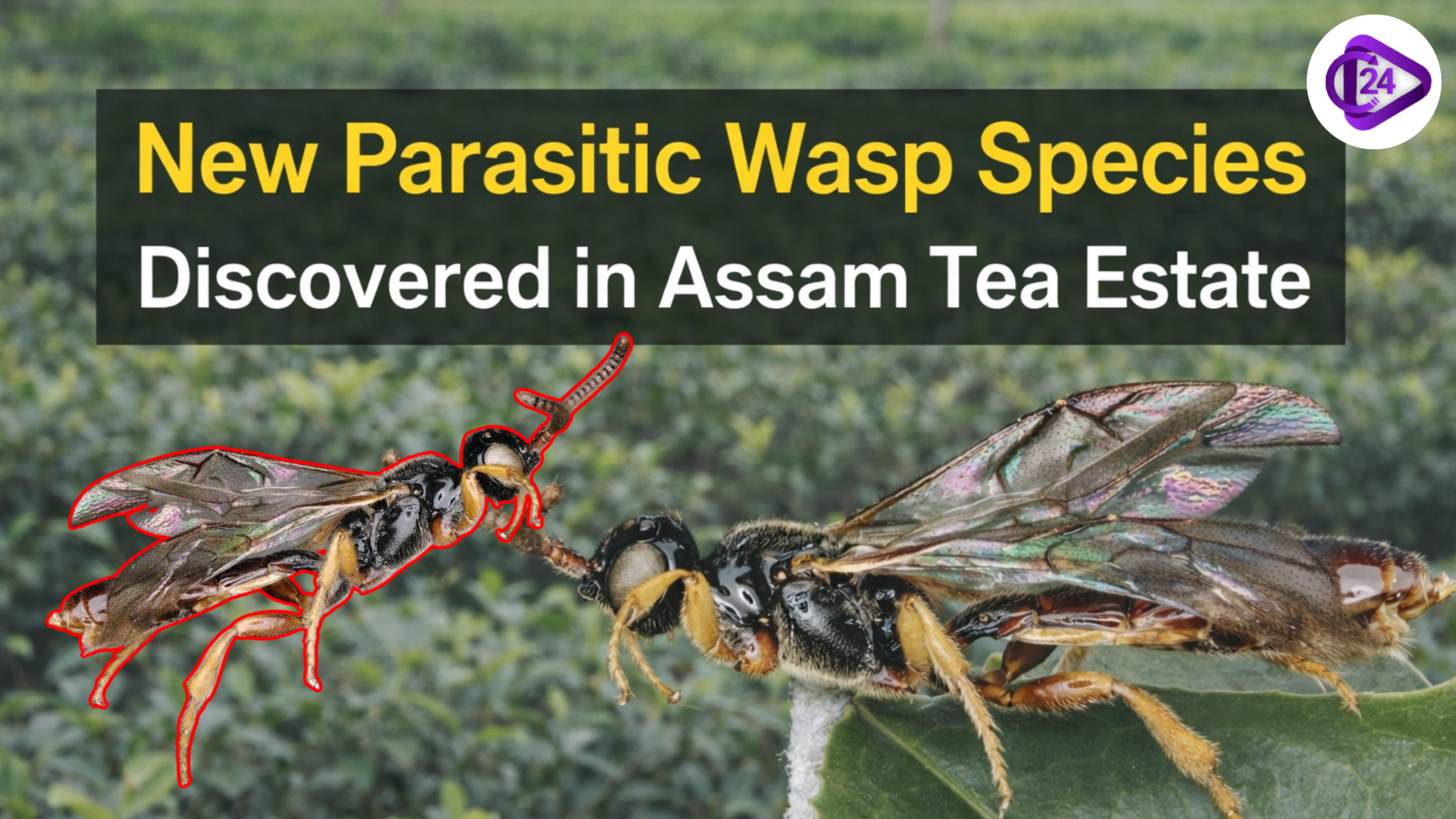
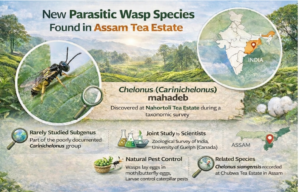
Researchers have discovered a previously unknown parasitic wasp species in a tea estate in Assam, revealing the hidden biodiversity in plantation ecosystems. Named Chelonus (Carinichelonus) mahadeb, the species was identified at the Nahortoli Tea Estate during a taxonomic survey. The study was conducted by scientists from the Zoological Survey of India, the University of Guelph (Canada), and the Kalinga Foundation. Another related species, Chelonus siangensis, was also recorded at Chubwa Tea Estate, showing a wider distribution in Northeast India. These findings expand scientific knowledge of parasitic wasps and highlight their potential role in natural pest control in agricultural landscapes.
New Parasitic Wasp Species Found in Assam Tea Estate
-
Chelonus (Carinichelonus) mahadeb belongs to the rare and poorly documented subgenus Carinichelonus.
-
The discovery in Nahortoli Tea Estate demonstrates that cultivated areas can support diverse insect life.
-
Chelonus siangensis was also recorded in Chubwa Tea Estate, indicating a broader regional presence.
-
These wasps are egg-larval parasitoids: they lay eggs in moth or butterfly eggs, and their larvae feed on the host, naturally controlling pests.
-
Parasitic wasps help reduce crop-damaging caterpillars and can support sustainable agriculture by reducing chemical pesticide use.
-
Documenting such species increases knowledge of India’s parasitoid diversity, which is still largely unexplored.
-
Tea plantations in Assam serve as biodiversity hotspots, hosting insects, spiders, birds, and other arthropods.
-
Understanding these ecological relationships can help design environmentally friendly pest management practices.
Previous Year Questions and Answers
| Question (with Options) | Answer |
|---|---|
| In which year was tea discovered in Assam? (A) 1820 (B) 1823 (C) 1826 (D) 1830 |
B) 1823 |
| Which river flows through Assam? (A) Ganga (B) Brahmaputra (C) Yamuna (D) Godavari |
B) Brahmaputra |
| Majuli is famous as the largest ___ in the world. (A) Lake (B) Island (C) Forest (D) Hill Station |
B) Island |
| Who was the founder of the Ahom kingdom in Assam? (A) Pratap Singha (B) Sukapha (C) Rudra Singha (D) Pushya Varman |
B) Sukapha |
| When was the first session of Assam Sahitya Sabha held? (A) 1905 (B) 1917 (C) 1921 (D) 1930 |
B) 1917 |
| Who was Assam’s first Chief Minister after Independence? (A) Gopinath Bordoloi (B) Bimala Prasad Chaliha (C) Sarat Chandra Sinha (D) Hiteswar Saikia |
A) Gopinath Bordoloi |
| When was the first railway service introduced in Assam? (A) 1872 (B) 1882 (C) 1892 (D) 1902 |
B) 1882 |
| Which is a traditional Assamese drink? (A) Lassi (B) Tea (C) Apong (D) Coffee |
C) Apong |
| Which rice variety is traditionally from Assam? (A) Joha Rice (B) Basmati (C) Sona Masuri (D) Gobindobhog |
A) Joha Rice |
| Which is the capital city of Assam? (A) Guwahati (B) Shillong (C) Dispur (D) Tezpur |
C) Dispur |
From 1776 to 2026: Adam Smith’s Lessons for the Global Econom
Conclusion (Wasp Species Found in Assam)
The discovery of a new parasitic wasp species in Assam highlights the region’s rich and largely unexplored biodiversity. It emphasises the ecological importance of tea estates as habitats for rare insects and underlines the role of such species in natural pest control, supporting both conservation and sustainable agriculture.