

Michelle Bachelet Wins Indira Gandhi Peace Prize 2024: 7 Key Facts
Former Chilean President Michelle Bachelet was selected for the 2024 Indira Gandhi Prize for Peace, Disarmament and Development in recognition of her contributions to human rights, gender equality, democracy and international cooperation.
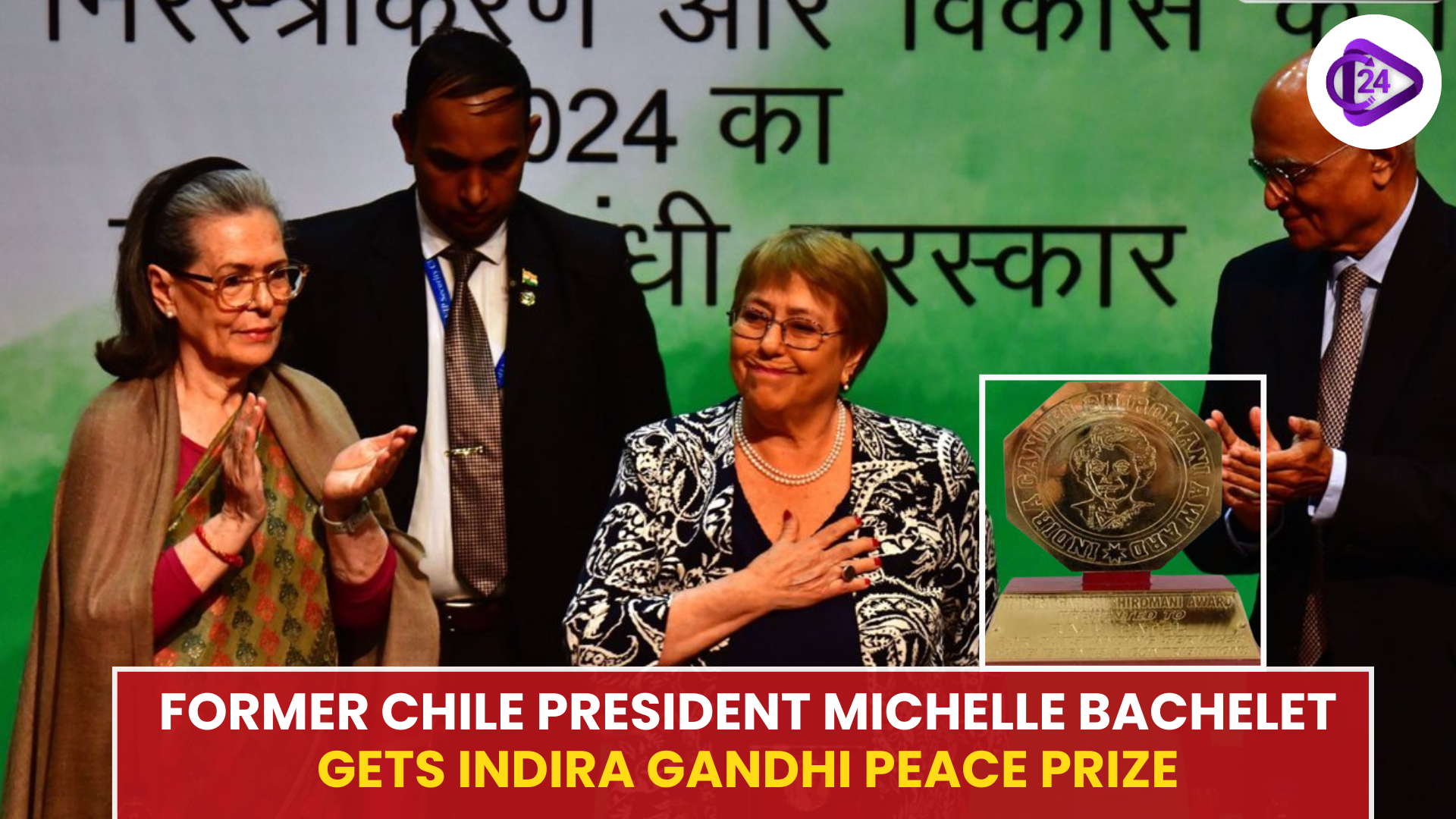
The award was announced on 6 December 2024 by the Indira Gandhi Memorial Trust. It was formally presented to Bachelet by Sonia Gandhi, Chairperson of the Trust, on 19 November 2025 at a ceremony in New Delhi.
Bachelet is known for her leadership as Chile’s first woman President, her role in establishing UN Women and her tenure as the United Nations High Commissioner for Human Rights. Her work has focused on protecting vulnerable communities, promoting women’s participation and strengthening international cooperation.
Indira Gandhi Peace Prize 2024: Key Highlights
| Particulars | Details |
| Award | Indira Gandhi Prize for Peace, Disarmament and Development |
| Award Year | 2024 |
| Recipient | Michelle Bachelet Jeria |
| Country | Chile |
| Announcement Date | 6 December 2024 |
| Presentation Date | 19 November 2025 |
| Presented By | Sonia Gandhi |
| Awarding Institution | Indira Gandhi Memorial Trust |
| Main Contribution | Human rights, peace, gender equality and democracy |
| Prize Money | ₹1 crore |
The award recognises Bachelet’s contributions to peace, gender equality, human rights, democracy and development under challenging circumstances. It also acknowledges her contribution to strengthening relations between India and Chile.
Who Is Michelle Bachelet?
Verónica Michelle Bachelet Jeria is a Chilean politician, physician and international human rights leader. She became the first woman President of Chile in 2006 and served two non-consecutive terms.
Before entering politics, Bachelet studied medicine and specialised in public health. Her early life was deeply affected by political developments in Chile.
In 1973, a military coup led by General Augusto Pinochet overthrew the government of President Salvador Allende. Bachelet’s father, Alberto Bachelet, was detained and died in custody in 1974. Michelle Bachelet and her mother were also detained before eventually going into exile.
These experiences influenced her later commitment to democracy, human rights and the protection of people facing political persecution.
Important Positions Held by Michelle Bachelet
| Position | Tenure |
| President of Chile | 2006–2010 |
| Executive Director of UN Women | 2010–2013 |
| President of Chile (Second Term) | 2014–2018 |
| UN High Commissioner for Human Rights | 2018–2022 |
Her career includes leadership roles at the national and international levels, making her an important figure in global discussions on equality and human rights.
Major Achievements of Michelle Bachelet
1. First Woman President of Chile
Michelle Bachelet made history in 2006 by becoming the first woman to hold the office of President of Chile.
She served two terms, from 2006 to 2010 and again from 2014 to 2018.
During her presidency, her government worked on social protection, healthcare, education and pension reforms. Her leadership also increased the visibility of women’s participation in Chilean politics.
2. First Executive Director of UN Women
In 2010, Bachelet became the first Executive Director of UN Women, the United Nations entity dedicated to gender equality and women’s empowerment.
UN Women was established in 2010 by merging several United Nations bodies working on women’s issues.
During her tenure, she helped establish the organisation’s institutional role and strengthen its international work on women’s rights, political participation and economic empowerment.
3. UN High Commissioner for Human Rights
Bachelet served as the United Nations High Commissioner for Human Rights from 2018 to 2022.
In this position, she worked on international human rights issues, including:
- Protection of vulnerable communities.
- Women’s and children’s rights.
- Freedom of expression.
- Equality and non-discrimination.
- Protection of human rights defenders.
- Accountability and international human rights standards.
Her work involved engagement with governments, civil society organisations and international institutions.
4. Promotion of Gender Equality
Throughout her political and international career, Bachelet has supported greater representation of women in decision-making institutions.
Her work has highlighted the importance of equal opportunities in education, employment, leadership and public life.
What Is the Indira Gandhi Prize for Peace, Disarmament and Development?
The Indira Gandhi Prize for Peace, Disarmament and Development is an international award instituted in 1985 in memory of former Indian Prime Minister Indira Gandhi.
It is administered by the Indira Gandhi Memorial Trust and recognises individuals or organisations that have made significant contributions to international peace, disarmament, development and the promotion of human freedom.
The award aims to encourage efforts that support cooperation among nations and improve the well-being of humanity.
Objectives of the Award
The prize recognises creative efforts in areas such as:
- International Peace: Promoting peaceful relations and understanding among nations.
- Disarmament: Supporting efforts to reduce weapons and encourage global security.
- Economic Cooperation: Promoting cooperation and a fairer international economic order.
- Development: Supporting the progress of developing countries.
- Science for Humanity: Encouraging the use of scientific discoveries for the larger benefit of society.
- Freedom and Human Dignity: Expanding freedom and enriching the human spirit.
History of the Indira Gandhi Peace Prize
The prize was instituted in 1985, and the first award was presented in 1986.
The first recipient was Parliamentarians for Global Action, an international organisation of legislators. It was recognised for its work supporting nuclear disarmament and promoting international peace and cooperation.
Over the years, the award has recognised individuals and organisations from different countries and fields.
Some notable recipients include:
| Year | Awardee | Contribution / Recognition |
| 1986 | Parliamentarians for Global Action | Nuclear disarmament |
| 1987 | Mikhail Gorbachev | Nuclear disarmament initiatives |
| 1989 | UNICEF | Children’s welfare |
| 1997 | Jimmy Carter | Peace, disarmament and human rights |
| 2000 | Mary Robinson | Human rights |
| 2006 | Wangari Maathai | Environment and social development |
| 2014 | ISRO | Space research and international cooperation |
| 2019 | David Attenborough | Biodiversity conservation |
| 2021 | Pratham | Education and learning |
| 2023 | Daniel Barenboim and Ali Abu Awwad | Peaceful dialogue and cooperation |
| 2024 | Michelle Bachelet | Human rights, gender equality and peace |
Note: The prize is intended to be awarded annually, but there were years in which no award was made, including 2016 and 2020.
Prize Money, Trophy and Selection Process
The Indira Gandhi Prize carries a cash award of ₹1 crore, along with a trophy and citation.
The trophy has a distinctive design and historical significance.
Features of the Trophy
- It is made from a square piece of banded Haematite Jasper.
- The stone is also used at Indira Gandhi’s memorial, Shakti Sthala, in New Delhi.
- It contains a portrait of Indira Gandhi created in the Jaipur miniature painting tradition.
- The trophy is placed in a rosewood box with silver edging.
Selection Process
The awardee is selected by a jury of distinguished individuals appointed by the Chairperson of the Indira Gandhi Memorial Trust.
According to the official procedure:
- The jury consists of at least five and no more than nine members.
- Nominations can be submitted by eligible individuals and organisations, including previous awardees and members of national parliaments.
- The jury examines the nominations and selects the recipient.
- The final decision is taken by consensus.
- The prize may be awarded to an individual or an organisation.
Why Was Michelle Bachelet Selected for the 2024 Prize?
The Indira Gandhi Memorial Trust recognised Bachelet for her sustained work in promoting peace, gender equality, human rights, democracy and development.
Her selection reflects several important contributions:
- She became the first woman President of Chile.
- She promoted women’s leadership and gender equality through her work with UN Women.
- She served as the UN High Commissioner for Human Rights.
- She advocated for the rights of vulnerable and marginalised communities.
- She contributed to strengthening relations between India and Chile.
Her career demonstrates the role that political leadership and international institutions can play in advancing human rights and cooperation.
Conclusion
The Indira Gandhi Peace Prize 2024 recognises Michelle Bachelet’s contributions to human rights, gender equality, democracy and international cooperation. As Chile’s first woman President, the first Executive Director of UN Women and a former UN High Commissioner for Human Rights, she has held several important leadership positions.
The award, presented by Sonia Gandhi on 19 November 2025, also highlights the importance of international cooperation and the protection of human dignity. It continues the legacy of recognising individuals and organisations working towards peace, disarmament and development.