


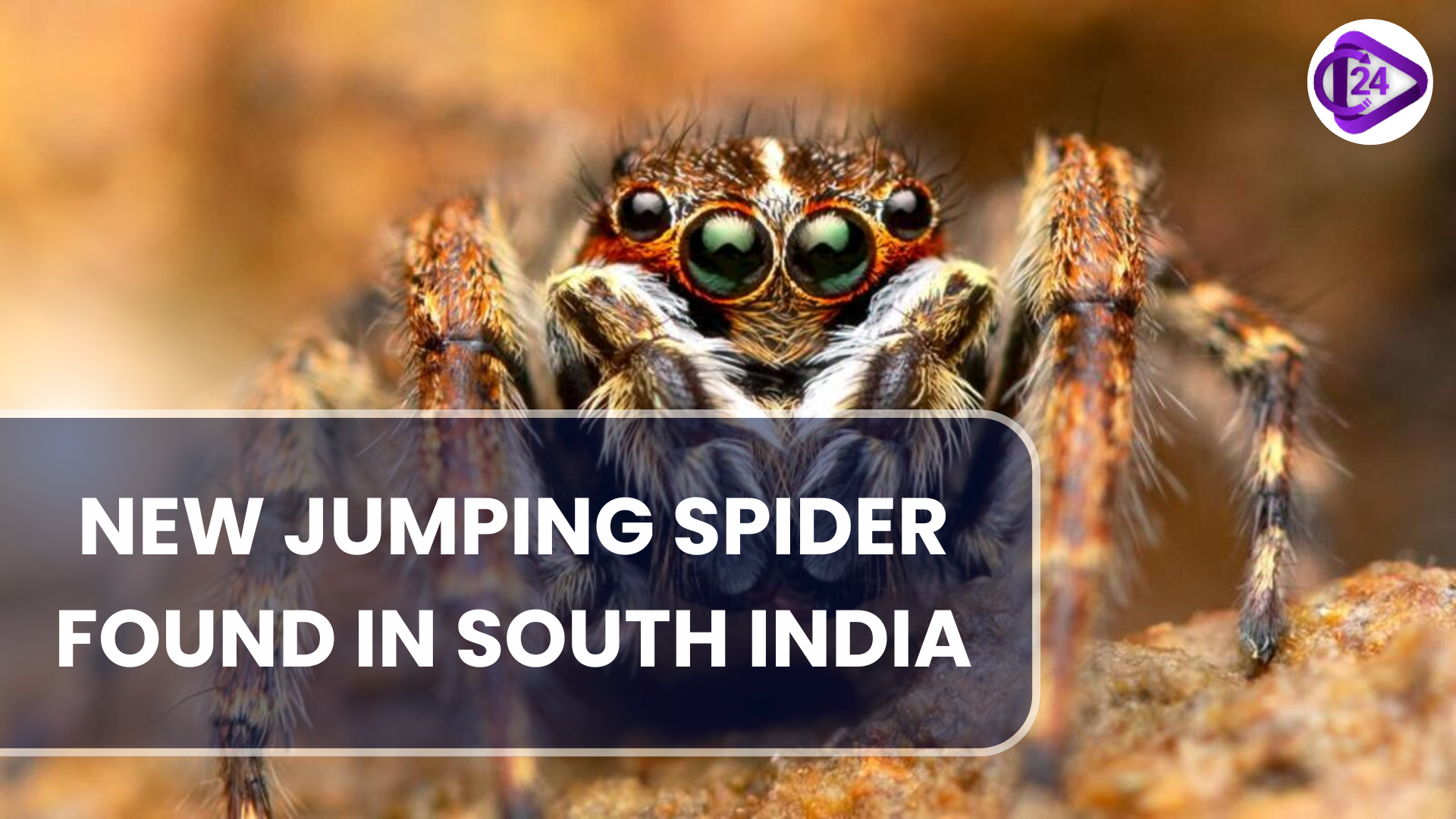
A new species of jumping spider, Spartaeus karigiri, has been described by researchers from southern India. The discovery is an important addition to India’s spider biodiversity because it also marks the first recorded presence of the genera Spartaeus and Sonoita in the country.
The research was published in 2025 in the European Journal of Taxonomy under the title Novel additions to the jumping spider subfamily Spartaeinae Wanless, 1984 from India. The study documents a new spider species, additional distribution records and important taxonomic findings.
The newly described species was recorded at Karigiri, also known as Elephant Hill, in Karnataka. Researchers also reported relevant spider observations from Villupuram district in Tamil Nadu. These findings highlight the importance of studying lesser-explored habitats in India’s southern region.
Spartaeus karigiri Discovery: Key Highlights
| Particulars | Details |
| Scientific Name | Spartaeus karigiri |
| Common Group | Jumping Spiders |
| Family | Salticidae |
| Subfamily | Spartaeinae |
| Discovery Location | Karigiri, Karnataka |
| Other Reported Location | Villupuram district, Tamil Nadu |
| Research Publication | European Journal of Taxonomy |
| Publication Year | 2025 |
| Research Lead Author | John T.D. Caleb |
| Important Finding | First Indian records of Spartaeus and Sonoita genera |
What Is Spartaeus karigiri?
Spartaeus karigiri is a newly described species of jumping spider belonging to the family Salticidae and subfamily Spartaeinae.
The species was identified from specimens collected at Karigiri, or Elephant Hill, in Karnataka. Its scientific name is derived from the name of this geographical location.
The discovery is significant because the genus Spartaeus had not previously been recorded in India. The study therefore adds both a new species and a new genus record to the country’s documented spider fauna.
The researchers provided detailed descriptions and scientific illustrations to establish the identity of the species. Such taxonomic work helps scientists distinguish closely related spiders and understand their geographical distribution.
First Indian Records of Spartaeus and Sonoita Genera
One of the most important findings of the research is the first reported occurrence of two spider genera in India:
- Spartaeus: The genus to which the newly described species Spartaeus karigiri belongs.
- Sonoita: Another genus reported for the first time from India through the study.
Before these findings, the genera were primarily known from regions outside India, including parts of Southeast Asia and Africa.
The researchers also documented a specimen identified as Sonoita cf. lightfooti in Karnataka. The abbreviation “cf.” means that the specimen is compared with the named species but its identification is not stated as fully confirmed.
This record is particularly interesting because Sonoita lightfooti was previously associated with Africa. Its occurrence in India raises questions about the geographical distribution of the species and whether it represents a natural range extension or an introduced population.
Further research may help clarify its origin and distribution.
Scientific Classification of Spartaeus karigiri
The new species belongs to the jumping spider family, which is scientifically known as Salticidae.
| Taxonomic Level | Classification |
| Kingdom | Animalia |
| Phylum | Arthropoda |
| Class | Arachnida |
| Order | Araneae |
| Family | Salticidae |
| Subfamily | Spartaeinae |
| Genus | Spartaeus |
| Species | Spartaeus karigiri |
Jumping spiders are known for their well-developed eyesight, active hunting behaviour and ability to move quickly. Unlike spiders that depend mainly on catching prey in webs, many jumping spiders actively locate and pursue their prey.
Habitat and Behaviour of the Newly Described Spider
The study provides observations about the habitat and behaviour of the spiders recorded during the research.
1. Rocky Habitats
Male specimens of Spartaeus karigiri were observed in rocky areas and crevices. Such habitats provide shelter and suitable spaces for spiders to move and hunt.
Karigiri’s rocky landscape is therefore an important location for understanding the species’ natural habitat.
2. Female Spider and Egg Protection
Female specimens were observed protecting their egg clutches. This behaviour is important for reproduction and the survival of the next generation.
3. Specialised Hunting Strategies
Spartaeinae spiders are known for interesting predatory behaviour. Some members of this group use specialised hunting strategies, including approaching or invading the webs of other spiders.
Such behaviour is often called web invasion or araneophagy-related hunting behaviour, depending on the particular interaction and prey.
Jumping spiders also use their strong vision to locate prey and coordinate their movements during hunting.
Research Team Behind the Discovery
The study was conducted by a team of researchers working on spider taxonomy and biodiversity.
The lead author was John T.D. Caleb, associated with the Department of Anatomy at Saveetha Medical College and Hospital, Chennai.
The research team included:
- John T.D. Caleb
- Puthoor Pattammal Sudhin
- B.G. Nisha
- Chinmay C. Maliye
- Rajesh V. Sanap
- Gautam Kadam
- Souvik Sen
Researchers associated with the Zoological Survey of India also contributed to the study. The paper contains detailed morphological descriptions, illustrations and distribution maps to support the identification of the spiders.
Other Important Taxonomic Findings
The research was not limited to the description of Spartaeus karigiri. It also contributed to the understanding of other jumping spiders found in India.
One notable finding was the taxonomic revision of Marpissa gangasagarensis. The researchers recognized it as a junior synonym of Phaeacius fimbriatus.
In taxonomy, a junior synonym is a scientific name that is considered to refer to the same species as an earlier established name. This helps maintain consistency in scientific classification.
The study also provided additional distributional information about species such as:
- Brettus anchorum
- Portia Albimana
- Portia labiata
These findings help improve the scientific record of India’s jumping spider diversity.
Why Is This Discovery Important?
The discovery of Spartaeus karigiri is significant for Indian biodiversity research for several reasons.
- New Species Identification: It adds a newly described species to India’s documented spider diversity.
- First Genus Records: The study reports the genera Spartaeus and Sonoita in India for the first time.
- Better Understanding of Biodiversity: It demonstrates that lesser-explored rocky habitats in southern India may contain species that have not been adequately documented.
- Taxonomic Research: The study improves scientific understanding through new species descriptions, distribution records, and taxonomic revisions.
- Biogeographical Importance: The record of Sonoita cf. lightfooti raises questions about species distribution and possible movement between geographical regions.
Conclusion
The discovery of Spartaeus karigiri in Karnataka is an important development in Indian arachnology. Published in the European Journal of Taxonomy in 2025, the research also records the genera Spartaeus and Sonoita in India for the first time.
The study provides valuable information about spider habitats, hunting behavior, geographical distribution, and taxonomy. It also highlights the need for further biodiversity surveys across India’s diverse ecosystems.
Such discoveries show that even relatively small and less-studied habitats can contribute significantly to our understanding of India’s rich biodiversity.