

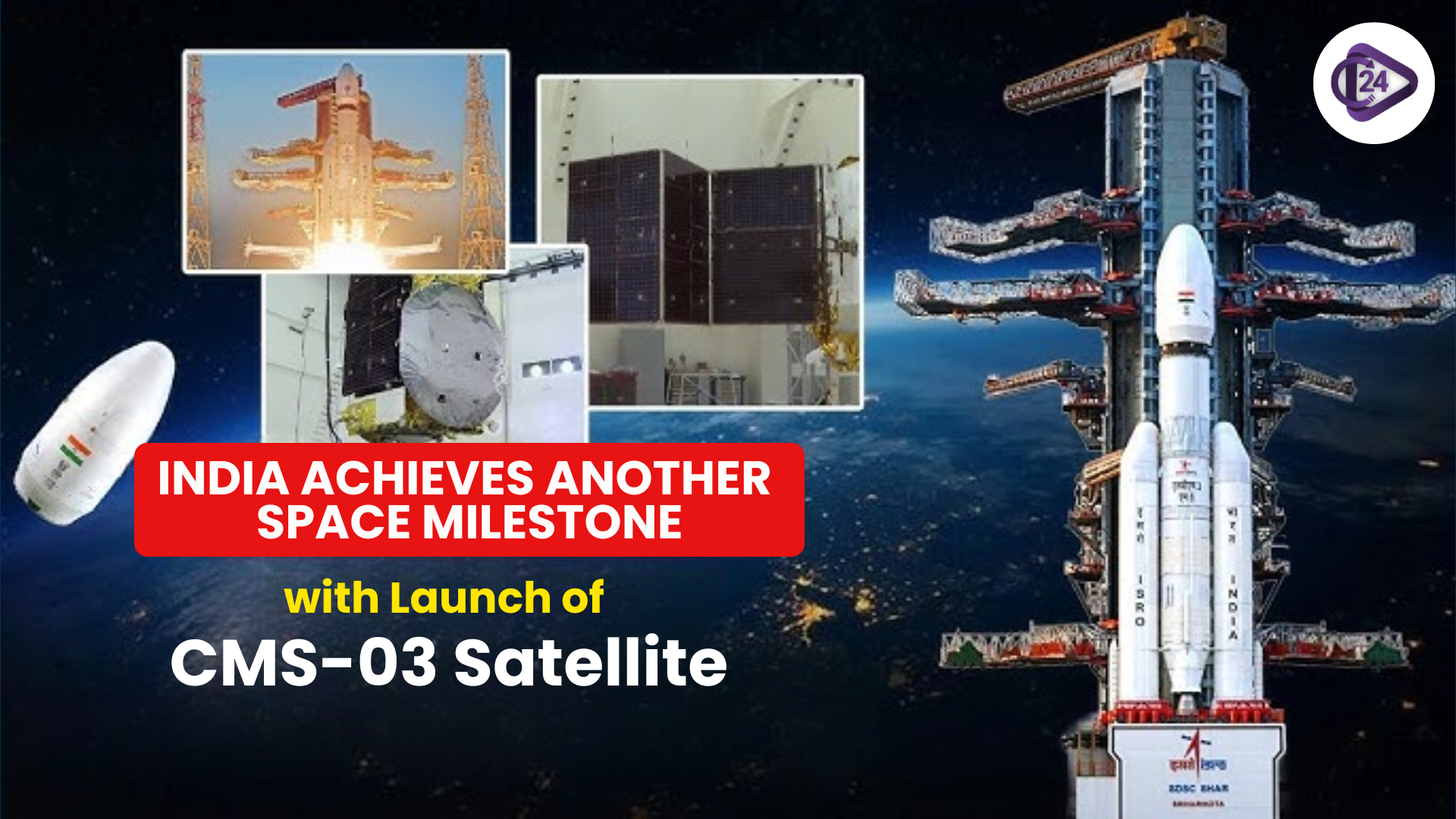
India achieved a significant milestone in space technology with the successful launch of CMS-03, a multi-band communication satellite designed to strengthen communication services across the Indian subcontinent and surrounding oceanic regions. The satellite was launched by the Indian Space Research Organisation (ISRO) on 2 November 2025 using its powerful LVM3-M5 launch vehicle, popularly known as the Bahubali rocket.
Weighing approximately 4,410 kg, CMS-03 is the heaviest communication satellite launched by India into a geosynchronous transfer orbit. The mission demonstrates India’s growing capabilities in heavy-lift launch technology and advanced satellite development. It is expected to strengthen communication infrastructure for strategic and civilian applications.
Key Features of the CMS-03 Satellite Mission
CMS-03 is designed to provide multi-band communication services over a wide geographical area. Its capabilities are intended to improve connectivity across the Indian mainland and maritime regions, supporting communication requirements in areas where terrestrial infrastructure may be limited.
Important Facts About CMS-03
- Satellite name: CMS-03
- Launch date: 2 November 2025
- Launch vehicle: LVM3-M5, popularly called Bahubali
- Launch agency: Indian Space Research Organisation (ISRO)
- Satellite weight: Approximately 4,410 kg
- Launch site: Satish Dhawan Space Centre, Sriharikota, Andhra Pradesh
- Mission type: Multi-band communication satellite
- Primary purpose: Strengthening communication coverage across India and surrounding oceanic regions
The mission also marked the fifth operational flight of the LVM3 launch vehicle, highlighting the continued development of India’s heavy-lift launch capabilities.
Role of ISRO’s Bahubali Rocket
The LVM3 is ISRO’s heavy-lift launch vehicle, developed to carry large satellites into space. Its powerful propulsion systems and multi-stage design enable it to transport substantial payloads for demanding space missions.
Significance of the LVM3-M5 Launch
The successful deployment of CMS-03 demonstrates the launch vehicle’s ability to carry a heavy communication satellite into its intended transfer orbit. This capability is important for India’s future satellite missions and its broader objective of strengthening independent access to space.
The LVM3 programme also supports India’s long-term ambitions in human spaceflight and other advanced space activities.
Applications of the CMS-03 Communication Satellite
Communication satellites play an important role in connecting people, institutions and services across large geographical areas. CMS-03 is designed to strengthen India’s space-based communication capabilities, particularly across the mainland and surrounding maritime regions.
Strategic and Civilian Communication
The satellite’s multi-band communication systems are intended to support voice, data and video communication services. Such capabilities can contribute to communication links for strategic users and other authorised applications.
Support for Maritime Operations and Disaster Response
Reliable satellite communication is particularly important in oceanic areas, where conventional terrestrial networks may not be available. Space-based communication can also support coordination during emergencies and natural disasters when ground infrastructure is disrupted.
Importance of CMS-03 for India’s Space Programme
The mission highlights the growing role of indigenous launch technology in India’s space programme. Launching a satellite of this size strengthens the country’s experience in managing complex missions and deploying heavier payloads.
Strengthening Technological Self-Reliance
Developing launch vehicles and communication satellites enhances India’s ability to plan and execute important space missions independently. Continued investment in space technology can support scientific research, national infrastructure and future commercial opportunities.
Conclusion
The successful launch of CMS-03 using ISRO’s LVM3-M5 Bahubali rocket marks an important achievement for India’s space programme. With its approximate weight of 4,410 kg and multi-band communication capabilities, the satellite is designed to strengthen communication coverage across India and surrounding oceanic regions. The mission also demonstrates the capabilities of India’s heavy-lift launch technology and its continuing progress towards greater self-reliance in space.