

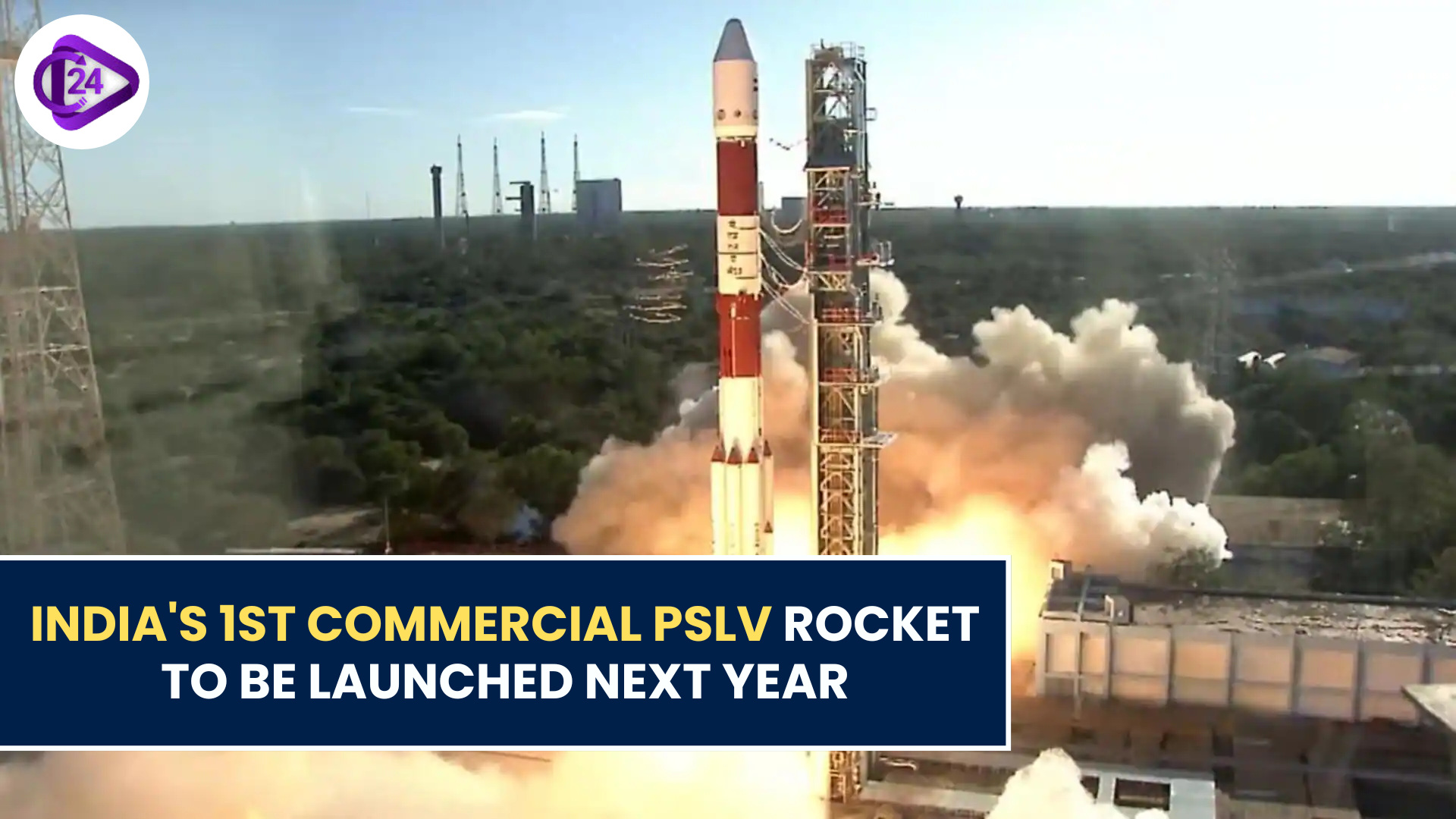
India is taking an important step towards increasing private sector participation in its space programme through the Industry Manufactured PSLV project. NewSpace India Limited (NSIL), the commercial arm of the Department of Space, has awarded a contract to a consortium led by Hindustan Aeronautics Limited (HAL) and Larsen & Toubro (L&T) for the end-to-end production of five Polar Satellite Launch Vehicles (PSLV-XL).
The first industry-produced vehicle is designated PSLV-N1. The project aims to transfer the production of India’s operational launch vehicles to the domestic industry while using existing ISRO infrastructure and technical support. It is expected to strengthen India’s launch capacity and allow ISRO to concentrate more on advanced space missions.
HAL and L&T Consortium to Manufacture Five PSLV Rockets
NewSpace India Limited (NSIL) has placed an order for five PSLV-XL launch vehicles with the HAL-L&T consortium. HAL is the lead partner of the consortium, while L&T is the other major industry partner.
The project represents a shift towards greater industrial participation in the production of India’s established launch vehicle.
Key facts about the project:
| Particulars | Details |
| Launch vehicle | Polar Satellite Launch Vehicle (PSLV-XL) |
| Number of rockets | 5 |
| Commercial agency | NewSpace India Limited (NSIL) |
| Lead consortium partner | Hindustan Aeronautics Limited (HAL) |
| Other consortium partner | Larsen & Toubro (L&T) |
| First industry-produced vehicle | PSLV-N1 |
| Production arrangement | Government-Owned, Contractor-Operated (GOCO) |
| Main facility | ISRO facilities at SDSC-SHAR, Sriharikota |
The project is intended to establish an end-to-end production capability within the Indian industry for the PSLV-XL launch vehicle.
What Is the GOCO Model?
The production of PSLV through the HAL-L&T consortium follows the Government-Owned, Contractor-Operated (GOCO) model.
Under this arrangement, the government retains ownership of the existing facilities and infrastructure, while the selected industry consortium undertakes the assigned manufacturing, assembly and integration activities.
For the PSLV production programme:
- NSIL acts as the nodal agency for industrial production.
- HAL and L&T are responsible for manufacturing and integrating the launch vehicle.
- Existing ISRO facilities are used for production-related activities.
- ISRO provides technical support and expertise.
- The model encourages the participation of Indian industries in the space sector.
The GOCO model is expected to help increase production capacity without requiring the creation of an entirely separate infrastructure network.
PSLV-N1: India’s First Industry-Produced PSLV
PSLV-N1 is the designation of the first PSLV-XL launch vehicle being realised through the HAL-L&T industry consortium.
The project began reaching important milestones in October 2023, when the consortium delivered essential propellant ingredients to the Satish Dhawan Space Centre (SDSC-SHAR) in Sriharikota for the production of solid motors.
The manufacturing process involves several major activities, including the production of launch vehicle systems, assembly, integration and testing.
According to a written reply in the Rajya Sabha on 29 January 2026, stacking of the first stage of the industry-produced PSLV had commenced on 22 December 2025. At that time, the targeted launch was Q1 of 2026.
The ISRO Annual Report 2025-26 also listed the first industry-produced PSLV-N1 as scheduled for launch during Q1 2026. However, the official ISRO launch records should be checked separately before describing the vehicle as successfully launched.
Role of NSIL in PSLV Production
NewSpace India Limited (NSIL) is a Central Public Sector Enterprise (CPSE) under the Department of Space. It was incorporated in March 2019 to commercially utilise Indian space capabilities and support the expansion of India’s space industry.
NSIL plays an important role in the industrial production of PSLV.
Its major responsibilities include:
- Coordinating the production of PSLV through Indian industries.
- Managing commercial arrangements for launch vehicles and satellite missions.
- Supporting the participation of private companies in the space sector.
- Promoting the commercial use of ISRO-developed technologies.
- Expanding India’s presence in the global satellite launch services market.
Through the HAL-L&T consortium, NSIL is working towards establishing a regular industrial production system for PSLV-XL vehicles.
Why Is Industry Participation in PSLV Manufacturing Important?
The transfer of launch vehicle production activities to Indian industries is an important part of India’s broader space sector reforms.
It can provide several benefits:
- Increased Launch Vehicle Production
Industrial participation can help expand the manufacturing capacity of PSLV and support the growing demand for satellite launches.
- Greater Role for Indian Companies
The project provides Indian companies with opportunities to develop advanced manufacturing, engineering, electronics and aerospace capabilities.
- Better Utilisation of ISRO Resources
With industries taking up more routine production responsibilities, ISRO can focus more resources on complex research and development activities, including human spaceflight and advanced launch technologies.
- Growth of the Commercial Space Sector
The project can strengthen India’s commercial launch services and improve the participation of domestic companies in the global space economy.
- Support for Atmanirbhar Bharat
Greater domestic manufacturing of launch vehicle systems supports India’s objective of building self-reliance in strategic and advanced technology sectors.
About the Polar Satellite Launch Vehicle (PSLV)
The Polar Satellite Launch Vehicle (PSLV) is India’s third-generation launch vehicle developed by the Indian Space Research Organisation (ISRO).
It is a four-stage launch vehicle that uses a combination of solid and liquid propulsion systems. PSLV is widely used to launch Earth observation, scientific, navigation and other satellites.
Some important facts about PSLV are:
- It is known as the workhorse launch vehicle of ISRO.
- Its first successful launch took place in October 1994.
- It can place satellites into multiple types of orbits.
- It has supported important Indian missions, including Chandrayaan-1, the Mars Orbiter Mission and Aditya-L1.
- It has also launched satellites for several international customers.
The production of PSLV through Indian industry is expected to strengthen India’s ability to provide commercial satellite launch services.
Conclusion
The Industry Manufactured PSLV project marks an important development in India’s space sector. Through NSIL, the HAL-L&T consortium has been entrusted with the end-to-end production of five PSLV-XL launch vehicles.
The first vehicle, PSLV-N1, represents the growing role of Indian industry in the manufacturing of operational launch vehicles. The GOCO model allows the consortium to use existing ISRO infrastructure while taking responsibility for major production activities.
This initiative is expected to increase industrial participation, strengthen domestic aerospace capabilities and support India’s expanding commercial space programme.