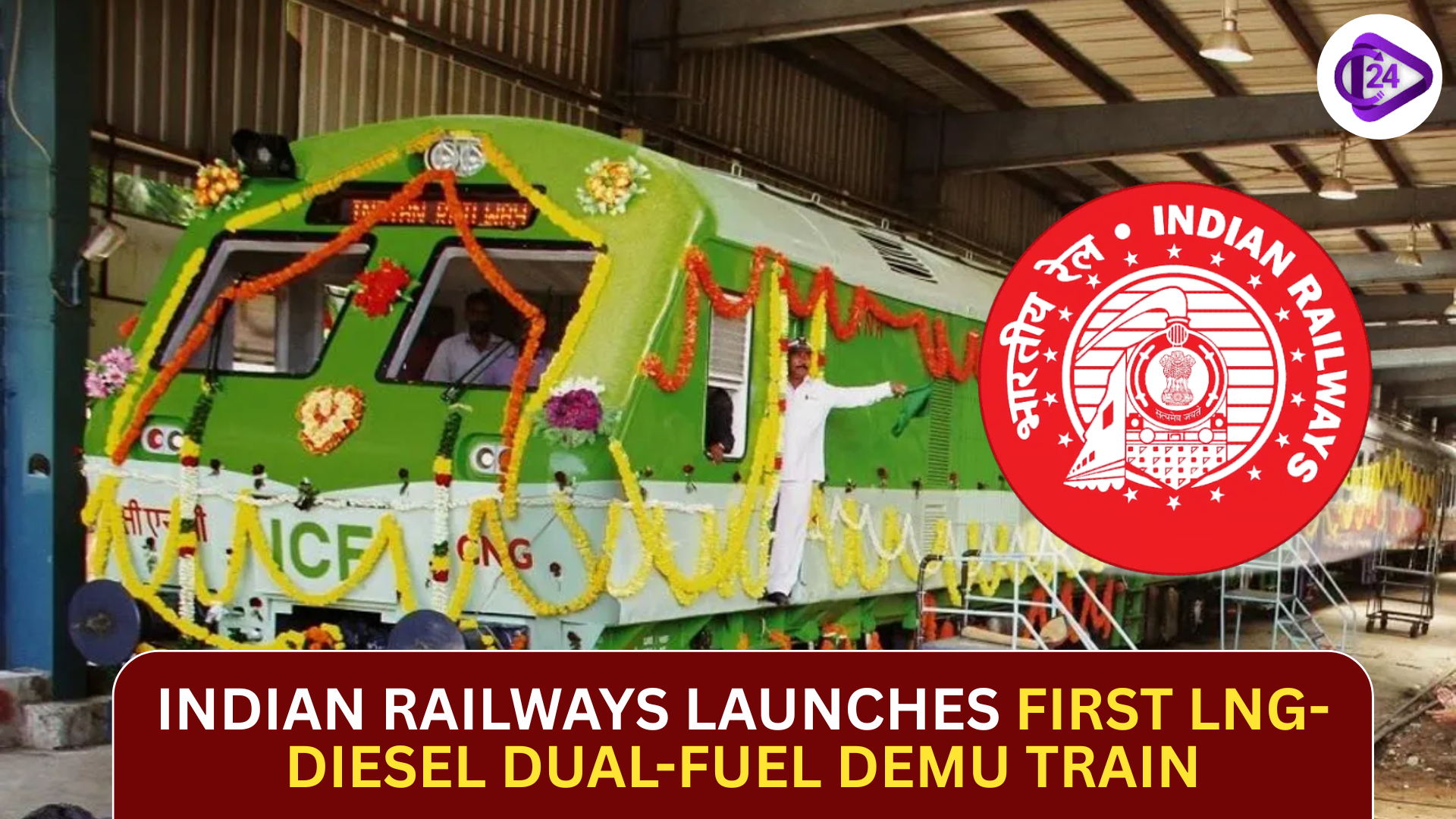
The first LNG-Diesel dual-fuel Diesel Electric Multiple Unit (DEMU) train in the country at Sabarmati, Ahmedabad, by Indian Railways, is a significant move to make rail transport more eco-friendly. Within this project, the driving power cars of a 1,400 HP DEMU were modified to run on a mix of liquefied natural gas (LNG) and diesel instead of approximately 40 per cent of the traditional diesel intake without any effect on performance. The dual-fuel train has since gone into regular passenger service following successful field trials of more than 2,000 km. The project should help in cutting down the emissions and reducing the fuel expenses, which will promote the sustainability of Indian Railways.
LNG-Diesel Dual-Fuel DEMU Train by Indian Railways: Key Highlights
-
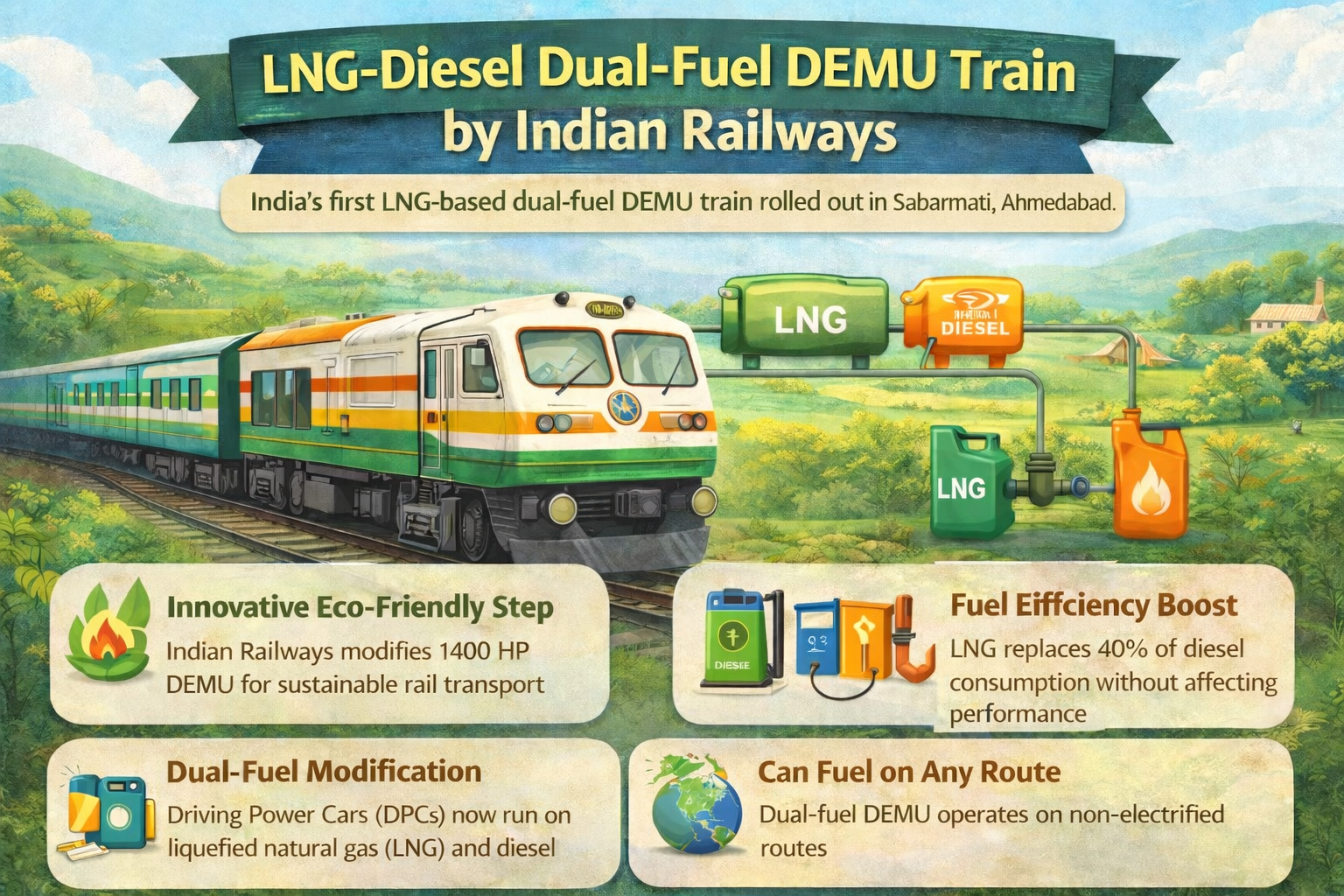
The Indian Railways has unveiled the first LNG-based dual-fuel Diesel Electric Multiple Unit (DEMU) train, which is also a major step towards sustainable rail transport.
-
The project consists of modifying Driving Power Cars (DPCs) so that the cars can perform on a blend consisting of Liquefied Natural Gas (LNG) and diesel without affecting performance.
-
The LNG replaces about 40 per cent of the diesel consumption and leads to high efficiency in terms of fuel consumption.
-
DEMU, which operates on 1,400 HP engines, is capable of fueling on non-electrified routes.
-
There were extensive field trials covering over 2,000 km, and then the train was introduced into the passenger service.
-
The train has a range of 2,200km using one LNG tank, which makes the train more flexible.
-
LNG consumption results in a decrease of carbon emissions, nitrogen oxides, and that of the particulate matter in favour of clean mobility.
-
The system can automatically change LNG to diesel and vice versa, which has made the operations continuous.
-
Indian Railways anticipates that this will save it a lot of money on fuel costs every year, with a lot of savings on a power car.
-
The project is in line with the vision of the Indian Railways project of having no carbon emission and enhancing environmentally friendly options for future rail running.
Important PYQs on Indian Railway
| Exam Name | Year | Question | Options | Correct Answer |
|---|---|---|---|---|
| UPSC Prelims | 2015 | Indian Railways was separated from the Public Works Department (PWD) in which year? | A) 1853 B) 1905 C) 1924 D) 1951 |
C) 1924 |
| SSC CGL | 2017 | Indian Railways was nationalised in which year? | A) 1947 B) 1951 C) 1957 D) 1965 |
B) 1951 |
| RRB NTPC | 2019 | Which is the headquarters of Indian Railways? | A) Mumbai B) New Delhi C) Kolkata D) Chennai |
B) New Delhi |
| SSC CHSL | 2018 | The first railway line in India was opened between | A) Bombay–Thane B) Howrah–Delhi C) Madras–Arcot D) Mumbai–Pune |
A) Bombay–Thane |
| RRB Group D | 2018 | Which gauge has the maximum railway network in India? | A) Narrow Gauge B) Meter Gauge C) Broad Gauge D) Standard Gauge |
C) Broad Gauge |
| SSC GD | 2020 | Which is the longest railway zone in India by route length? | A) Northern Railway B) Central Railway C) Eastern Railway D) Western Railway |
A) Northern Railway |
| RRB JE | 2021 | What is the full form of RDSO? | A) Railway Development Safety Org. B) Research Design & Standards Organisation C) Rail Design Service Office D) Regional Development Safety Org. |
B) Research Design & Standards Organisation |
| SSC MTS | 2021 | Indian Railways comes under which ministry? | A) Ministry of Transport B) Ministry of Civil Aviation C) Ministry of Railways D) Ministry of Home Affairs |
C) Ministry of Railways |
| SSC CGL | 2022 | Which railway station has the longest platform in India? | A) Kharagpur B) Gorakhpur C) Prayagraj D) Howrah |
B) Gorakhpur |
Conclusion (Indian Railways’ First-Ever LNG-Diesel Dual-Fuel DEMU Train)
The LNG-diesel dual-fuel DEMU train at Indian Railways is a big step towards cost-effective and sustainable rail transportation. The innovation helps meet green mobility targets and works toward the purpose of making India ready to operate its railroads more cleanly, as the reduced consumption of diesel and generated emissions do not impair the performance of the vehicle.