

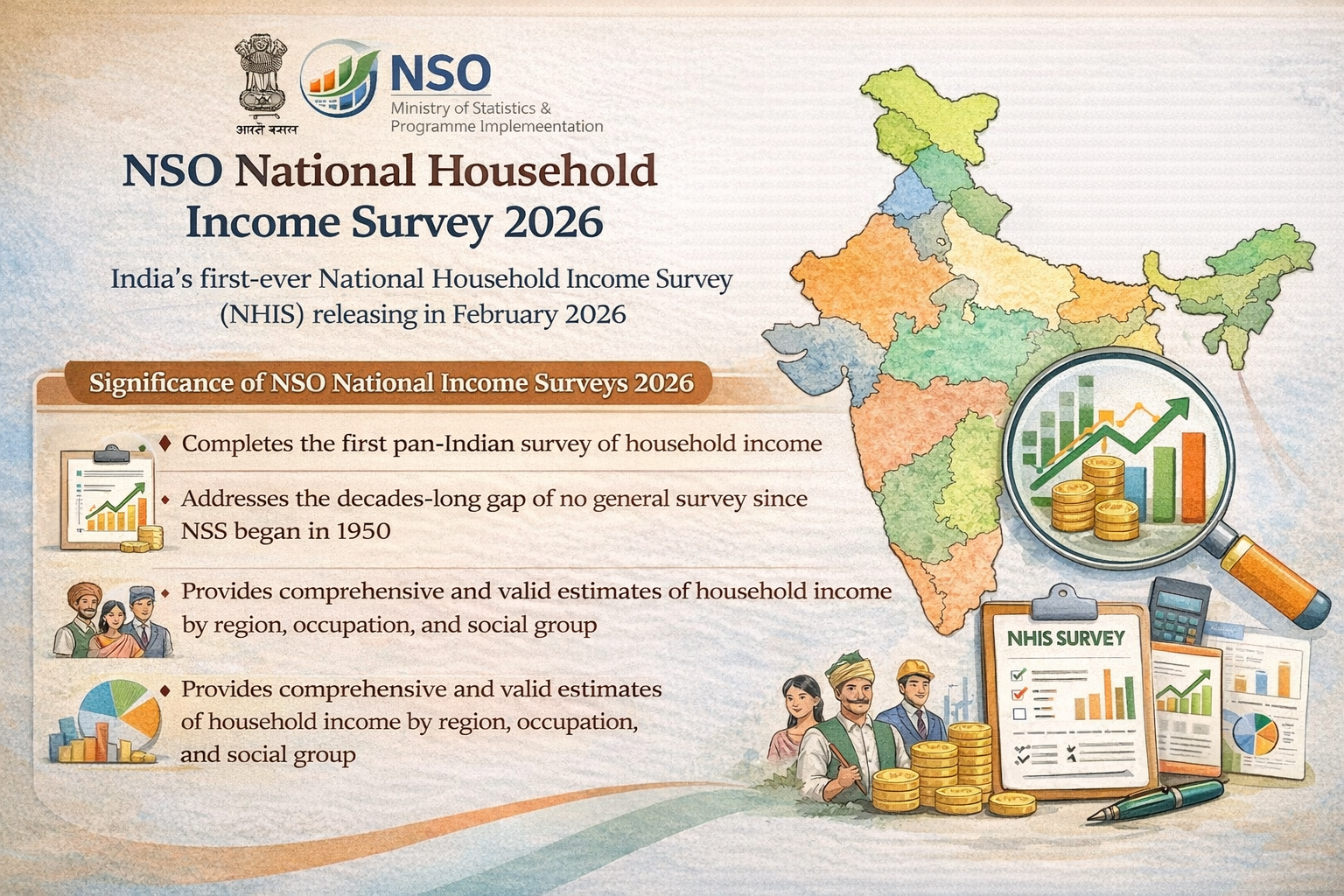
The National Statistics Office (NSO) under the Ministry of Statistics and Programme Implementation (MoSPI) is planning to release India's first-ever National Household Income Survey (NHIS) in February 2026. This survey will produce the first pan-Indian household income and living conditions statistics and associated socio-economic variables to fill long-term gaps in official statistical data. It will facilitate evidence-based policymaking and offer credible information about income trends among regions and groups. The NHIS is a significant leap in empowering the statistical system of India and enlightening economic planning in the future.
Significance of NSO National Income Surveys 2026
-
The National Household Income Survey (NHIS) 2026 will become the first pan-Indian survey of household income dedicated solely to the measurement of household income, as a long-running gap in the Indian statistical system.
-
It deals with the fact that a general national distribution of household incomes survey does not exist despite the decades of household data collection by the National Sample Survey (NSS) since 1950.
-
NHIS will yield comprehensive and valid estimates of overall household income, which will facilitate the correct analysis of patterns of income in the regions, in occupations and among social groups.
-
Data collected by the survey will be utilised in policy-making and promote evidence-based policymaking, which will assist the government in reviewing and adjusting welfare programmes and fiscal interventions to the real-life income situation.
-
The outcomes will be in the form of improved measurement of poverty and inequality, the enabling of more accurate targeting of the social support, and the empowerment of socio-economic planning.
-
The data of NHIS will be employed to narrow down consumer price indices and develop better preparation of National Accounts Statistics, which enhances the quality and credibility of economic indicators.
-
Through harmonising the statistical system of India with the international standards, the survey contributes to the international comparability of income data.
-
The economic research, policy formulation and planning at the national, state and district levels are informed by the survey.
-
NHIS will enable easier tracking of the trend of income growth and will contribute towards the realisation of the effectiveness of the government schemes.
-
It also boosts accountability and transparency, ensuring that official income statistics are stronger and more open.
Important Previous Year Questions of National Income
| Exam | Question Asked | Answer |
|---|---|---|
| SSC MTS | In national income accounting, what is Gross Domestic Product (GDP)? Options: value of export / value within borders / government income / total savings |
Value of all goods and services produced within a country’s borders during a specific period. |
| SSC CGL Tier-I | Which of the following is a correct statement? 1) National income is GNP at factor cost 2) National Income is NDP at market price 3) National Income is GDP at market price 4) National Income is NNP at factor cost |
Option 4 — National Income is NNP at factor cost. |
| UPSC CSE Prelims | The national income of a country for a given period is equal to: 1) Total value of goods/services by nationals 2) Sum of total expenditure 3) Sum of personal incomes 4) Money value of final goods & services produced |
Money value of final goods and services produced. |
| UPSSSC / SSC | The National Income Committee in India was formed in which year? A) 1947 B) 1949 C) 1951 D) 1954 |
1949 — Formed post-independence. |
| SSC | Who was the chairman of the first National Income Committee formed in 1949? | P.C. Mahalanobis. |
| UPSSSC | Who made the first estimate of India’s national income? | Dadabhai Naoroji (1867-68). |
| UPSSSC / SSC | Who made the first scientific estimate of national income in India? | Dr V. K. R. V. Rao (1931-32). |
| SSC | The list of subjects which may be entrusted to local bodies is given in which schedule? A) Eleventh Schedule B) Twelfth Schedule C) Seventh Schedule D) State List |
Eleventh Schedule. |
Conclusion (NSO National Income Surveys 2026)
The NSO National Income Surveys 2026 can be considered an important step towards the empowerment of the Indian economic data ecosystem. These surveys can give an exact, prompt, and thorough understanding of the income, production, and expenses of the country. They can aid the evidence-based decisions about policies, ameliorate planning, and increase transparency and are beneficial to researchers, policy makers and even citizens.