


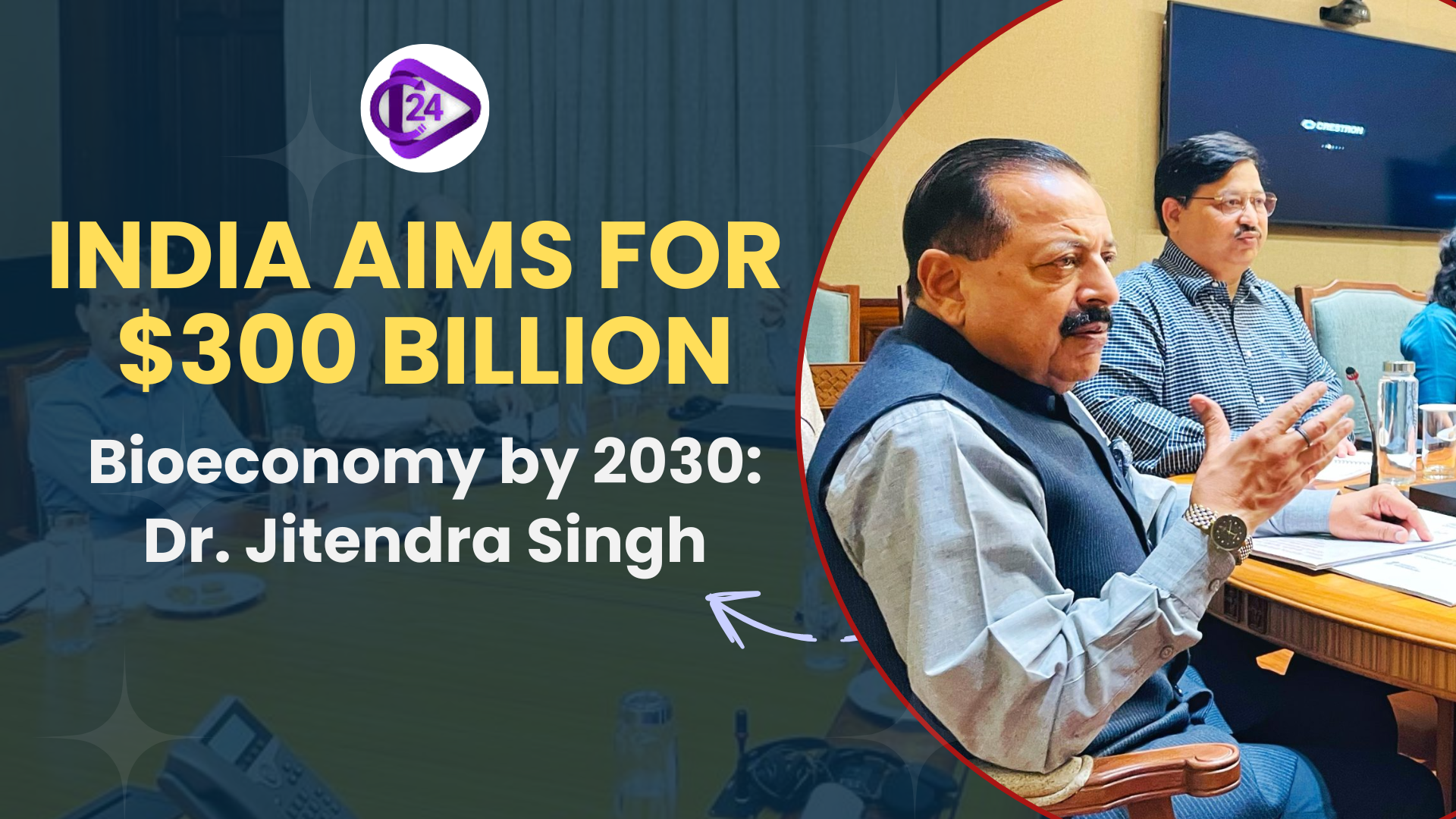
At the World Bioproduct Day event, Dr. Jitendra Singh, Union Minister of Science & Technology, emphasized India’s goal to achieve a $300 billion bioeconomy by 2030. He highlighted the importance of inclusive participation in the biotechnology mission, with every Indian being a stakeholder in the nation’s bioeconomy. The BioE3 Policy and the focus on public engagement are crucial steps toward realizing this vision
Key Details:
What is Bioeconomy?
Definition:
-
Bioeconomy can be described as the creation, operating, and preserving biological resources, including associated understanding, science, technology and innovation, to offer products, procedures and services in various sectors of the economy serving the sustainability.
-
Target of India: Reach 300 billion bioeconomy in 2030.
Major Areas of Bioeconomy:
-
Biopharma/Biomedical
-
BioAgri (Agriculture)
-
BioIndustrial
-
BioResearch/BioIT
-
Bioeconomy in India: The relevance:
Significance of bio ecomony
-
Economic Growth:
-
In 2024, the contribution of bioeconomy to GDP grew up to 4.25%, with the growth of this industry being at $165.7 billion in 2014 when it was at only $10 billion.
-
-
Entrepreneurship:
-
Innovation came through the growth in biotech startups which grew in a span of a decade to reach 10,000+.
-
-
International Centre of Cheap Medicines:
-
India is number 3 in pharma manufacture (in volume) and manufactures 65 percent of the world's vaccines.
-
-
Food Security:
-
BioAgri sector enhances productivity of agri, livestock products by use of GM crops, bio-products and animal biotechnology.
-
-
Employment:
-
The number of jobs that bioeconomy is expected to generate is 35 million.
-
-
Energy Security:
-
The level of ethanol blending rose to 15% by 2024, up to 20% by 2025, decreasing imports of the crude oil, as well as CO 2 emissions.
-
-
Environmental Benefits:
-
Circular Economy: Second generation ethanol and bioplastics are gaining use since they limit waste emission.
-
Pollution Control: Utilization of biofertilizers and bioremediation decreases the use of chemicals and enhances ecosystems.
-
Climate-Smart Crops: Creation of high yielding and drought resistant crops.
-
Schemes and Policies that Favour Bioeconomy:
-
BioE3 Policy 2024 :
-
It is centered on advanced biomanufacturing, bio-foundry clusters and bio-AI hubs around bio-based product development.
-
-
National Biopharma Mission:
-
With an endeavor to improve the capability of India in the area of vaccines, biosimilars, and medical devices with the perspective that industry academia collaboration is going to help us.
-
Biotechnology Research Innovation and Entrepreneurship Development (Bio-RIDE) Scheme:
-
Facilitates bio-entrepreneurship, innovation and academia-industry partnership.
-
-
Genome India Project:
-
Establishes a database of genetic variations to show the diversity of population in India.
-
-
Biotech-KISAN:
-
Collaboration between scientists and farmers so as to empower the farmers through agricultural innovations, particularly in rural and tribal regions.
-
-
The Biofuels National Policy 2018
-
Would increase the use of biofuels in the energy and transport sectors.
-
Obstacles to the Development of India Bioeconomy:
-
Regulatory and Policy Problems:
-
Duplication of laws and unspecificity in ministries and committees.
-
Pirating of bio-piracy relates to abuse of traditional knowledge.
-
Conflicts in laws as was the case of the Protection of Plant Varieties and Farmers Rights Act and the Patent Act.
-
-
The Research and Development (R&D) Issues:
-
There is poor spending in research and development (0.64 percent of Gross Domestic Product, compared to 2 percent in China and 3 percent in the US).
-
Sectoral imbalance: Biotech (<10%) and fuel (<10%) is behind pharma (40%).
-
-
Other Issues:
-
There was the issue of safety of genetically modified organisms (GMOs).
-
Financial support and insufficient infrastructure of genomic data.
-
Chain supply problems and reliance on foreign sources of ingredients.
-
Lack of competent expertise in biotechnology areas.
-
Way Forward:
-
Policy and regulating Framework:
-
Develop a National Bioeconomy Mission that would include stakeholder representation.
-
Put in place a single window regulatory system of biotechnology innovations.
-
Consolidate legislations e.g. align Protection of Plant Varieties with the Patent Act.
-
-
Encourage Investing and Financing:
-
Give incentives on the R&D investments.
-
Install an outcome funding scheme of high-risk innovations and corporate innovation funds with government matching.
-
-
Bring out the Human Capital Development:
-
Develop Centers of Excellence in education of biotech, creating specialist curricula.
-
Create a National Biological Data Repository in order to have improved data storage and international cooperations.
-
-
Cope with Safety Hazards:
-
Use safer designs and complete economic, environmental and safety evaluation of biotech projects.
-
-
Empower Biotechnology infrastructure:
-
Invest more in genomic data collection, storage and analysis platforms.
-
Enhance field trial systems of GM crops in collaboration with the agricultural universities.
-
Conclusion:
India’s vision for a $300 billion bioeconomy by 2030 is rooted in inclusive participation, innovation, and sustainability. The event reinforced biotechnology’s role in various sectors, from agriculture to industry, and highlighted India’s commitment to leveraging its resources for economic and environmental benefits. The BioE3 Policy and the focus on public engagement are crucial steps toward realizing this vision.