

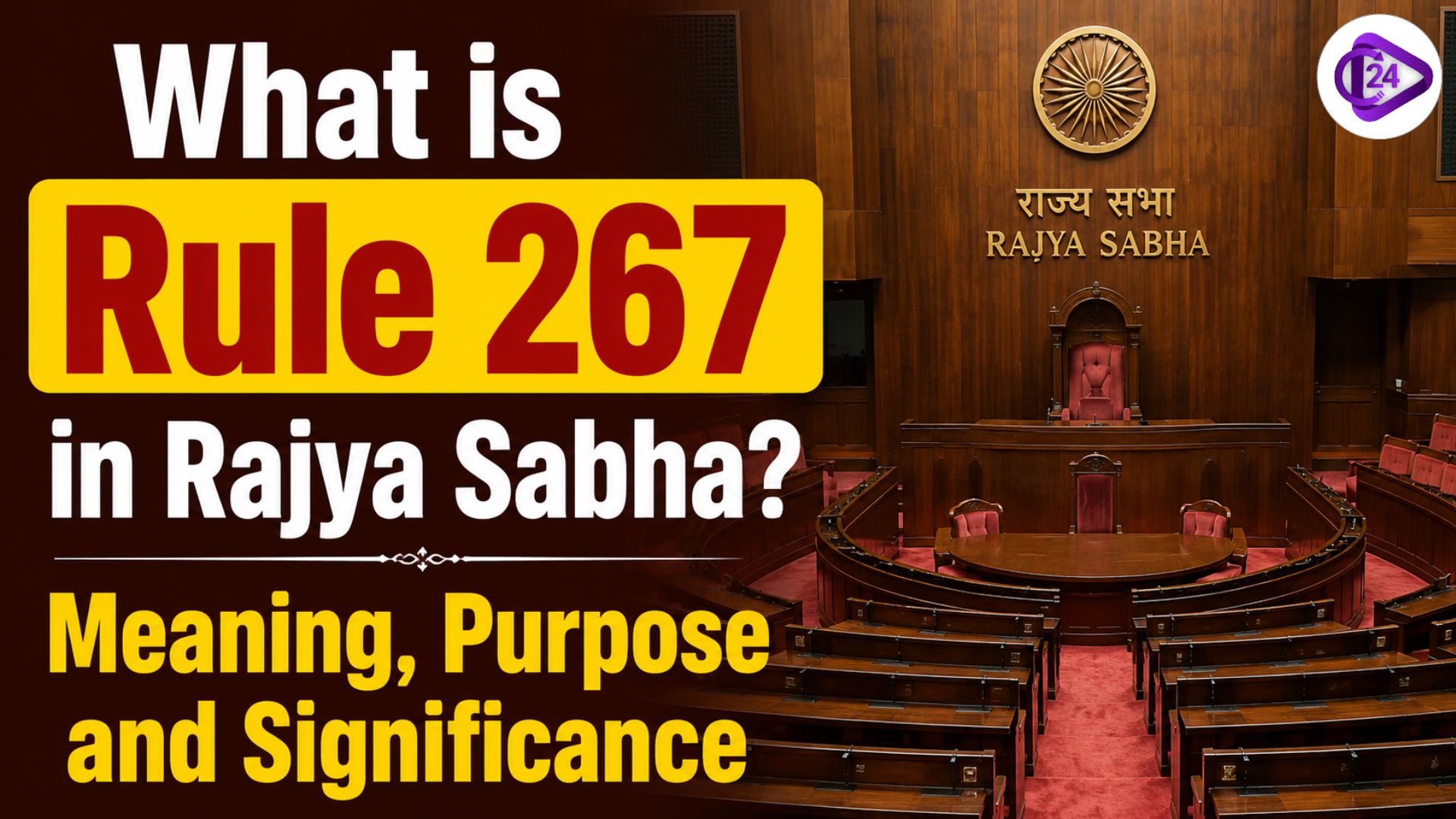
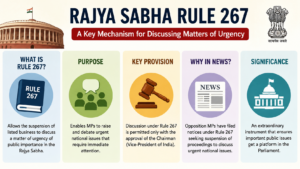
The Rajya Sabha has a specific provision (Rules of Procedure and Conduct of Business in the Rajya Sabha Rule 267), which enables the suspension of the listed business to debate a matter of urgency of public importance. The mechanism is regarded as an extraordinary instrument of serving the procedure as it allows the Members of Parliament (MPs) to address urgent national issues that need urgent attention. But Rule 267 provides for a discussion only after approval by the Chairman of the Rajya Sabha (Vice-President of India).
Why in News?
Rule 267 of Rajya Sabha, which seeks suspension of proceedings of the chamber for the discussion of urgent National issues, has once again caught media limelight following notices filed by Opposition MPs for the suspension of House proceedings. The notices were made under Rule 267.1, which permits the Chairman to deviate from the listed agenda and to permit a discussion of an issue of immediate public concern when he considers it suitable.
Key Highlights of Rule 267
- The Rules of Procedure and Conduct of Business in the Rajya Sabha have Rule 267.
- It enables the listing of a business for the day to be suspended, so that a matter of public urgent importance may be discussed.
- Any member of Parliament in the Rajya Sabha can write a notice relating to Rule 267.
- The discussion can take place only if the Chairman admits the notice.
- The Chairman may accept or reject a Rule 267 notice at his discretion.
- Parliamentary procedure rules 267 is considered to be an exceptional procedure and is rarely used.
- It allows Parliament to promptly address National issues that demand immediate intervention.
What is Rule 267 under Rajya Sabha?
An Urgent Public Question’ is allowed to be discussed in the House of the Rajya Sabha under Rule 267 of the Rules of Procedure and Conduct under the Rajya Sabha. Rule 267 of the Rules of Procedure and Conduct under the Rajya Sabha empowers the Chairman to suspend the normal business of the House and permit a discussion on a matter which he considers to be of urgent public importance. The rule is used only in extraordinary situations, because it postpones the agenda of the legislature. The Chairman’s decision on admission of a notice under Rule 267 is final.
Purpose of Rule 267
- For discussion of immediate questions of national concern.
- To give the Parliament quick and easy access to information regarding unforeseen events.
- For the accountability of the government on important contemporary matters of public concern.
- To give the Members of Parliament a chance to seek an immediate discussion.
- To enhance the role of Parliament as a check and balance on the executive.
How Does Rule 267 Work?
- A notice to the Chairman under Rule 267 is tabled in the Rajya Sabha by a Member.
- The notice communicates the problem which should be addressed immediately.
- The Chairman reviews whether the business is of critical public concern.
- The business is suspended if admitted by the Chairman.
- The issue is brought to the attention of the Rajya Sabha, which is the place to discuss ‘Urgent issues’.
Key Features of Rule 267
- It can be implemented in the Rajya Sabha.
- Makes an exception to the business schedule.
- Only used for emergencies of national importance.
- All admission is by the permission of the Chairman.
- Lacking admission of the notice, no discussion can be made.
- Special parliament structure regarded as a wonder.
Rule 267 vs Adjournment Motion
| Basis | Rule 267 (Rajya Sabha) | Adjournment Motion (Lok Sabha) |
| House | Rajya Sabha | Lok Sabha |
| Objective | Suspend listed business for urgent discussion | Adjourn normal business to discuss a definite urgent matter |
| Approval | Chairman of Rajya Sabha | Speaker of Lok Sabha |
| Nature | Procedural provision | Parliamentary device |
| Government Accountability | Discussion | Discussion with greater political implications |
Previous Year Questions (PYQs) on Rajya Sabha
| Exam | Year | Question | Options | Correct Answer |
| UPSC Prelims | 2017 | Which of the following is not a special power of the Rajya Sabha? | (A) Authorising Parliament to legislate on a State List subject (B) Creating new All India Services (C) Passing a Money Bill (D) Declaring a subject of national importance under Article 249 | (C) Passing a Money Bill |
| UPSC Prelims | 2015 | Which House of Parliament has equal powers with the Lok Sabha in the election and impeachment of the President? | (A) Rajya Sabha (B) Legislative Council (C) State Assembly (D) None of these | (A) Rajya Sabha |
| UPSC Prelims | 2013 | Under Article 249 of the Constitution, Parliament can legislate on a State List subject if the Rajya Sabha passes a resolution by: | (A) Simple Majority (B) Two-thirds of members present and voting (C) Absolute Majority (D) Special Majority of total membership | (B) Two-thirds of members present and voting |
| UPSC Prelims | 2009 | The Vice-President of India is the ex-officio: | (A) Speaker of Lok Sabha (B) Chairman of Rajya Sabha (C) Deputy Chairman of Rajya Sabha (D) Leader of the House | (B) Chairman of Rajya Sabha |
| SSC CGL | 2022 | Who is the ex-officio Chairman of the Rajya Sabha? | (A) President of India (B) Prime Minister (C) Vice-President of India (D) Speaker of Lok Sabha | (C) Vice-President of India |
| SSC CGL | 2021 | The maximum strength of the Rajya Sabha is: | (A) 250 (B) 245 (C) 238 (D) 252 | (A) 250 |
| CDS | 2020 | Which House of Parliament is known as the Council of States? | (A) Lok Sabha (B) Rajya Sabha (C) Legislative Assembly (D) Legislative Council | (B) Rajya Sabha |
| CAPF (AC) | 2018 | Members of the Rajya Sabha are elected for a term of: | (A) 4 years (B) 5 years (C) 6 years (D) 7 years | (C |
Vande Mataram Bill, Purpose, Key Provisions and Importance
Conclusion (Rule 267) of Rajya Sabha
Rule 267 in Parliament, Rajya Sabha, was one of the important Rules of Parliament which allows a Member of Parliament to seek an opportunity to discuss issues whose solution is urgent to the public and is served by suspending the Parliament’s regular business. The rule is subject to the approval of the Chairman but is very instrumental in holding the Members of Parliament accountable, transparent and prompt for national issues for debate. It is a common topic in parliamentary proceedings, which makes it an important topic in UPSC, SSC, State PCS, PCS, CSE, MAT, CAT, and similar exams.