

India and France have one of the closest defense partnerships in the world, and two big naval deals have been at the center of it. The first is the purchase of 26 Rafale-M (Marine) fighter jets for the Indian Navy. The second is a proposal to build three additional Scorpene-class submarines in India. When these plans were first reported in January 2025, newspapers said the two deals together could cross $10 billion. Since then, the Rafale-M deal has been signed, while the submarine deal is still waiting for a final decision.
This article explains both deals in simple language, shows where each one stands today, and covers the other events that made India-France defense ties a major current affairs topic.
Why India and France Are Strategic Partners
India and France have worked together on defense for decades. France has supplied Mirage 2000 fighters, the Scorpene submarine design, and, from 2016, 36 Rafale jets for the Indian Air Force. The two countries also hold regular military exercises, including Varuna for the navies, which has been held since 1983.
For India, France is a dependable partner because it shares technology and supports local manufacturing. For France, India is one of its biggest defense customers and an important friend in the Indian Ocean and Indo-Pacific region.
Deal 1: 26 Rafale-M Jets for the Indian Navy
The Rafale-M is the carrier-based version of the Rafale multirole fighter. It is built to take off from and land on a ship, with a reinforced undercarriage, a tailhook for stopping on the deck, and a design suited to life at sea.
Key facts about the Rafale-M deal
- What India is buying: 26 aircraft, made up of 22 single-seat jets and 4 twin-seat trainers. The trainers are expected to be used mainly from shore bases.
- Cost: about ₹63,000 to ₹64,000 crore, roughly $7.4 billion or €7 billion.
- Approval: the Cabinet Committee on Security cleared the proposal in April 2025.
- Signing: the two governments signed an Inter-Governmental Agreement on 28 April 2025.
- Delivery: the jets are expected to arrive in phases, with deliveries to be completed around 2030 to 2031.
- Where they will operate: mainly from INS Vikrant, India’s first indigenous aircraft carrier, which was commissioned in September 2022 and can carry about 30 aircraft. The jets may also be used on INS Vikramaditya.
Why the Navy needs the Rafale-M
The Navy’s current carrier fighter is the Russian-origin MiG-29K, which has faced technical problems and maintenance issues since it joined service. The Rafale-M will replace the MiG-29K over time. It carries advanced radar, modern missiles and strong electronic warfare systems, which will improve India’s ability to protect sea lanes and respond to threats in the Indian Ocean.
It is also a useful commercial milestone for France, because India became the first export customer of the naval Rafale. In the selection process, the Rafale-M was compared with the American F/A-18 Super Hornet, and trials of the Rafale-M were held at the shore-based test facility at INS Hansa in Goa in January 2022.
Another benefit is common equipment. Since the Indian Air Force already flies Rafales, the Navy can share some training, spare parts and support with it. The agreement also includes provisions for technology transfer so that Indian weapons can be integrated on the jets.
Deal 2: Three More Scorpene-Class Submarines
The Scorpene-class is a modern diesel-electric attack submarine designed by France’s Naval Group. India built six of them under Project 75 at Mazagon Dock Shipbuilders Limited (MDL) in Mumbai. These are also known as the Kalvari-class. The sixth and last of them, INS Vaghsheer, was commissioned on 15 January 2025.
A follow-on order for three more submarines is called Project 75 (Additional), or P75-AS. The reasons behind it are
- The newer Project 75I program, meant to bring six advanced submarines, has been slow, so the Navy wants a quick way to strengthen its underwater fleet.
- Several older submarines are nearing the end of their service life by the early 2030s.
- India’s neighborhood is seeing more submarine activity, which raises the need for stealthy platforms in the Indian Ocean Region.
What has been reported about the deal
- The three submarines are to be built at MDL in partnership with Naval Group.
- The reported value is above ₹36,000 crore.
- The submarines are expected to have about 60% indigenous content, nearly double that of the first six.
- Reports say they will have some design changes and be slightly larger than the earlier boats.
Where it stands today
Unlike the Rafale-M deal, the Scorpene contract has not been signed yet. In early October 2026, the Defense Secretary said that the additional Scorpene submarines are still under consideration, while a separate and larger deal of over ₹80,000 crore for six Project 75I submarines, built with a German partner, is in its final stages. Students should therefore avoid writing that the Scorpene deal has been completed.
Other Events That Strengthened India-France Defence Ties
Charles de Gaulle visits Goa and Kochi. In January 2025, the French nuclear-powered aircraft carrier FNS Charles de Gaulle arrived at Goa’s Mormugao port on 4 January as part of Mission Clemenceau 25. The carrier strike group then visited Kochi. It carried out joint tactical maneuvers with the Indian Navy, including with the frigate INS Mormugao, and sailed on for the next stage of its deployment on 9 January. The visit was linked to the Varuna naval exercise, which was held again in March 2025 with both INS Vikrant and Charles de Gaulle taking part and included mock air combat between the Rafale-M and the MiG-29K.
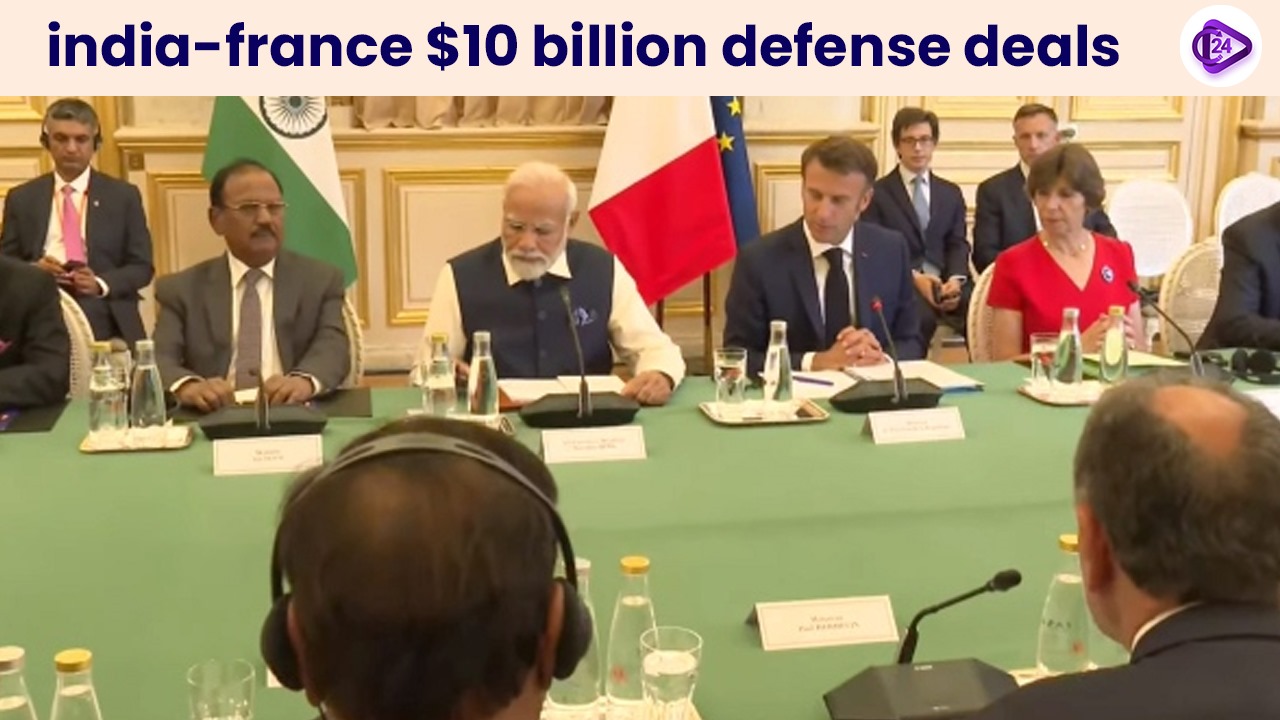
Modi’s visit to France. Prime Minister Narendra Modi visited France from 10 to 12 February 2025. India and France co-chaired the AI Action Summit on 10 and 11 February, and the leaders also reviewed defence cooperation, including future P75-AS submarines. France welcomed India’s decision to host the next AI summit.
Defense start-ups. The two countries also launched FRIND-X (France-India Defence Startup Excellence) in December 2024 to connect young companies working on defense technology.
Why These Deals Matter
- Stronger naval air power: Rafale-M jets on INS Vikrant make India’s carrier far more capable.
- Underwater strength: More Scorpene submarines would help fill gaps while newer programs are being built.
- Make in India: Higher indigenous content and local production at MDL support self-reliance in defense.
- Indo-Pacific balance: A strong Indian Navy and a close partnership with France support a free and open Indian Ocean.
- Technology cooperation: Cooperation is expanding from buying equipment to joint work on technology, start-ups, and artificial intelligence.
Challenges Ahead
Both projects need careful management. Delivery schedules must be met, the cost of additional Scorpene submarines has drawn questions because it is much higher per boat than the original six, and Indian shipyards must handle several large submarine projects at once. India will also need to build enough trained pilots, maintenance crews, and infrastructure to support the Rafale-M fleet.
Quick Facts for Exams
- Rafale-M order: 26 jets (22 single-seat, 4 twin-seat) for INS Vikrant.
- Rafale-M deal signed: 28 April 2025, an Inter-Governmental Agreement worth about ₹63,000-64,000 crore.
- Approving body: Cabinet Committee on Security (CCS), not “Cabinet Standing Committee.”
- Scorpene program: Project 75; an additional three under Project 75 (Additional), to be built at Mazagon Dock with Naval Group.
- INS Vaghsheer: sixth and final Scorpene, commissioned 15 January 2025.
- Exercise: Varuna, the India-France naval exercise, held since 1983.
- Mission: Clemenceau 25, the French carrier deployment that visited Goa and Kochi in January 2025.
- AI Action Summit: Paris, 10-11 February 2025, co-chaired by France and India.
Conclusion
The India-France defense partnership has moved from simple purchases to joint production, shared exercises, and technology cooperation. The Rafale-M agreement shows how quickly a long-planned deal can turn into a signed contract, while the Scorpene proposal shows that big defense projects can still take time. Together, these programs aim to give the Indian Navy stronger eyes, wings, and underwater reach in the Indian Ocean. For students, the key lesson is to track each deal’s current status, since defense news changes fast.