


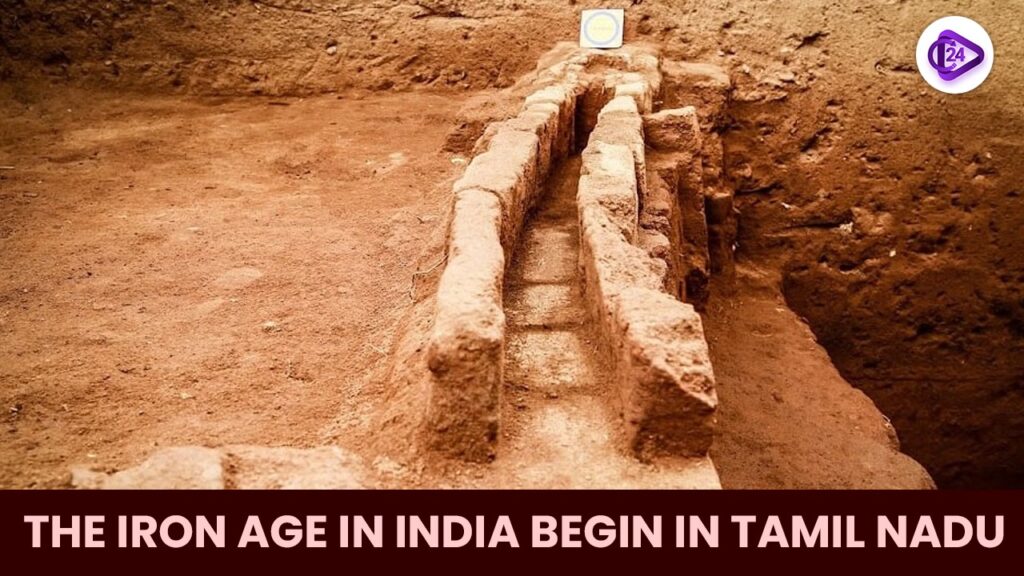
Archaeological discoveries of iron artifacts in Tamil Nadu have produced dates ranging from 3,345 BCE to 2,953 BCE thus refuting previous beliefs about when the Indian Iron Age began. Chief Minister M.K. Stalin of Tamil Nadu has confirmed that Tamil soil began iron smelting in the fourth millennium BCE based on a report from the Tamil Nadu State Archaeology Department declaring the Antiquity of Iron. The dating of iron use discovered in the Ganga Plains stands at approximately 1800 BCE which proves to be an earlier time compared to previous research findings.
Scientists now reevaluate how early metallurgy and civilization growth occurred in India because of this discovery. This discovery has created numerous inquiries regarding technological progress variations across regions because of their impact on historical developments.
Causes of Early Iron Usage in Tamil Nadu
-
Limited Availability of Copper Ore
-
North Indian regions that possessed copper ore deposits (needed for Copper-Bronze Age development) did not have comparable copper resources in Tamil Nadu as the latter possessed minimal extractable copper.
-
Early Tamil societies had to start working with iron as a substitution metal because of the limited copper availability in their region.
-
-
Abundance of Iron Ore in Southern India
-
Salem together with Krishnagiri and Tiruvannamalai Districts constitute the primary locations for iron ore reserves in Tamil Nadu.
-
Early societies discovered iron ores more easily which allowed them to perform iron smelting and tool fabrication before the northern populations.
-
-
Technological Innovation & Cultural Continuity
-
Archaeological findings from Mayiladumparai and Sivagalai as well as Adichanallur demonstrate that Tamil cultural groups independently discovered methods to produce iron.
-
Tamil Nadu did not experience a Chalcolithic era thus Neolithic followed directly into the Iron Age without passing through the Copper-Bronze stage.
-
-
Economic and Agricultural Needs
-
Early settlements valued the discovery of iron tools because they improved forest clearance and plowing of lands which resulted in better agricultural output.
-
Advantages of Early Iron Usage in Tamil Nadu
-
Technological Advancement
-
Given to them first the early adoption of iron tools allowed Tamil societies to dominate in agricultural production and warfare and craftsmanship.
-
Settled civilizations along with increased food production resulted from improved ploughs in farming practices.
-
-
Architectural and Urban Development
-
The combination of iron chisels with tools could potentially lead to improved construction of dwellings as well as irrigation systems and monumental structures.
-
-
Expansion of Trade and Economy
-
The early introduction of iron tools enabled trading activities both inside and outside India as well as between ancient civilizations.
-
Early metallurgy in Tamil Nadu contributed to economic growth because the region maintained trade relations with Rome Egypt along with Southeast Asia.
-
-
Military Superiority
-
Iron weapons surpassed copper and bronze weapons because they offered superior defense abilities to protect against invaders along with reinforced governance stability.
-
The production of early Tamil kingdoms experienced acceleration because of iron weapons.
-
Disadvantages and Challenges
-
Environmental Impact
-
Iron smelting operations at a large scale caused extensive deforestation because the extraction process relied heavily on charcoal for operations.
-
Soil erosion together with changing climates could have occurred if extraction remained without control.
-
-
Resource Exploitation and Social Hierarchies
-
Overseeing iron mining led to social hierarchy development because particular groups held exclusive rights to produce and use iron products.
-
The development of warring domains eventually triggered conflicts related to resource management disputes.
-
-
Lack of Extensive Archaeological Evidence
-
Radiometric dating indicates Tamil Nadu could have pioneered iron use yet complete nationwide examinations and comparison studies should validate early iron artifacts throughout India.
-
Historical Development
Tamil Nadu’s Role in the Development of Indian Civilization
-
Conventional historical records established that India's Iron Age arrived during 1800 BCE.
-
The new findings of early iron artifacts imply that India's Iron Age should be dated to 4th millennium BCE and alters our perceptions of ancient civilizations.The archaeological find demonstrates how Tamil Nadu served as an essential force behind the early development of Indian metallurgy and economy and trade.
-
The study of Indian history mainly concentrated on the Ganga Plains together with the Indus Valley Civilization for many years.
-
The evidence reveals how early technological innovation extended beyond North India which confirms South India's historical significance to early Indian civilization.
-
Iron technology developments from preceding periods would have benefited the time span of the Sangam Age (300 BCE – 300 CE).
-
Future studies in South Indian archaeological sites are predicted to increase in number.
-
The discovery allows researchers to view differently how technology spread between different regions.
Conclusion
-
The discovery that Tamil Nadu served as the first region in India for the emergence of the Iron Age challenges mainstream historical interpretations. Without doubt the numerous iron-smelting sites identified from 3300 BCE reveal South India as a leading region for early adoption of iron production technology in the region.
-
The research community requires additional evidence to verify and determine Tamil Nadu's position in the wider Indian Iron Age context yet these discoveries now enable better understanding of ancient Indian history. Historical studies need better inclusivity because they should acknowledge regional differences beyond North Indian studies.
-
The research discoveries affect policy decisions regarding Tamil Nadu's heritage protection together with excavation financing and tourist attractions which enhance India's historical and cultural heritage