


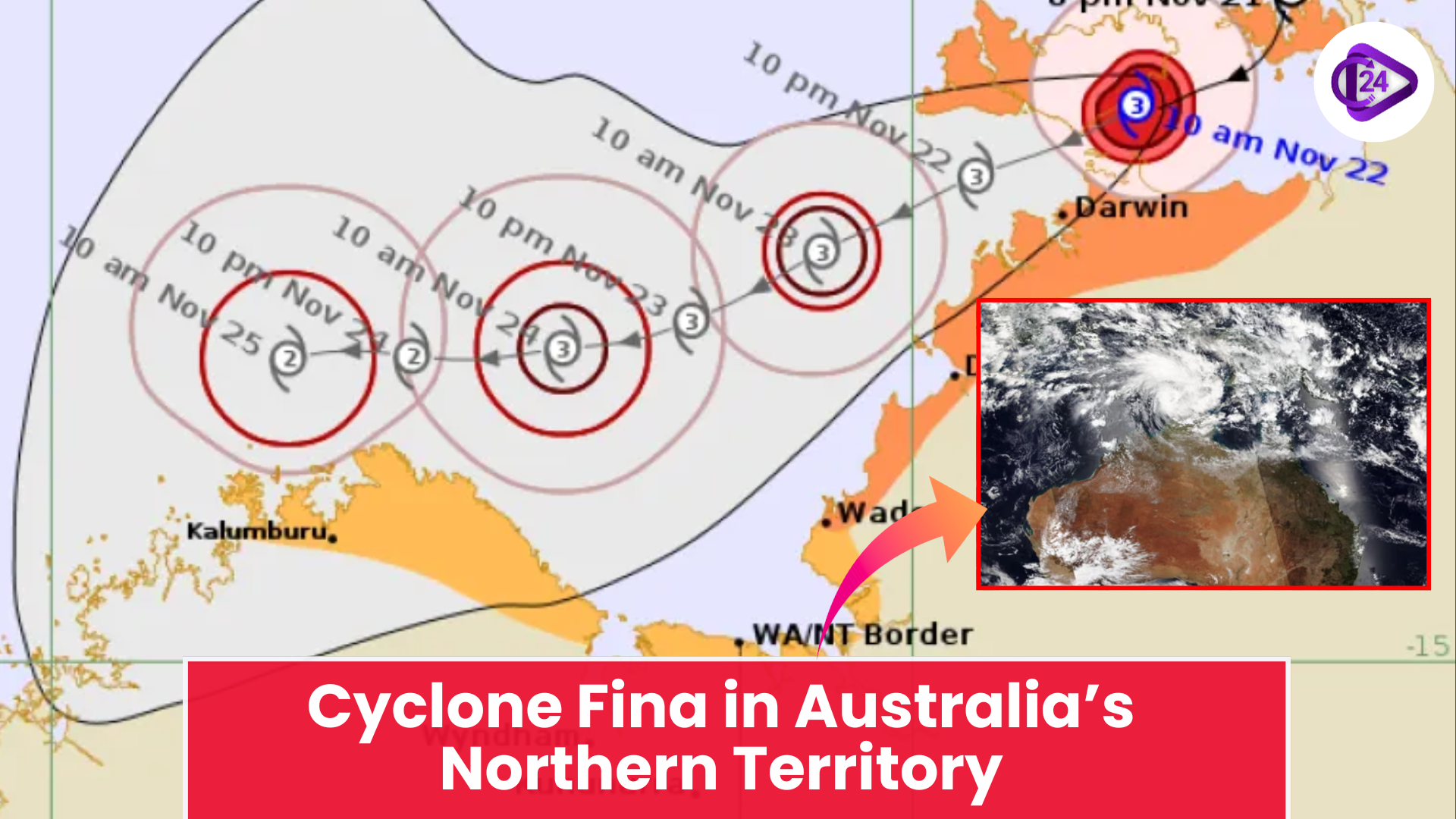
Cyclone Fina 2025 was one of the most significant tropical cyclones to affect Northern Australia during the 2025–26 cyclone season. The severe tropical cyclone brought destructive winds, torrential rainfall and widespread power outages across the Northern Territory, particularly affecting the Tiwi Islands and the Darwin region.
The cyclone developed in November 2025 and intensified as it moved towards Australia’s northern coastline. It reached Category 3 intensity near Darwin before strengthening further into a high-end Category 4 system over the Timor Sea region.
Cyclone Fina caused extensive damage to trees, infrastructure and electricity networks. Around 19,000 properties in the Greater Darwin region experienced power outages. Heavy rainfall also caused localised flooding, while emergency authorities issued warnings and activated disaster response measures.
Despite the significant damage, no fatalities or serious injuries were reported in the Greater Darwin region.
What Was Cyclone Fina 2025?
Severe Tropical Cyclone Fina was a tropical weather system that affected Australia’s Northern Territory and Western Australia’s Kimberley region in November 2025.
It was the first tropical cyclone of the 2025–26 Australian cyclone season. According to Australia’s Bureau of Meteorology (BoM), Fina became the most intense tropical cyclone recorded in the Australian region during November.
The cyclone also equalled the record for the earliest landfall on the Australian mainland, matching Severe Tropical Cyclone Ines, which made landfall on 21 November 1973.
Key Highlights of Cyclone Fina
| Particulars | Details |
| Cyclone Name | Fina |
| Year | 2025 |
| Country | Australia |
| Affected Region | Northern Territory and Western Australia |
| Season | 2025–26 Australian Cyclone Season |
| Named | 18 November 2025 |
| First Landfall | Cobourg Peninsula, 21 November 2025 |
| Maximum Intensity | High-end Category 4 |
| Intensity Near Darwin | Category 3 |
| Maximum Sustained Wind Speed | Approximately 195 km/h |
| Major Affected Areas | Tiwi Islands, Darwin and Kimberley Coast |
| Main Impact | Heavy rainfall, damaging winds and power outages |
| Cyclone End Date | 25 November 2025 |
Formation and Development of Cyclone Fina
Cyclone Fina developed from a tropical low-pressure system that formed north of the Kimberley region of Western Australia on 15 November 2025.
The system gradually moved eastwards and strengthened under favourable atmospheric and oceanic conditions.
On 18 November, it developed into a tropical cyclone and was officially named Fina.
Its intensity and movement changed several times before it reached the Northern Territory coastline.
Timeline of Cyclone Fina
| Date | Major Development |
| 15 November 2025 | Tropical low-pressure system formed north of the Kimberley. |
| 18 November 2025 | System developed into Tropical Cyclone Fina. |
| 19 November 2025 | Intensified to Category 2. |
| 20 November 2025 | Weakened to Category 1 and changed direction. |
| 21 November 2025 | Reached Category 2 and made landfall on the Cobourg Peninsula. |
| 22 November 2025 | Intensified to Category 3 near the Tiwi Islands and Darwin. |
| 23 November 2025 | Strengthened into a high-end Category 4 system. |
| 24 November 2025 | Made another landfall near the Berkeley River Mouth in Western Australia as Category 3. |
| 25 November 2025 | Weakened below tropical cyclone intensity. |
| 26 November 2025 | Cyclone event concluded. |
Areas Affected by Cyclone Fina in Australia
Cyclone Fina affected several coastal and inland communities in Northern Australia.
The Tiwi Islands and Greater Darwin region experienced damaging winds, heavy rainfall and disruption to essential services.
The cyclone later moved towards Western Australia’s Kimberley coast, where it also caused significant damage.
Major affected areas included:
- Tiwi Islands: Experienced strong winds and significant damage, particularly around Wurrumiyanga on Bathurst Island.
- Darwin: Experienced damaging wind gusts, fallen trees and widespread electricity outages.
- Cobourg Peninsula: Experienced the cyclone’s first landfall on 21 November.
- Van Diemen Gulf: The cyclone intensified as it moved through this region.
- Kimberley Coast: Experienced another landfall as the cyclone moved towards Western Australia.
The Bureau of Meteorology reported that Darwin experienced wind gusts of approximately 120 km/h, although the most destructive core of the cyclone passed north of the city.
Major Impacts of Cyclone Fina 2025
Cyclone Fina caused widespread disruption across Northern Australia. Its effects were visible in electricity networks, transport services, public infrastructure and local communities.
1. Heavy Rainfall and Flooding
One of the most significant impacts of Cyclone Fina was the exceptionally heavy rainfall across the Northern Territory.
Several locations recorded rainfall totals between 100 mm and 300 mm in 24 hours.
Middle Point, near Darwin, recorded an extraordinary 430 mm of rainfall in the 24 hours up to 9 am on 23 November 2025.
This was the highest daily November rainfall recorded in the Northern Territory and the fourth-highest November daily rainfall total recorded anywhere in Australia.
The intense rainfall increased the risk of flash flooding and affected several local communities.
2. Power Outages
Strong winds brought down trees and damaged electricity infrastructure across the Greater Darwin region.
Around 19,000 properties experienced power outages, creating difficulties for households and essential services.
Emergency teams worked to restore electricity and remove fallen trees from roads and public spaces.
3. Damage to Trees and Infrastructure
The cyclone caused widespread tree damage, affecting parks, roads, public facilities and residential areas.
The Tiwi Islands experienced particularly significant damage, while the Berkeley River Lodge in Western Australia also suffered structural and vegetation damage.
4. Transport and Public Service Disruptions
The cyclone disrupted normal activities across the affected regions.
- Darwin International Airport was temporarily closed as a precaution.
- Several public facilities and community centres were closed.
- Roads were affected by fallen trees and debris.
- Emergency services were deployed to assess damage and support communities.
- Some schools and public facilities remained closed until safety inspections were completed.
5. Human Impact
Despite the destructive nature of the storm, the Greater Darwin region reported no fatalities or serious injuries.
Emergency warnings, public shelters and community preparedness played important roles in helping residents respond to the cyclone.
Why Was Cyclone Fina Significant?
Cyclone Fina was significant because of its intensity, early-season landfall and impact on Northern Australia.
Some important reasons include:
- Strongest November Cyclone: It became the most intense tropical cyclone recorded in the Australian region during November.
- Early Landfall: Its first landfall on 21 November equalled the Australian mainland’s earliest cyclone landfall record.
- Category 4 Intensity: It strengthened into a high-end Category 4 system on 23–24 November.
- Darwin Impact: It was the strongest tropical cyclone to pass within 100 km of Darwin since Cyclone Tracy in December 1974.
- Record Rainfall: Middle Point recorded 430 mm of rainfall in 24 hours.
- Widespread Disruption: Around 19,000 properties experienced electricity outages.
The cyclone highlighted the vulnerability of Northern Australia’s coastal communities to severe tropical weather events.
What Is a Category 3 and Category 4 Tropical Cyclone?
Australia uses a five-category system to classify tropical cyclones according to their maximum wind gusts and potential damage.
| Category | Maximum Wind Gusts | Potential Impact |
| Category 1 | Less than 125 km/h | Minor damage |
| Category 2 | 125–164 km/h | Moderate damage |
| Category 3 | 165–224 km/h | Severe damage |
| Category 4 | 225–279 km/h | Very severe damage |
| Category 5 | 280 km/h or more | Extremely severe damage |
Cyclone Fina reached Category 3 intensity near Darwin and later strengthened to a high-end Category 4 system.
Disaster Management and Emergency Response
The Northern Territory authorities activated emergency response arrangements as Cyclone Fina approached populated areas.
Residents received warnings through emergency communication channels, and public shelters were opened in Darwin and parts of the Tiwi Islands.
Important emergency response measures included:
- Issuing cyclone and flood warnings.
- Opening public emergency shelters.
- Advising residents to secure their homes and prepare emergency kits.
- Temporarily closing schools and public facilities.
- Deploying emergency personnel to assess damage.
- Removing fallen trees and restoring essential services.
The response highlighted the importance of early warnings, community preparedness and coordination between emergency agencies.
Important Facts About Cyclone Fina for Competitive Exams
The following facts are useful for UPSC, RAS, SSC, State PCS and other competitive examinations.
- Cyclone Fina occurred in November 2025.
- It was the first tropical cyclone of the 2025–26 Australian cyclone season.
- It affected Northern Territory and Western Australia.
- It was named on 18 November 2025.
- Its first landfall occurred on the Cobourg Peninsula on 21 November 2025.
- It reached Category 3 intensity near Darwin.
- It later strengthened into a high-end Category 4 cyclone.
- It was the most intense tropical cyclone recorded in the Australian region during November.
- Around 19,000 properties experienced power outages.
- Middle Point recorded 430 mm of rainfall in 24 hours.
- It was the strongest cyclone to pass within 100 km of Darwin since Cyclone Tracy in 1974.
Conclusion
Cyclone Fina 2025 was a major tropical weather event that affected Northern Australia in November 2025. Its development into a high-end Category 4 system, record-breaking rainfall and widespread power outages made it one of the most significant cyclones of the Australian region.
Although the storm caused considerable damage to infrastructure and disrupted essential services, emergency warnings and community preparedness helped reduce its human impact.
The event highlights the importance of effective disaster management, early warning systems and climate-resilient infrastructure in cyclone-prone regions.