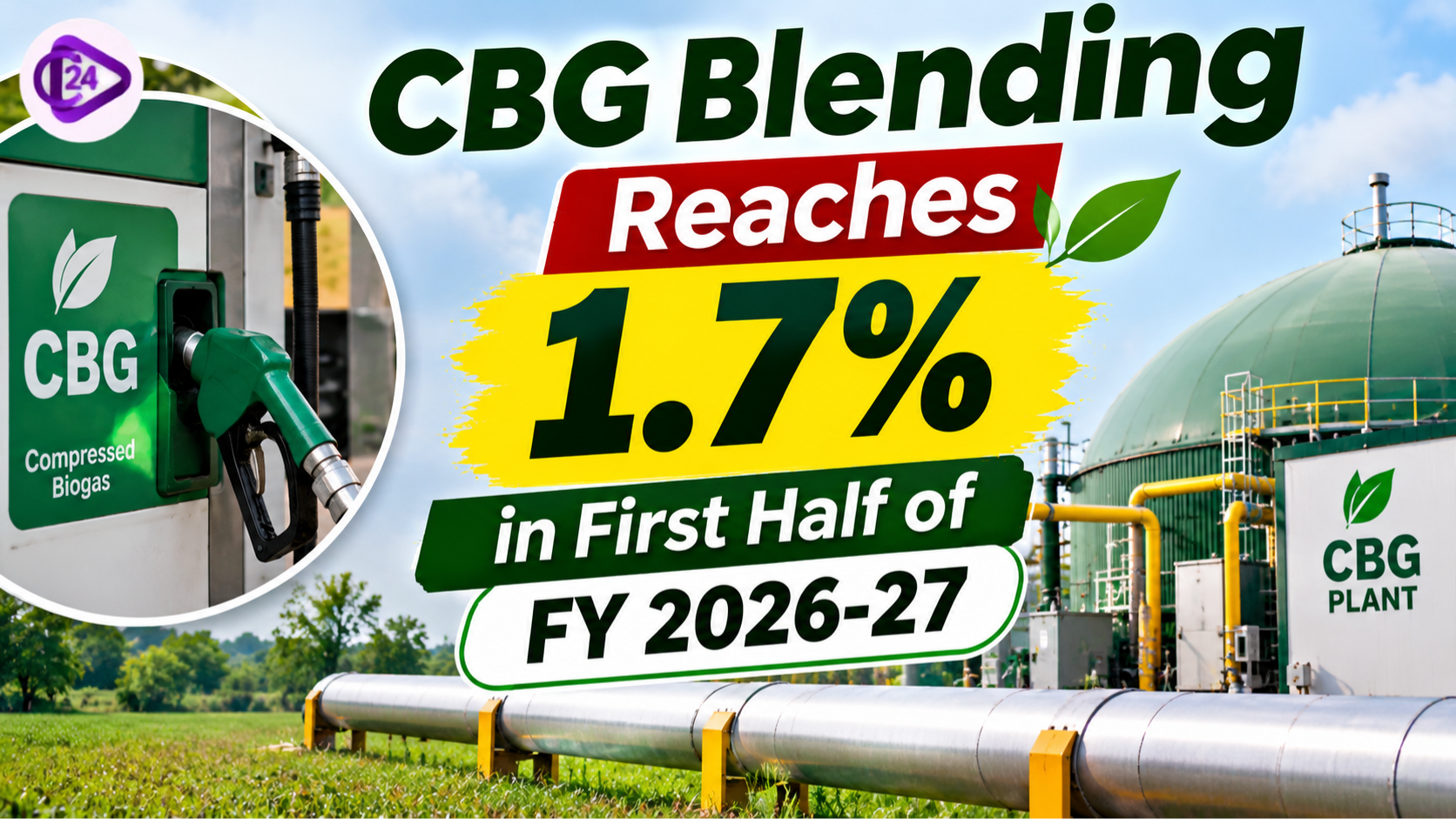


India has achieved 1.7% blending of Compressed Biogas (CBG) with Compressed Natural Gas (CNG) and Domestic Piped Natural Gas (D-PNG) during the first half of the financial year 2026-27. However, the country needs to accelerate CBG production and sales to achieve its annual blending target of 3%.
According to the Petroleum and Natural Gas Regulatory Board (PNGRB), pipeline connectivity is one of the major challenges affecting the growth of India’s CBG sector. Improved infrastructure, assured market access and better utilisation of existing plants are essential to achieving the government’s renewable energy targets.
What is Compressed Biogas (CBG)?
Compressed Biogas (CBG) is a renewable fuel produced by purifying and compressing biogas generated from organic waste materials.
It is produced through the anaerobic digestion of biodegradable materials, including agricultural residue, cattle dung, municipal solid waste, food waste and sewage.
After removing impurities such as carbon dioxide and hydrogen sulphide, biogas is upgraded to obtain methane-rich gas and compressed for use as fuel.
CBG has properties similar to compressed natural gas (CNG), making it suitable for use in vehicles and domestic gas distribution networks.
Key Highlights of CBG Blending in India
- CBG blending achieved: 1.7% during April–September 2026.
- Annual blending target: 3% for FY 2026-27.
- CBG sales in first half: 115.9 Million Standard Cubic Metres (MMSCM).
- Combined CNG and D-PNG sales: 6,800 MMSCM.
- Functional CBG plants: 210.
- Average capacity utilisation: 44%.
- Future blending target: 4% in FY 2027-28 and 5% in FY 2028-29.
To achieve the 3% target, India’s CBG sales need to reach approximately 408 MMSCM during the full financial year, requiring an additional 292.1 MMSCM in the second half.
Why is Pipeline Connectivity Important?
Pipeline connectivity is essential for transporting CBG from production plants to city gas distribution networks.
According to PNGRB, several CBG plants are operating below their installed production capacity because of inadequate transportation infrastructure and uncertain market access.
Out of 210 functional CBG plants, average capacity utilisation is approximately 44%. Plants having pipeline connectivity, or where connectivity is under development, achieve around 65–69% utilisation.
Furthermore, 247 out of 308 CBG plants under construction have no planned pipeline connectivity.
Improving pipeline infrastructure can ensure regular gas procurement, reduce transportation costs and increase the commercial viability of CBG projects.
Benefits of CBG for India
Energy Security: CBG can reduce dependence on imported natural gas and strengthen domestic energy production.
Environmental Protection: It promotes scientific waste management and helps reduce greenhouse gas emissions.
Agricultural Development: Agricultural residues and cattle dung can become valuable resources for renewable energy production.
Rural Employment: CBG plants create employment opportunities in waste collection, transportation, production and distribution.
Circular Economy: Organic waste is converted into clean fuel, while the remaining digestate can be processed into organic manure.
Government Initiatives Related to CBG
The Government of India has introduced several initiatives to promote compressed biogas production and consumption.
- SATAT Initiative: Sustainable Alternative Towards Affordable Transportation aims to promote CBG production from waste and biomass.
- GOBARdhan Scheme: Promotes the conversion of cattle dung and organic waste into biogas, CBG and organic manure.
- National Bioenergy Programme: Supports the development of bioenergy projects, including waste-to-energy and biogas facilities.
- CBG Blending Obligation: Introduces progressively higher blending targets for CBG in the CNG (Transport) and PNG (Domestic) segments.
Challenges and Way Forward
India’s CBG sector faces challenges such as inadequate pipeline infrastructure, irregular feedstock availability, high initial investment, low plant utilisation and limited market access.
To overcome these challenges, the government and private sector should prioritise pipeline connectivity, strengthen city gas distribution networks, encourage private investment and ensure assured procurement from independent CBG producers.
Greater coordination between CBG manufacturers, oil and gas companies and regulatory authorities will be essential for achieving future blending targets.
Conclusion
Compressed Biogas has significant potential to support India’s clean energy transition, circular economy and energy security. Achieving the 3% blending target in FY 2026-27 will require faster CBG sales and improved pipeline connectivity.
Strengthening the CBG ecosystem can help India reduce fossil fuel dependence, promote sustainable waste management and advance its long-term renewable energy objectives.