


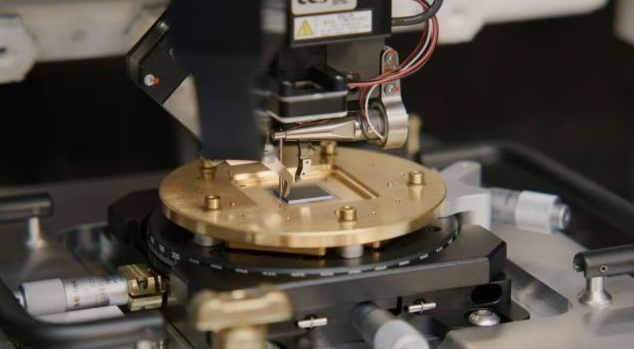
Amazon launched its first in-house quantum chip entitled Ocelot which became public on February 27, 2025 during the quantum computing revolution. Through its development by Amazon Web Services (AWS) Ocelot serves as a nine-qubit processor which improves quantum computing while offering better error correction and enhanced computational efficiency and reduced hardware costs for practical operating systems.
Amazon made its debut in the quantum technology field to challenge Microsoft and Google and IBM in quantum computing. Microsoft adopted its high-scalable quantum chip 'Majorana 1' into the market a week after its debut in the quantum race. The pursuit of quantum supremacy between organizations drives novel breakthroughs which may transform artificial intelligence (AI), cryptography, material science, finance and medical research domains.
Understanding Amazon’s ‘Ocelot’ Quantum Chip
Quantum computing represents the top-tier technological breakthrough because it handles complex problems at an exponential speed beyond the capabilities of standard computing systems. The two principal difficulties which hinder quantum computing development are scalability and error correction.
Key Features of ‘Ocelot’
✅ Nine-Qubit Processor – The technology delivers enhanced system stability together with accurate calculations while raising computational capability.
✅ Advanced Quantum Error Correction – The reduction reaches 90% which ensures calculation reliability.
✅ Cost-Effective Architecture – The technology offers potential price reductions of approximately 80% for quantum computing equipment.
✅ Integration of ‘Cat Qubits’ – The qubits based on Schrödinger’s cat concept automatically minimize errors.
✅ Scalable and Efficient Design – According to Amazon, the Ocelot technology has the potential to speed up the development of practical quantum computing by five years.
Amazon has established a platform for error resistance since the beginning as it resolves a fundamental limitation that affects qubits at scale. Qubits in quantum computing systems are the basic components that require intense protection from environmental disturbances and thus tend to produce errors through temperature fluctuations and pressure changes. The 'cat qubits' design from Ocelot creates fewer errors thus extending quantum computer stability periods.
Quantum Computing: A Game-Changer for the Future
How Quantum Computing Works
The operational principle of quantum computers deviates from classical machines which work through 0s and 1s since quantum computers leverage qubits as their processing components. Quantum superposition lets qubits maintain multiple states simultaneously thus allowing quantum systems to handle enormous information simultaneously. Due to their ability to process data simultaneously in various states quantum computers achieve exponential power compared to ordinary computers for particular operations.
The principal restriction for quantum computing emerged as quantum decoherence which drives qubits to lose their quantum state due to environmental disturbances. The success of quantum error correction methods is important to minimize this issue. The Ocelot chip developed by Amazon embeds inherent error-resilience elements that enable profitable quantum computing deployments on a large scale.
Amazon vs Microsoft: The Global Quantum Race Intensifies
Amazon’s Ocelot launch has occurred immediately following Microsoft’s unveiling of Majorana 1 which aims to scale quantum computing up to one million qubits. The two businesses use separate strategies for their development.
| Feature | Amazon ‘Ocelot’ | Microsoft ‘Majorana 1’ |
|---|---|---|
| Qubit Count | Nine-Qubit | Potentially scalable to 1M+ |
| Error Correction | Advanced, Cat Qubits-Based | Microsoft’s Topological Qubits |
| Primary Goal | Cost-Effective, Practical Computing | High Scalability & Long-Term Advancements |
| Impact on Quantum Race | Faster Adoption & Deployment | Future-Proof for Large-Scale Applications |
Major competitors in the worldwide quantum computing competition extend beyond Amazon and Microsoft as additional key performers in this field are active at present.
🔹 Google – Working on ‘Bristlecone’, a 72-qubit processor.
🔹 IBM – Developing ‘Condor’, a 1,000-qubit quantum processor.
🔹 China – Alpha Group continues to invest substantially into developments of quantum cryptography and communication technologies.
The competition within the quantum sector drives researchers to develop real-world technologies by speeding up discoveries applicable to AI and defense, drugs and supercomputing systems.
Amazon’s Quantum Roadmap: Braket & Future Plans
The company started its quantum computing investment strategy multiple years ago. Amazon debuted Amazon Braket during 2020 as its quantum computing platform through which users can try out quantum processors made by IonQ and Rigetti and D-Wave. Amazon is taking a new direction through the development of Ocelot technology to construct quantum computing hardware which could determine the path of quantum computing development.
Amazon envisions quantum computing revolutionizing:
📌 Artificial Intelligence (AI) & Machine Learning – The platform makes model training processes quicker and allows processing complex data structures.
📌 Cybersecurity & Encryption – The company works on developing cryptographic methods that use quantum technologies to secure important data.
📌 Pharmaceutical & Medical Research – The process of simulating molecular interactions becomes faster for drug discovery purposes.
📌 Financial Modeling & Market Predictions – The company strives to improve both operational risk evaluations and financial investment management.
📌 Climate Science & Material Discovery – The company works to address climate-related computational obstacles as it creates next-generation materials.
Relevance for UPSC, SSC, and Other Competitive Exams
This development is extremely pertinent for UPSC, SSC, Banking, and other government exams with topics pertaining to Science & Technology, International Relations, and Economic Impact.
Why is this Important for Exams?
✅ Science & Technology – Comprehensively addresses developments in quantum computing, AI, and cryptography.
✅ International Relations – The technology race between Amazon, Microsoft, Google, IBM, and China.
✅ Economic & Industrial Impact – How industries such as finance, pharmaceuticals, and defense can be disrupted by quantum computing.
✅ Government Policies – India's National Quantum Mission (NQM) and worldwide efforts in quantum research.
India’s Role in Quantum Research
The Government of India introduced the National Quantum Mission (NQM) in 2023, investing ₹6,000 crore to augment quantum research. The mission targets:
- Indigenous quantum computing technology development.
- Quantum-safe encryption for bolstering cybersecurity.
- Quantum communication network establishment.
India's increasing investment in quantum computing may enhance its status in the global tech community, and thus it is an important sector for government policies and future research.
Conclusion
Amazon's Ocelot quantum chip is a breakthrough, bringing stronger error correction, cost-effectiveness, and quantum computing scalability nearer to the future. While technology companies such as Amazon, Microsoft, Google, and IBM engage in a competition, quantum computing is ready to transform sectors like cybersecurity, AI, finance, and pharmaceutical research.
With quick development, quantum technology is likely to be a revolutionizing influence over the next ten years, so it is a must-learn subject for competitive exams, policymaking, and future technological advancement.