

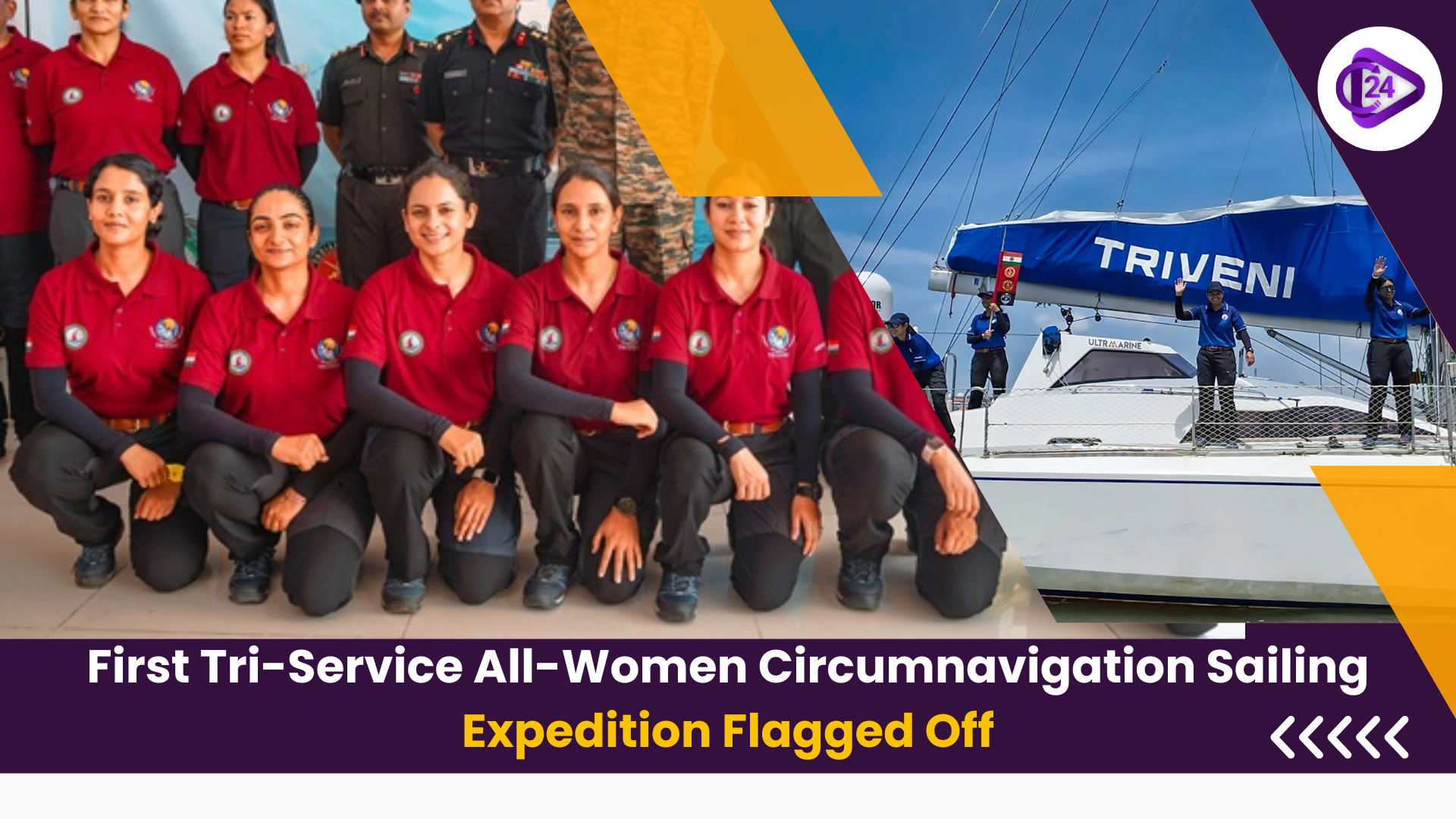
India launched Samudra Pradakshina, its first-ever tri-service all-women circumnavigation sailing expedition, on 11 September 2025. Defence Minister Rajnath Singh virtually flagged off the expedition from the Gateway of India in Mumbai. The mission brought together women officers from the Indian Army, Indian Navy, and Indian Air Force to undertake a challenging voyage around the world.
The expedition was planned to cover approximately 26,000 nautical miles aboard the indigenously built Indian Army Sailing Vessel (IASV) Triveni. It represents a significant milestone in women’s participation in the armed forces, maritime capability, and cooperation among India’s three military services.
Key Highlights of Samudra Pradakshina
Samudra Pradakshina is a major maritime initiative combining endurance sailing, technical expertise, teamwork, and international engagement. The expedition demonstrates the ability of women officers to undertake demanding maritime operations.
Important Facts About the Expedition
- Name: Samudra Pradakshina
- Flagged off: 11 September 2025
- Starting point: Gateway of India, Mumbai
- Participants: 10 women officers from the Army, Navy, and Air Force at launch
- Vessel: Indian Army Sailing Vessel (IASV) Triveni
- Planned distance: Approximately 26,000 nautical miles
- Expected duration at launch: Around nine months
- Planned return: Mumbai, in May 2026
The expedition was designed as a round-the-world voyage, requiring the crew to navigate different oceans and challenging weather conditions.
What Is IASV Triveni?
IASV Triveni is a 50-foot sailing yacht built indigenously in Puducherry. Its name reflects the coming together of the Indian Army, Indian Navy, and Indian Air Force.
Indigenous Design and Technology
The vessel is equipped with modern navigation and communication systems to support long-distance sailing. Its development highlights India’s efforts to strengthen domestic capabilities in maritime technology and specialised sailing operations.
Using an indigenously built vessel also reflects the broader objective of Atmanirbhar Bharat, which promotes self-reliance in manufacturing, technology, and strategic capabilities.
Route and Major Challenges
The expedition was planned to cross the Equator twice and round the Three Great Capes: Cape Leeuwin, Cape Horn, and the Cape of Good Hope.
Navigating Difficult Oceans
Long-distance sailing requires careful navigation, weather forecasting, equipment management, and continuous communication. The crew must adapt to changing winds, rough seas, and demanding conditions while maintaining the vessel’s safety.
Training and Preparation
Before departure, the participating officers underwent extensive preparation in ocean sailing, navigation, communication, scuba diving, first aid, and other essential skills. Such training is important for managing emergencies and making sound decisions during extended voyages.
Significance of the Expedition
Samudra Pradakshina has significance beyond its sailing distance. It highlights women’s professional capabilities, joint military cooperation, and India’s growing interest in maritime activities.
Women Empowerment in the Armed Forces
The participation of women officers in a demanding circumnavigation mission demonstrates the importance of equal opportunities, professional training, and leadership development. Their experience can encourage more women to pursue specialised roles in the armed forces.
Tri-Service Coordination
The expedition brings together personnel from the Army, Navy, and Air Force in a shared mission. Working together requires effective communication, mutual trust, and coordinated decision-making, reflecting the value of jointness among the services.
India’s Maritime Outlook
A successful circumnavigation strengthens awareness of navigation, ocean conditions, and international maritime cooperation. Visits to foreign ports can also create opportunities for professional exchanges and diplomatic engagement.
Conclusion
Samudra Pradakshina is a landmark Indian military sailing expedition that combines women’s empowerment, indigenous technology, and cooperation among the three armed services. Conducted aboard IASV Triveni, the voyage was planned to cover approximately 26,000 nautical miles and navigate some of the world’s most challenging maritime routes. The expedition reflects India’s commitment to developing maritime capabilities and expanding opportunities for women officers in demanding professional roles.