



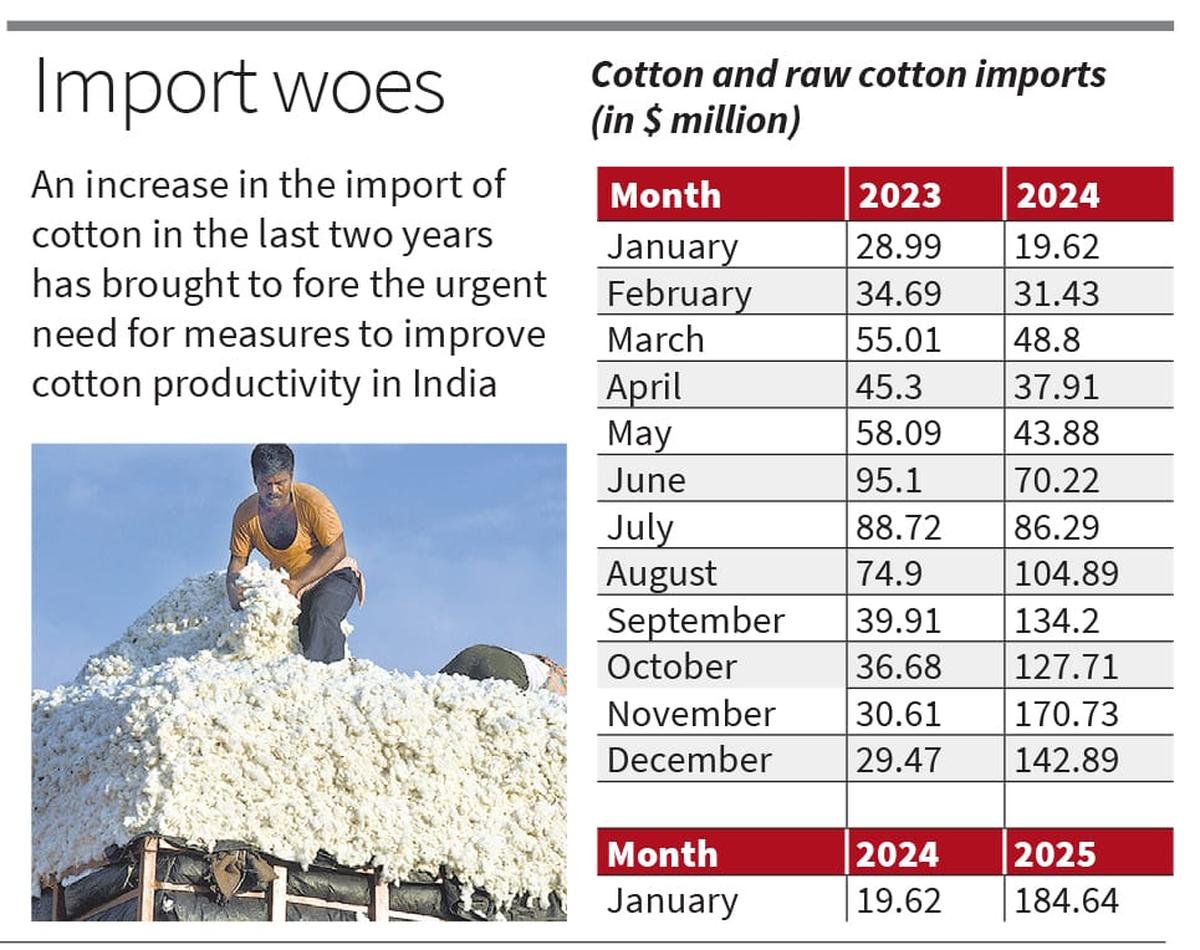
The rising cotton import levels across India during the previous seven months reveals concerns about local cotton productivity alongside competitive pricing. Textile manufacturers in India choose less expensive cotton from Brazilian, Australian, and American sources rather than domestic supplies because local farmers face lower output along with elevated production expenses. The Cotton Corporation of India (CCI) uses minimum support pricing to buy domestic cotton yet local farmers remain unprofitable. A Cotton Mission introduced by the government runs through the Union Budget aims to boost productivity yet experts insist that solid implementation methods are necessary to support domestic fiber supply and market competitiveness.
Key Points:
-
Rising Cotton Imports:
-
The quantity of imported cotton increased dramatically from $19.62 million in January 2024 to $184.64 million in January 2025.
-
The Indian textile industry selects foreign cotton imports from abroad because international rates remain lower than local cotton markets even with the 11% tax duty.
-
-
Farmers’ Challenges:
-
The cotton harvest from Indian fields reaches only 450 kg per hectare whereas Brazilian fields obtain twice as much with 1,800-2,000 kg of cotton per hectare.
-
The production cost amounts to ₹9,000 per quintal yet brokers only present open market offers between ₹5,000 and ₹5,500.
-
Integrational cotton prices remain lower than the prices Indian farmers currently receive so they must sell their produce at reduced rates.
-
-
Government Intervention & Policy Measures:
-
The Cotton Mission in the Union Budget received scrutiny from experts because they believed the budgetary amount was insufficient to achieve its productivity goals.
-
A system of acreage-based Minimum Support Price (MSP) should exist to safeguard farmers when they face economical losses.
-
According to industry leaders the textile sector should boost its export activities as a means to stabilize cotton market prices inside India.
-
-
Impact on the Textile Industry:
-
Cotton-based garments make up more than 60% of Indian exported clothing products so the industry depends on competitive raw material supply.
-
Foreign import of Extra Long Staple cotton under tariff exemptions assists exporters even though it creates anxiety among local cotton producers.
-
The primary details essential to understand cotton cultivation need to be examined.
-
About Cotton:
-
The cultivation of cotton stands as one of India's key commercial agricultural products since it generates about 25% of the worldwide cotton output.
-
“White-Gold” is one of its many names because of its vital role in the Indian economy.
-
The cotton farming industry in India persists in two distinct regions with 67% grown in rain-fed zones followed by 33% organized in irrigated farming.
Growing Conditions:
-
Climate: Cotton cultivation necessitates a hot, and sunny climate with a long frost-free period. Hottest and most humid climatic environments provide optimum results for its cultivation.
-
Soil: Cotton successfully grows across various types of soils in India including deep alluvial soils of the northern regions together with variable-depth black clayey soils in the central region along with the mixed black and red soils of the southern zone.
-
Surviving Condition: Many cotton varieties survive salt conditions although they suffer major damage from waterlogged conditions indicating farmers must manage soil drainage properly.
Hybrid and Bt Cotton:
-
Suppliers make Hybrid Cotton through crossbreeding two parent lines with contrasting genetic backgrounds. Spontaneously generated hybrid varieties form naturally in open-pollinated plant populations when different plant types mate with their related species.
-
The genetically modified pest-resistant cotton plant variety is known commercially as “Bt Cotton”.
India’s Scenario:
-
According to Global Production records of November 2023, India produces cotton in the biggest quantities and China ranks second and the United States comes third.
-
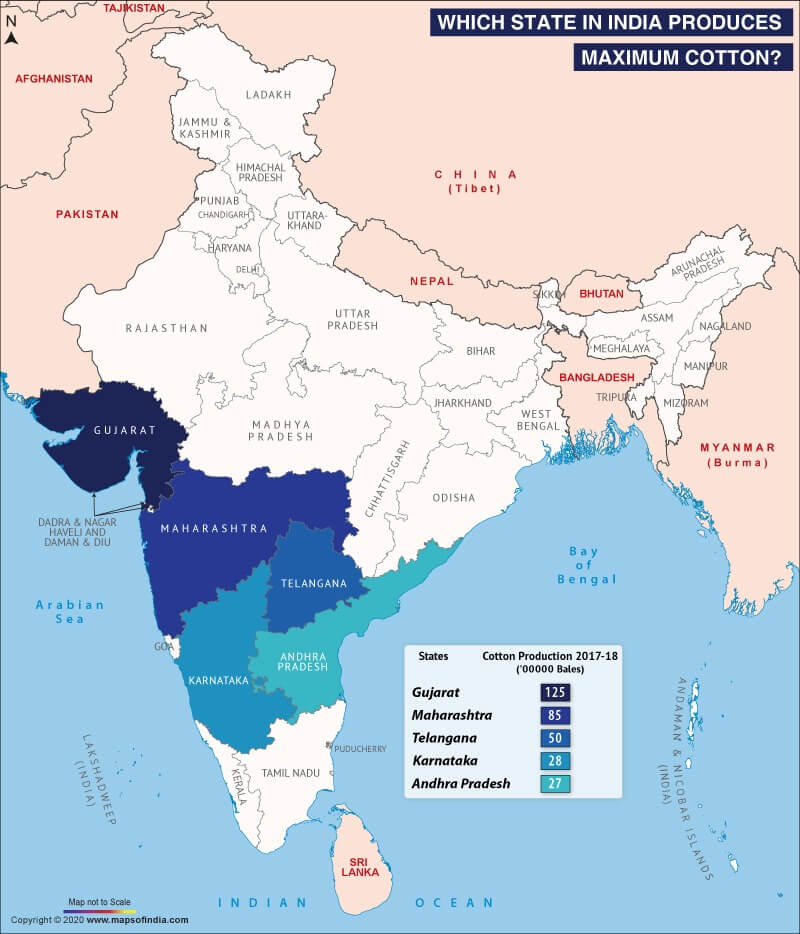
Largest Producing Zone (2022-23): Central Zone (Gujarat, Maharashtra, Madhya Pradesh).
Indian Government Initiatives For Development of the Cotton Sector
-
Cotton Development Programme Under the National Food Security Mission (NFSM):
-
Since 2014-15 the Department of Agriculture & Farmers Welfare has implemented a cotton development program through the National Food Security Mission across 15 major cotton-growing states.
-
-
Cotton Corporation of India (CCI):
-
The Ministry of Textiles began managing this government enterprise through Cotton Corporation of India (CCI) in 1970 as a Public Sector undertaking under the Companies Act 1956.
-
The organization is responsible for price support enforcement by implementing support measures whenever market prices decline under government-established price targets.
-
-
MSP Formula for Cotton:
-
A2+FL multiplied by a factor of 1.5 served as the basis to determine the Minimum Support Price (MSP) thus protecting the economic position of cotton growers and safeguarding the supply of cotton for textile industries.
-
Under MSP operations CCI conducts its duties as Central Nodal agency for seed cotton kapas belonging to Fair Average Quality when prices drop below MSP levels.
-
-
Textile Advisory Group (TAG):
-
The Ministry of Textiles formed this organization to bring stakeholders from the cotton value chain together for resolving productivity and price and branding concerns among others.
-
-
Cott-Ally Mobile App:
-
A user-friendly platform exists to offer farmers vital information about the MSP Rate alongside location details of procurement centers through this application.
-
-
Committee on Cotton Promotion and Consumption (COCPC):
-
The organization has been established to guarantee steady cotton supply for the textile industry.
-
Which Problems Affect the Cotton Industry of India?
-
Pest Attack:
-
The appearance of the pink bollworm pest (Pectinophora gossypiella) resulted in substantial decreases in cotton production levels.
-
The cotton ball invasion of PBW larvae causes both decreased production output and weakens crop quality.
-
The continuous use of Bt hybrid seeds has resulted in PBW populations building resistance capabilities.
-
Heavy infestations of cotton pests are found currently in Gujarat, Punjab, Haryana and Rajasthan.
-
-
Yield Fluctuations:
-
The combined factors of restricted irrigation access together with deteriorating soil conditions and unpredictable weather outcomes result in unpredictable cotton harvests.
-
-
Smallholder Dominance:
-
In India most cotton farming belongs to small-scale farmers who perform traditional agriculture but have inadequate access to contemporary farming technology.
-
-
Limited Market Access:
-
The majority of cotton farmers battle market access problems which forces them to sell their crops at low intermediated prices.
-
Way Forward
-
Integrated Pest Management:
-
IPM programs should implement natural pest controls with trap crops and beneficial insect populations in order to minimize chemical pesticide usage during effective pest management.
-
-
Address the Yield Gap:
-
The NFSM Large-Scale Demonstrations Project serves as a platform to introduce HDPS along with value chain solutions for better yielding outcomes.
-
-
Modernisation and Infrastructure Development:
-
The Technology Upgradation Fund Scheme (TUFS) and Mega Textile Parks (MITRA) should receive support from the government to modernize ginning and spinning and weaving operations thus boosting operational efficiency and worldwide market competitiveness.
-
-
Improve MSP Calculation:
-
A new MSP calculation system which applies a 1.5 times factor to production expenses guarantees reasonable profits for farmers. Additional changes to farmer income security will benefit from recommendations made by NITI Aayog.
-
-
Strengthen Market Linkages:
-
Prices at better levels with fewer middleman exploitations can be achieved through strengthened procurement systems and price funding as well as strict cotton grade standards.
-
-
Branding and Traceability:
-
The creation of the Kasturi Cotton brand enables India to establish its cotton as a distinctive and high-quality product in the global marketplace.
-
Initiatives in the Cotton Sector:

-
PM Mega Integrated Textile Region and Apparel (PM MITRA) Parks Scheme
-
Through the Production Linked Incentive (PLI) Scheme the government promotes MMF Apparel as well as MMF Fabrics and Products of Technical Textiles.
-
Cotton development programme under NFSM
-
Through Cott-Ally mobile app users will gain greater awareness about the implementation of Minimum Support Price for Cotton.
-
Branding of Indian Cotton as "Kasturi Cotton India"
-
Under NFSM the program demonstrates wide-scale implementation of productive methods to boost cotton yields.
-
SAMARTH (Scheme for Capacity Building in the Textile Sector)
-
The Technology Upgradation Fund Scheme was modified to become ATUFS.
Budget Allocation:
-
The government expects to allocate INR 5272 crores during the 2025-26 financial year for the Ministry of Textiles.
-
The Cotton Mission introduces a five-year plan that targets productivity increases of extra-long staple cotton varieties.
Conclusion
Indian cotton farming faces uncertain prospects since the country continues to depend more heavily on cotton imports. Weak international competitiveness and high costs of production along with low productivity levels are the main obstacles facing the industry. The Cotton Mission policy initiative from the government requires additional strong measures to improve productivity rates while maintaining harmonious relations between farmers and the textile sector and controlling domestic cotton prices. The resolution of these problems stands essential for India to preserve its dominance in world cotton and textile trades.