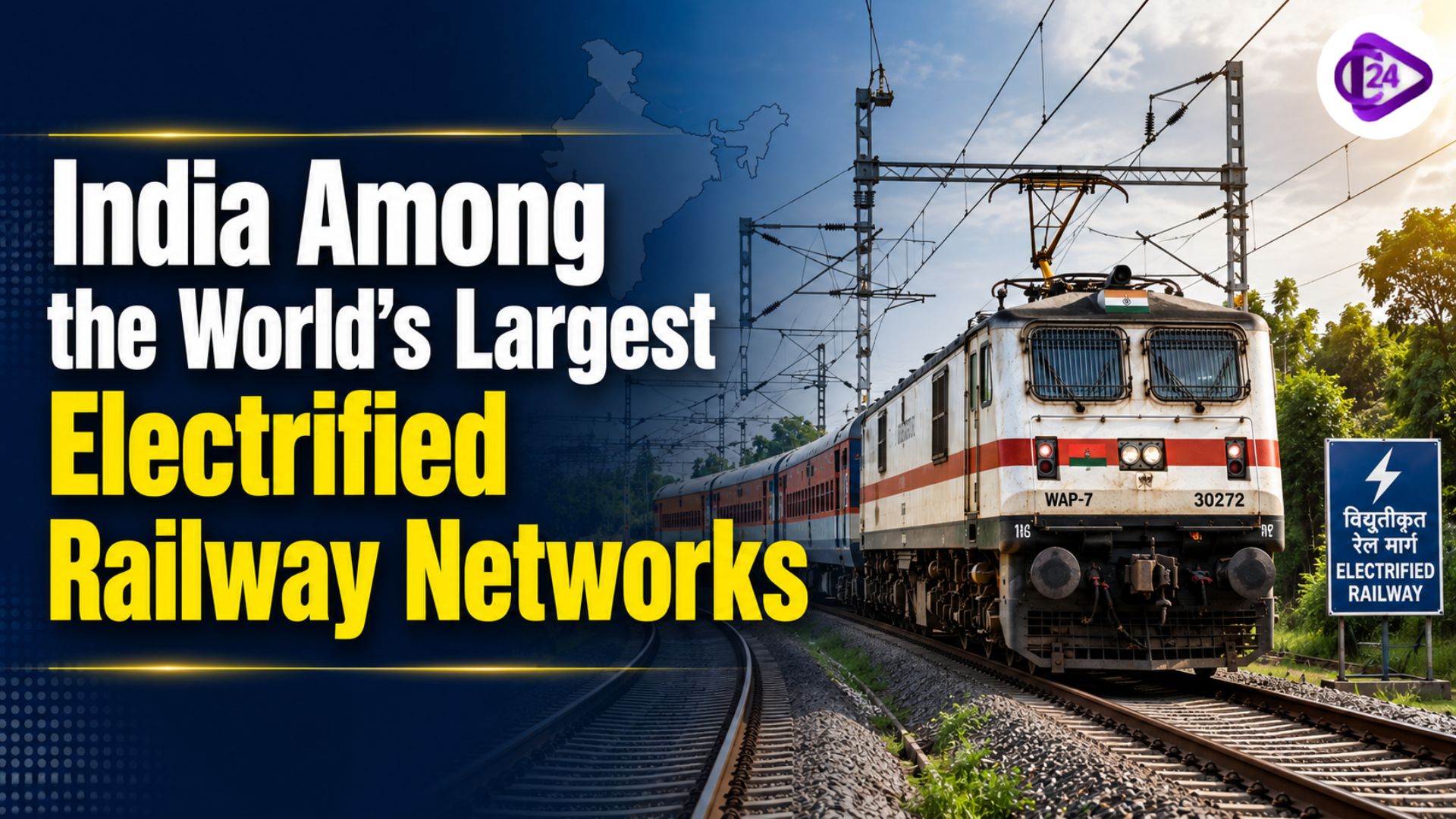
India is among the world’s largest electrified railway networks, a great milestone along the path to sustainable and energy-efficient transportation in India. In the last decade, Indian Railways has made great strides in railway electrification and, as a result, one of the world’s biggest rail networks is now an eco-friendly and budget-friendly mode of transportation.
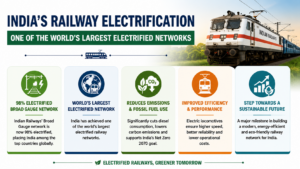
The Broad Gauge (BG) network in India has become 98% electrified, and India is among the top countries in the world for railway electrification. This accomplishment will help reduce reliance on imported fossil fuels, lower greenhouse gas emissions, increase operational efficiency, and meet India’s 2070 target to reach Net Zero emissions.
Why in News?
Indian Railways is in the news as it has become one of the world’s largest electrified railway systems with one of the highest ratios of railway electrification in the world.
The development is important because:
- The electrification has been completed in the Indian Railways’ Broad Gauge network with coverage of above 98%.
- Now Indian Railways is one of the largest railway networks that is electrified in the world.
- The councils had both a substantial reduction in diesel consumption resulting from the electrification and a reduction in carbon emissions.
- To enhance speed, efficiency and operational reliability, electric locomotives are used.
- The achievement benefits India’s commitments to green transportation and Net Zero 2070.
- This helps reduce operational expenses and boost electricity security.
- The project is in line with the government’s ambition of creating a state-of-the-art, sustainable railway network.
What is Railway Electrification?
Railway electrification is the transmission of electricity rather than burning fuel with locomotive power to drive a train. Electric traction leads to more efficient train operation, lower fuel consumption and reduced environmental pollution.
Overhead electric lines, substations, electric locomotives and the supporting infrastructure make up an electrified railway system and provide power to the trains at all times.
One of the most effective strategies for creating an environment of sustainable mobility is railway electrification.
Features of India’s Electrified Railway Network
- The majority of the Indian Broad Gauge network is electrified, with over 98% of the entire network electrified, which includes most important passenger and freight routes.
- Better Acceleration, higher speeds, and/or operational efficiency with Electric Locos is High Speed Electric Operations.
- Carbon emissions, air pollution and diesel consumption are all drastically decreased with Electrification.
- Energy Efficiency: Electric trains utilise more energy-efficient fuels, making for lower costs of operation for the train.
- Greater freight capacity: Electric freight corridors make the transportation of goods across the country faster.
- Lower Maintenance costs: Electric locomotives have a lower maintenance requirement than diesel engines.
- Promotes Renewable Energy: Indian Railways has been progressively adopting renewable energies like solar and wind.
- Digital Railway Infrastructure: Modern signalling systems, automatic and electric traction boost their operational efficiency and safety.
Previous Year Questions
| Exam | Year | Question | Options | Correct Answer |
| UPSC Prelims | 2023 | Dedicated Freight Corridors (DFCs) are primarily developed to: | (A) Promote tourism (B) Increase freight transport efficiency (C) Develop metro rail (D) Improve air cargo | (B) |
| SSC CGL | 2024 | Which ministry is responsible for the administration of Indian Railways? | (A) Ministry of Transport (B) Ministry of Road Transport & Highways (C) Ministry of Railways (D) Ministry of Commerce | (C) |
| RRB NTPC | 2022 | The headquarters of Indian Railways is located at: | (A) Mumbai (B) Kolkata (C) New Delhi (D) Chennai | (C) |
| RRB Group D | 2022 | Which gauge is the most widely used in Indian Railways? | (A) Narrow Gauge (B) Broad Gauge (C) Metre Gauge (D) Standard Gauge | (B) |
| SSC CHSL | 2023 | The Dedicated Freight Corridor Corporation of India Limited (DFCCIL) functions under which ministry? | (A) Ministry of Commerce (B) Ministry of Railways (C) Ministry of Finance (D) Ministry of Heavy Industries | (B) |
| NDA & CDS | 2021 | Which is the longest railway platform in India? | (A) Kharagpur (B) Gorakhpur (C) Hubballi (D) Kollam Junction | (C) Hubballi |
| State PSC (BPSC/MPPSC/RPSC etc.) | 2023 | Indian Railways has set a target to become Net Zero Carbon Emitter by: | (A) 2030 (B) 2040 (C) 2050 (D) 2070 | (A) 2030 |
| SSC GD | 2022 | Vande Bharat Express trains mainly operate using: | (A) Diesel Traction (B) Steam Engine (C) Electric Traction (D) CNG Engine | (C) |
| RRB ALP | 2021 | Railway electrification primarily helps in: | (A) Increasing diesel consumption (B) Reducing fuel costs and pollution (C) Increasing ticket prices (D) Reducing railway stations | (B) |
| State PCS | 2024 | Which organisation is responsible for constructing Dedicated Freight Corridors in India? | (A) IRCTC (B) DFCCIL (C) RITES (D) Konkan Railway Corporation | (B) |
RBI Invites EoI for Polymer Substrates
Conclusion on India Achieves 99.6% Railway Electrification
India Among the World’s Largest Electrified Railway Networks highlights India’s dedication to contemporary, eco-friendly, and effective transportation solutions. There has been a significant penetration of electricity into the railway network; diesel has been phased out; and carbon emissions have been minimised. In India’s journey towards full electrification and Net Zero, Indian Railways will remain a key enabler of the country’s untapped potential for economic growth, environmental progress, and national energy security.