
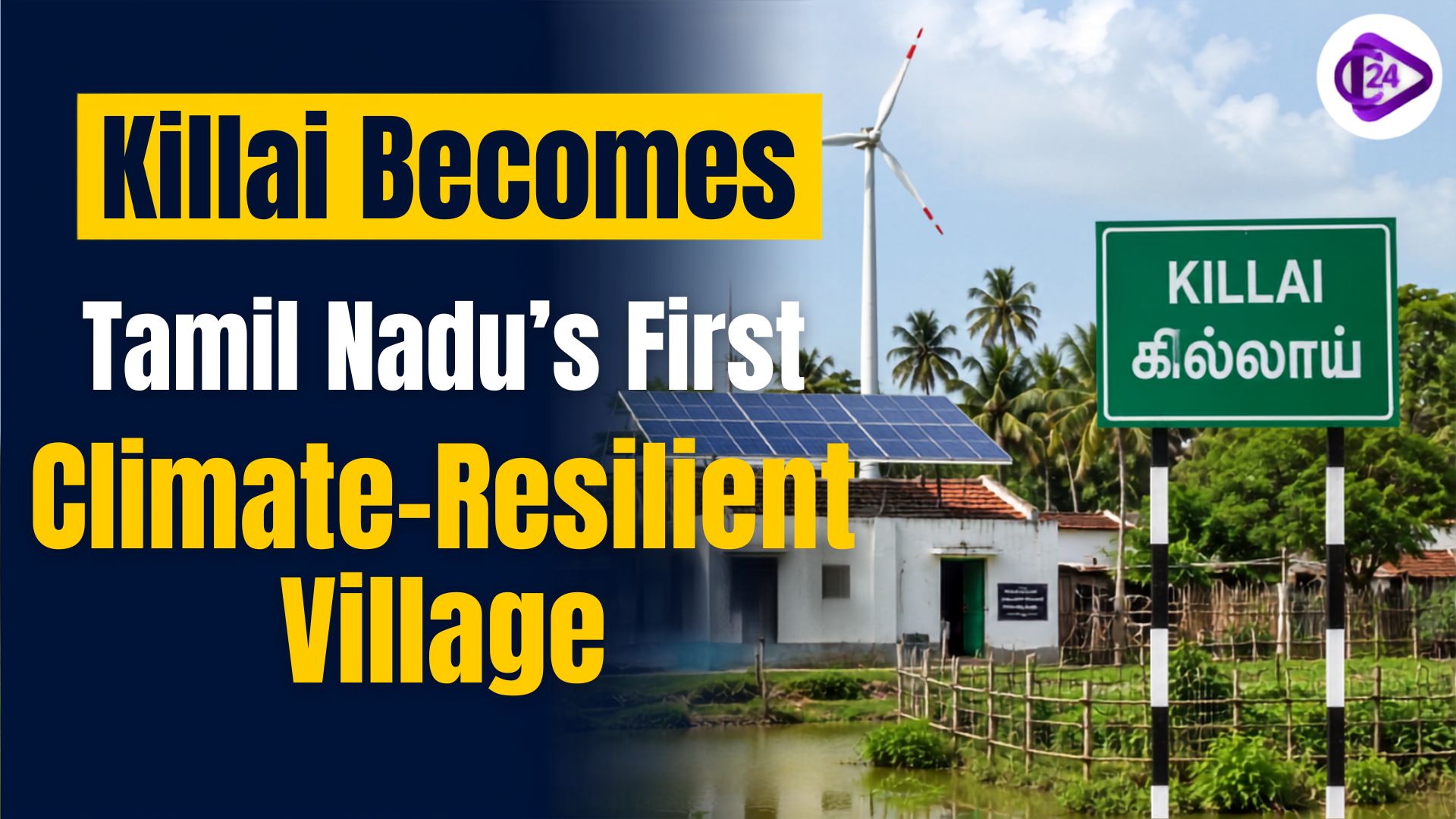
Killai is the first Climate Resilient Village of Tamil Nadu, showcasing a key achievement in India’s climate change adaptation strategy using Community-Based Development. Killai, which is close to the ecologically sensitive Pichavaram Mangrove Forest in Cuddalore District, has taken up many measures to adapt to the changing climate to make the area more resilient to cyclones, floods, coastal erosion and sea-level rise.
The scheme has proven that scientific planning, ecosystem conservation and community involvement can all play a role in mitigating climate threats while enhancing the livelihoods of communities. Because of the impact of climate change on coastal areas, the model that is used at Killai could be applied to other coastal villages facing climate change in India.
Key Highlights of Killai Climate-Resilient Village
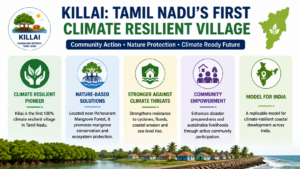
- The village of Killai becomes the first climate resilient towards 100% in full operation in Tamil Nadu.
- In the Cuddalore district near the Pichavaram Mangrove ecosystem.
- Concentrates on adaptation to climate change, not just mitigation.
- Improves conditions for cyclones, flood and, sea-level rise and coastal erosion resistance.
- Advocates for NbS by conserving mangroves.
- Accommodates resource-friendly living for local people.
- Improves disaster preparedness using community participation.
- Becomes a template for climate-change-sensitive coastal development in India.
What is a Climate-Resilient Village?
A climate-resilient village is a community that builds resilience to prepare for, respond to and recover from climate-related disasters while sustaining its development.
Rather than responding to calamities, villages resilient to climate change look to planning for the future. These incorporate the protection of the environment, resilient buildings, disaster preparations, water use conservation and livelihood diversification to lower vulnerability.
A climate-resilient village, in a simple sense, is capable of facing climate shocks and assuring the well-being of its inhabitants.
Major reasons for Tamil Nadu’s First Climate-Resilient Village
- As sea levels rise, coastal settlements will be threatened.
- Increased number and intensity of cyclones.
- Homes and agricultural land are lost to coastal erosion.
- Waters of influence are impacted by saltwater intrusion. Freshwater resources are impacted by saltwater intrusion.
- Uncertainties in livelihoods for fishing communities.
- Increased flooding risk with extreme rainfall.
Climate Challenges Faced by Coastal Tamil Nadu
- Frequent cyclones: Tamil Nadu’s coastlines are very vulnerable to severe cyclones, resulting in damage to agriculture and fisheries, homes and infrastructure.
- Beach Erosion and Loss of Agriculture and Settlement along coasts due to persistent wave attack and rising sea level.
- Sea Level Rise: Sea-level rise is a growing threat to low-lying villages due to inundation and flooding.
- Saltwater Intrusion: Over-entry of seawater into the ground and into agricultural land, reduces groundwater availability and soil fertility.
- Extreme Rainfall & Flooding: Heavy rainy days result in urban and rural flooding and adversely affect livelihoods as well as public service delivery.
- Income Loss: The fisher and farming communities lose income as weather patterns change, ecosystems degrade, and the sea is unpredictable.
Features of Killai Climate-Resilient Village
- Community-Led Climate Planning: Community-led climate planning involves empowering local people to co-develop a climate plan and make changes to climate risks, which improves sustainability.
- Nature-based solutions: including natural protection measures such as conserving mangrove forestry, which is located in proximity to the village to help alleviate the effects of cyclones, storm surges and coastal erosion.
- Improved Disaster Preparedness: Early warning systems, evacuation plans, emergency shelters, and regular awareness programmes enhance the village’s resilience and response to climate-related disasters.
- Resilient infrastructure, such as roads, drainage and public services, etc., provides good protection against floods and extreme weather events.
- Water Resource Management: This involves rainwater harvesting, efficient drainage, conserving water resources and addressing saltwater ingression issues to secure water supply.
- Sustainable Livelihoods: This programme fosters adoption of climate-smart agriculture, sustainable fishing methods and means of earning an alternative income to lower vulnerability and bolster economic resilience.
- Environmental Conservation: Improving mangroves, wetlands and coastal biodiversity increases environmental and ecological balance, protecting natural ecosystems and improving carbon sequestration.
- Replicable Development Model: Killai has proven to be a model of climate-resilient development that can be replicated in other coastal villages in a region at risk for future climate change.
PYQs Climate Change
| Year | Exam | Question | Options | Correct Answer |
| 2021 | UPSC Prelims | With reference to the ‘Global Climate Alliance’, which of the following launched it? | (A) UNEP (B) World Bank (C) European Union (D) World Economic Forum | (C) European Union |
| 2021 | UPSC Prelims | Which one of the following best describes the term ‘Carbon Neutrality’? | (A) Zero carbon emissions (B) Net-zero carbon emissions after balancing emissions with removals (C) No fossil fuel use (D) Zero industrial emissions | (B) |
| 2020 | UPSC Prelims | Consider the following statements regarding carbon dioxide emissions: Which of the statements given above is/are correct? | (A) 1 only (B) 2 only (C) Both 1 and 2 (D) Neither 1 nor 2 | (C) |
| 2019 | UPSC Prelims | Consider the following statements about the Global Environment Facility (GEF): Which of the statements given above is/are correct? | (A) 1 only (B) 2 only (C) Both 1 and 2 (D) Neither 1 nor 2 | (C) |
| 2018 | UPSC Prelims | The term ‘Blue Carbon’ is sometimes seen in the news. It refers to: | (A) Carbon captured by oceans and coastal ecosystems (B) Carbon stored in glaciers (C) Carbon from industries (D) Carbon in freshwater lakes | (A) |
| 2017 | UPSC Prelims | Which of the following are the objectives of the Paris Agreement? | (A) Limiting global temperature rise (B) Increasing fossil fuel production (C) Reducing biodiversity (D) Promoting coal consumption | (A) |
| 2016 | UPSC Prelims | The term ‘Intended Nationally Determined Contributions (INDCs)’ is associated with: | (A) Kyoto Protocol (B) Paris Agreement under UNFCCC (C) Montreal Protocol (D) Ramsar Convention | (B) |
| 2015 | UPSC Prelims | The term ‘Green Climate Fund’ is related to: | (A) WTO (B) UNFCCC (C) IMF (D) World Bank | (B) |
Vande Mataram Bill, Purpose, Key Provisions and Importance
Conclusion on Killai Becomes India’s Climate Adaptation Model
Killai Becomes Tamil Nadu’s First Climate Resilient Village is a significant stride towards developing sustainable and resilient coastal communities. Killai presents a practical Climate Change adaptation model through a community-engaged perspective, Mangrove preservation, Disaster preparedness and climate-smart planning.
The lessons learned from the implementation of resilient villages at Killai show that these are achievable and critical in the face of worsening climate risks in order to save lives, economies, and nature. The Model can generate improved long-term climate resilience across vulnerable coastal areas of India when replicated.