

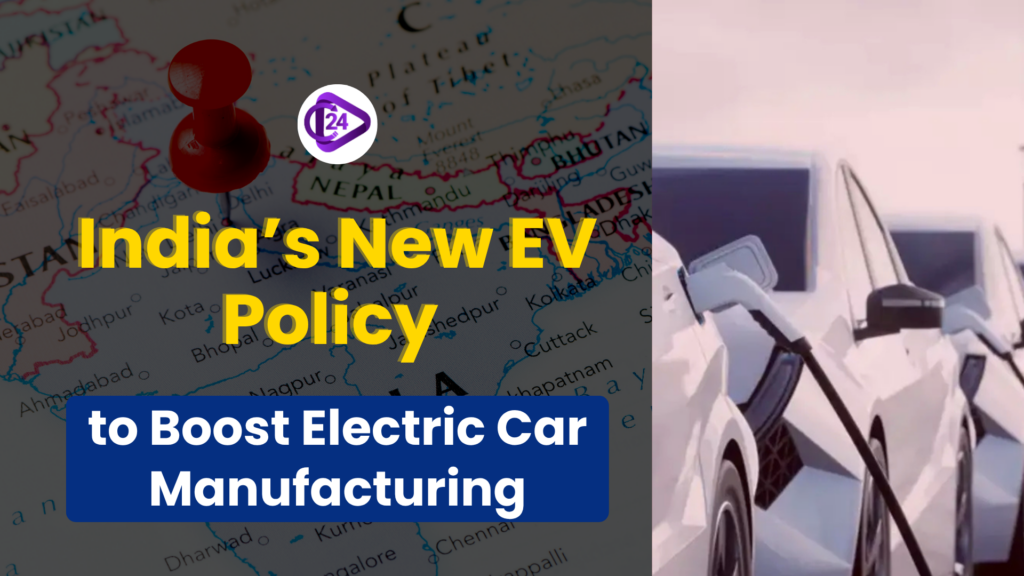
MHI has released the details for the Scheme to Promote Manufacturing of Electric Passenger Cars in India, which people were waiting for. The purpose of this policy is to grow local EV manufacturing as it also allows some import exemptions for global electric vehicle players. It mainly involves mixing foreign investment as well as domestic manufacturing. Many experts are questioning the guidance on technology sharing, the environment, and the main focus on cars instead of affordable and public transport. Today, people are debating how to grow industry without harming the environment or reducing Turkey’s ability to make important decisions on its own.
Context
-
India waives import duties on electric vehicles as long as businesses invest and make them locally.
-
Legal changes may hurt the local manufacturing industry unless they are accompanied by the necessary research and training, officials say.

Key Points
-
Reducing the import duty rate
-
The customs duty on SUVs and passenger cars priced more than $35,000 was lowered to 15% (from 70–100%) for five years.
-
-
Investment Requirements:
-
Any foreign company needs to invest ₹4,150 crore over a period of three years.
-
-
Localization Targets:
-
Vehicles made in Serbia have to increase to 25% within 3 years of the agreement being reached.
-
Close to half of hearings should be concluded within 5 years.
-
-
Import Cap:
-
At most, 8,000 vehicles can be imported into Thailand using the reduced duty system.
-
-
Duty Forgone Cap:
-
Customs duty under the scheme is limited to ₹6,484 crore.
-

Industry’s Shift & Changes in the International Scene
-
Foreign Capital-Centric Approach:
-
Some say that the approach puts too much importance on foreign capital without boosting the country’s own tech systems.
-
-
Comparison with global EV policy
-
Europe (EU, EFTA, UK)
-
Plan of Action: Use tax policies, make certain areas emission-free.
-
In India, it is important to keep supporting finances and enforcing new rules.
-
-
China
-
The government helps new startups a lot while competitors between them grow.
-
Increase internal competition and make sure policies are well coordinated in India.
-
-
USA
-
Approach: Tesla and GM come up with new ideas, and funding from the government.
-
India is advised to develop R&D infrastructure and decrease its use of subsidies little by little.
-
Benefits of EV
-
Urban air quality and health concerns decrease as there are no emissions coming out of electric cars.
-
Electricity is more efficient to use and costs less per Kilometer than gasoline/diesel.
-
Makes cities and towns less noisy by running smoothly.
-
Electric motors are able to use electricity more efficiently than engines that run on gasoline or diesel.
Important Challenges Related to the Use of EVs
-
Financial issue
-
It costs virtually double to buy a Tata Nexon EV compared to its ICE variation.
-
Expensive items are squealing demand in the market.
-
-
Lack of charging stations
-
Most development is in cities, little is being done outside of urban areas.
-
Causes certain buyers to worry about not being able to finish their trips.
-
-
Battery import dependence
-
India gets its lithium-ion batteries mostly from China, Japan, and S. Korea.
-
Over 1 billion US dollars’ worth of batteries was imported into the country in 2022.
-
-
Grid Emissions
-
Depending on coal makes it difficult for cars to be greener in India.
-
For our emissions to go down, we need cleaner grids.
-
-
Skill Gap
-
Not enough skilled people to service and check EVs.
-
-
Climatic Constraints
-
When it is really hot outside, car’s battery efficiency can drop by up to 17%.
-
-
Problems in battery recycling
-
No one system has been established for handling used lithium-ion batteries.
-
-
Range Anxiety
-
It is hard to be confident about long trips because many chargers are not available and electric cars have limited range.
-

Steps to Speed Up the Adoption of Electric Vehicles
-
Battery Lease-to-Own Scheme
-
Reduces the initial cost of an EV by 30- 40%.
-
Recycling or buying new batteries does not require users to spend a lot of money.
-
-
Battery research and development.
-
Develop batteries that are strong and yet light, made from alternative energy systems.
-
Make use of the National Mission on Battery Storage (2019).
-
-
Increase Charger Density
-
As per CII, India needs 1.3 million chargers by the year 2030.
-
In urban areas, “Charge-as-You-Park” models should be used.
-
-
Standardized Fast-Charging Protocols
-
A common charging system makes it easy to use electric vehicles.
-
-
The program for EV Rural Entrepreneurs
-
Smaller loans provided to people who want to install chargers in their rural areas.
-
-
Electric highways made for battery swapping
-
Support dhaba owners so that they can add battery swap stations to what they offer.
-
The use of online booking systems to solve the problem of high travel during peak seasons.
-
-
Equal Subsidies for EVs and Hybrids
-
It affects the environment and how much energy they help save.
-
Helps people transfer to new brands in a market that concerns prices.
-
-
Second-Life Battery Bazaar
-
Resell the used EV batteries to make microgrids, solar systems, and e-rickshaws.
-
Encourages recycling and limits the amount of e-waste.
-
Conclusion
Although the EV manufacturing policy is important for India’s green objectives, its success depends on making sure foreign investments match with the growth of domestic players. Transferring new technologies, enhancing research and training programs, and promoting electric buses will help the country become environmentally friendly and self-sufficient.
UPSC Prelims Practice Question
Q. As stated in India’s (EV policy), this is what it means:
-
It is estimated that ₹4,150 crore must be invested in 3 years.
-
People buying EVs over $35,000 are now subject to customs duty of 15%.
-
The duty rate is reduced when less than 8,000 electric vehicles are imported.
-
3 years from now, half of the workforce is expected to be local.
Select the correct code:
A. 1 and 2 only
B. 2 and 3 only
C. 1, 2 and 3 only
D. All of the above
UPSC Mains Practice Question
Q. Briefly discuss the main challenges in EV adoption in India and suggest short-term solutions to support both industry and environment.