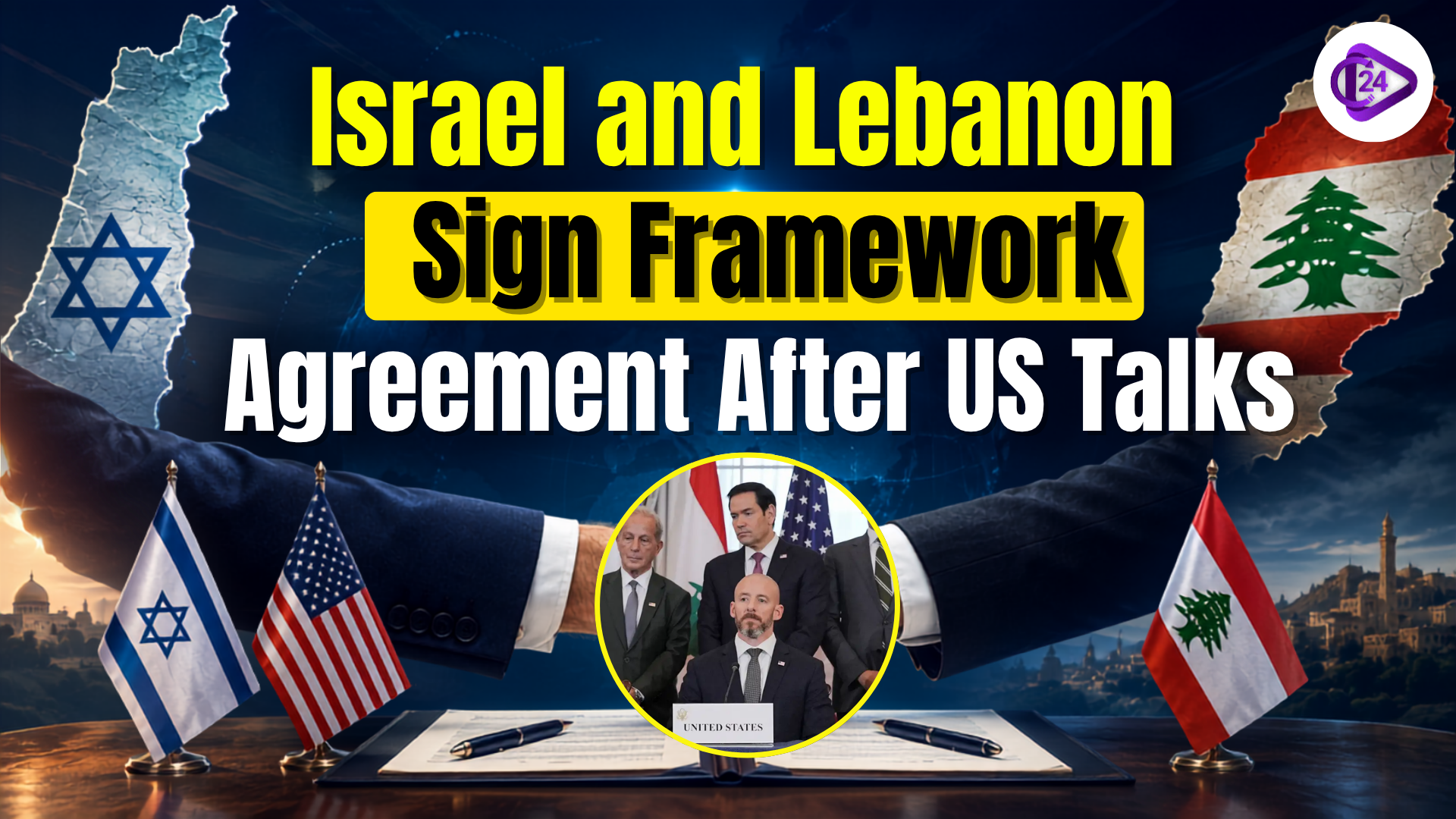


The signing of a framework agreement between Israel and Lebanon after talks in the United States is one of the most important steps in the Middle East in recent years. Through intensive US mediation, the agreement seeks to defuse the tensions between Israel and Lebanon along the Israel-Lebanon border, develop a mechanism for dialogue, and provide a roadmap for solving long-standing security concerns. This is not an actual peace treaty, but it’s a starting point for the negotiations.
This is “a good opportunity to bring stability” and help “build security coordination” and “minimise the possibility of conflicts between land borders of countries”, say the experts on the regional level. But a commitment of the political will from all concerned to ensure the success of implementation will be key.
Key Highlights of Israel and Lebanon Reach New Framework Agreement
- After US-brokered negotiations, a new framework for diplomatic relations was signed between Israel and Lebanon.
- The principles of the agreement are to alleviate tensions on the border.
- Sets procedures for further talks.
- Coordinating security and confidence-building measures are key components.
- The USA was the main mediating power.
- The framework serves as a peace agreement and not a final peace treaty.
- To make this a reality, constant diplomatic action is needed.
- If commitments are met, there may be an improvement in regional stability.
Israel and Lebanon Sign Framework Agreement: Overview
- This framework accord was agreed upon between U.S. and Israeli negotiators in Washington with Lebanon.
- The three governments announced that their purpose with the Framework is to bring lasting peace and security to the Israeli-Lebanese situation.
- Israel and Lebanon reiterated the right to exist side by side in peace and the desire to make a peace pact between neighbours.
- The Framework states the goal of bringing an end to the conflict ‘through future agreements and direct negotiations’.
- Both countries agreed to solve all their problems through bilateral negotiations mediated by the United States.
- The agreement envisages the gradual establishment of all the components of the Lebanese armed forces throughout Lebanon, restoring Lebanese state authority.
- The United States will set up a Military Coordination Group to help implement the Framework.
- As well, the US announced humanitarian aid to Lebanon, worth $100 million to implement.
- Enhancing the sovereignty, territorial integrity and security of Israel and Lebanon are highlighted in the Framework.
- The agreement is said to be the first step in a “comprehensive” peace deal that still needs to be finalised.
India–Israel Defence PYQs from Various Exams
| Year | Exam | Question | Options | Answer |
| 2023 | CDS | Barak-8 missile system has been jointly developed by India and which country? | (A) France (B) Russia (C) Israel (D) USA | (C) |
| 2022 | AFCAT | Spike missile, inducted by the Indian Army, belongs to which category? | (A) Surface-to-Air Missile (B) Cruise Missile (C) Anti-Tank Guided Missile (D) Ballistic Missile | (C) |
| 2022 | CAPF (AC) | Heron, operated by the Indian Armed Forces, is a: | (A) Fighter Aircraft (B) Helicopter (C) Unmanned Aerial Vehicle (UAV) (D) Transport Aircraft | (C) |
| 2021 | NDA | Which country jointly developed the MRSAM (Barak-8) missile system with DRDO? | (A) Russia (B) France (C) Israel (D) UK | (C) |
| 2021 | State PCS | Israel Aerospace Industries (IAI) is associated with: | (A) Nuclear Reactors (B) Space Tourism (C) Defence and Aerospace Systems (D) Shipbuilding | (C) |
| 2020 | SSC GD (Current Affairs) | India procured the Spike Anti-Tank Guided Missile from: | (A) France (B) USA (C) Israel (D) Germany | (C) |
| 2019 | CAPF | The Phalcon AWACS used by India has been developed with the help of: | (A) Russia (B) USA (C) Israel (D) Japan | (C) |
| 2018 | CDS | Searcher and Heron are examples of: | (A) Tanks (B) Radars (C) UAVs (D) Destroyers | (C) |
Three States Close Ranks on Tungabhadra Basin
Conclusion on Israel, Lebanon Sign Historic Agreement
The decision that Israel and Lebanon signed the Framework Agreement after US Talks represents an important diplomatic breakthrough. This does not solve all the remaining problems, but sets out an ordered process for ongoing negotiations on security cooperation and conflict prevention.
The deal is a positive sign of regional peace and peacebuilding, as well as the importance of continued diplomatic efforts. However, it will only succeed for the long-term if it is consistently and effectively applied, if there is political will and if there is ongoing negotiation between the two countries. The ongoing process would have a positive impact on achieving everlasting peace in the region if continued.