

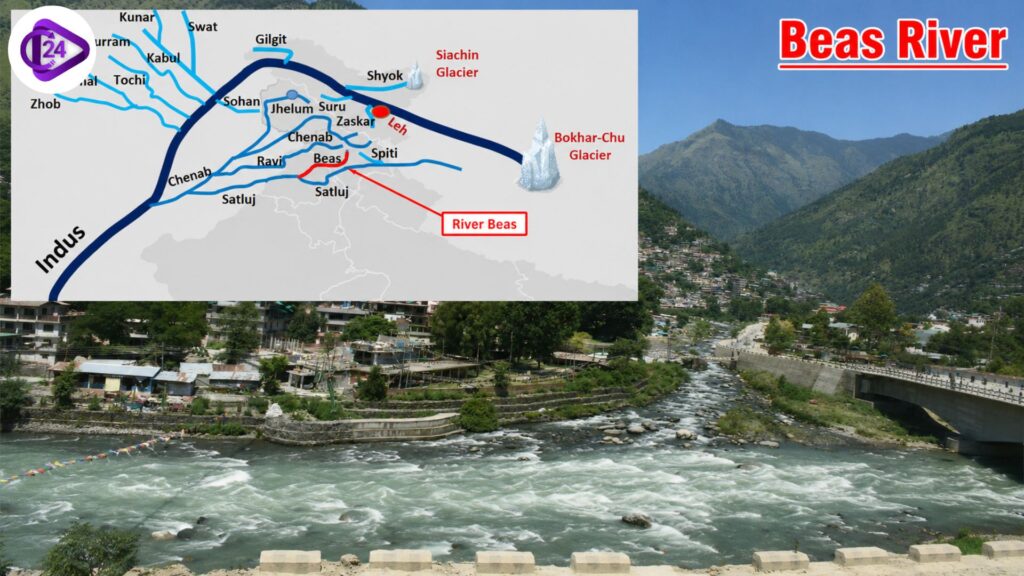
The Beas River is one of the six major rivers of the Indus River System and is the only tributary river of the Indus which flows completely in India. The river’s source is Beas Kund, a glacial lake near Rohtang Pass in the Kullu district of Himachal Pradesh at about 4,361 metres above sea level. It is the Beas that flows for about 470 km through Himachal Pradesh and Punjab to meet the Sutlej River at Harike in Punjab. The river, which is fed by snowmelt and monsoon rainfall, supports irrigation, hydropower generation and water supply through major projects including the Pandoh Dam and non-sustainable Pong Dam.
Beas River Origin & Source
- The Beas River is one of six major rivers of the Indus River System and is the only major Indus tributary to flow wholly within India.
- As per official data from the river basin, the river starts at Beas Kund, at an altitude of around 3,800 meters above sea level.
- Its source begins near the Rohtang Pass in the Western Himalaya’s northern Pir Panjal Range.
- The source of the river is at a height of about 4,361 metres (14,308 ft) above sea level.
- Originating from the snow-fed, perennial Beas, it gets supply from three sources: glacier water, snowmelt and monsoon rainfall.
- It originates in the Kullu Valley after flowing southwards. From this valley, it enters the Punjab plains.
- The Beas flows for around 470 km before it meets the Sutlej River in Harike in Punjab
Major Tributaries of Beas River System
| Tributary | Bank of Confluence | Origin | State/Region | Key Features |
| Parbati River | Right Bank | Parbati Glacier, Himachal Pradesh | Kullu district, Himachal Pradesh | One of the largest tributaries; joins the Beas at Bhuntar and supports major hydropower projects. |
| Uhl River | Left Bank | Dhauladhar Range, Himachal Pradesh | Mandi district, Himachal Pradesh | Important tributary known for the Uhl Hydroelectric Project. |
| Binwa River | Left Bank | Dhauladhar Range, Himachal Pradesh | Kangra district, Himachal Pradesh | Drains the southern slopes of the Dhauladhar Range. |
| Neugal Khad | Left Bank | Dhauladhar Range, Himachal Pradesh | Kangra district, Himachal Pradesh | Seasonal stream contributing monsoon flows to the Beas. |
| Banganga River | Left Bank | Dhauladhar Range, Himachal Pradesh | Kangra district, Himachal Pradesh | Important tributary flowing through the Kangra Valley. |
| Luni River (Himachal Pradesh) | Right Bank | Great Himalayan Range, Himachal Pradesh | Kullu district, Himachal Pradesh | Mountain stream contributing to the upper Beas basin. |
| Manuni Khad | Left Bank | Dhauladhar Range, Himachal Pradesh | Kangra district, Himachal Pradesh | Seasonal tributary supporting local irrigation. |
| Gaj Khad | Left Bank | Dhauladhar Range, Himachal Pradesh | Kangra district, Himachal Pradesh | Joins the Beas in the lower Kangra Valley. |
| Chakki River | Left Bank | Siwalik Hills | Himachal Pradesh and Punjab | Major tributary in the lower Beas basin; contributes significant monsoon runoff. |
Important Dams & Hydropower Projects on Beas River System
| Project/Dam | River/Tributary | Location | Type | Installed Capacity | Key Features |
| Pong Dam (Maharana Pratap Sagar) | Beas River | Kangra district, Himachal Pradesh | Multipurpose dam | 396 MW | One of India’s highest earth-fill dams; provides irrigation, flood control, fisheries, and hydropower generation. |
| Pandoh Dam | Beas River | Mandi district, Himachal Pradesh | Diversion dam | 990 MW* | Diverts Beas waters to the Sutlej River through the Beas–Sutlej Link Project for power generation. |
| Dehar Power House | Beas–Sutlej Link | Mandi district, Himachal Pradesh | Hydropower project | 990 MW | Utilises water diverted from the Beas to generate electricity under the Beas Project. |
| Larji Hydroelectric Project | Beas River | Kullu district, Himachal Pradesh | Run-of-the-river project | 126 MW | Generates power using the flow of the upper Beas River. |
| Parbati-II Hydroelectric Project | Parbati River | Kullu district, Himachal Pradesh | Run-of-the-river project | 800 MW | Major NHPC project on the largest tributary of the Beas. |
| Uhl Stage-III Hydroelectric Project | Uhl River | Mandi district, Himachal Pradesh | Hydropower project | 100 MW | Important project on the Uhl, a major tributary of the Beas. |
| Binwa Hydroelectric Project | Binwa River | Kangra district, Himachal Pradesh | Small hydropower project | 6 MW | Utilises the waters of the Binwa tributary for local power generation. |
Also Read
| Yamuna River System | Son River |
| Ganga River System | Jhelum River System |
| Indus River System | Godavari River System |
| Brahmaputra River System | Indian River Systems |
Importance of the Beas River
- The river is one of the five major eastern tributaries of the Indus River System and flows entirely in India.
- It supplies irrigation water for agricultural land in Himachal Pradesh, Punjab, Haryana and Rajasthan through the Beas–Sutlej link system.
- These include extensive hydropower projects like the Pong Dam, Pandoh Dam and Dehar Power House.
- The waters of the Beas are given to India under the Indus Waters Treaty.
- It serves the purpose of flood control, drinking water supply and groundwater recharge.
- It supports fisheries, wetlands and biodiversity, including the Maharana Pratap Sagar wetland ecosystem.
- The Beas River is crucial for regional economic development, tourism and energy security throughout northern India.
FAQs on the Beas River
The Beas River originates from Beas Kund, a glacial lake near Rohtang Pass in the Kullu district of Himachal Pradesh, at an elevation of about 4,361 metres above sea level.
The Beas River has a total length of approximately 470 km, flowing entirely within India.
The Beas River flows through the states of Himachal Pradesh and Punjab before merging with the Sutlej River.
Major tributaries of the Beas River include the Parbati, Uhl, Binwa, Banganga, Neugal, Gaj, Manuni, and Chakki rivers.
Key projects on the Beas River system include the Pong Dam (Maharana Pratap Sagar), Pandoh Dam, Dehar Power House, Larji Hydroelectric Project, and Parbati Hydroelectric Projects.