

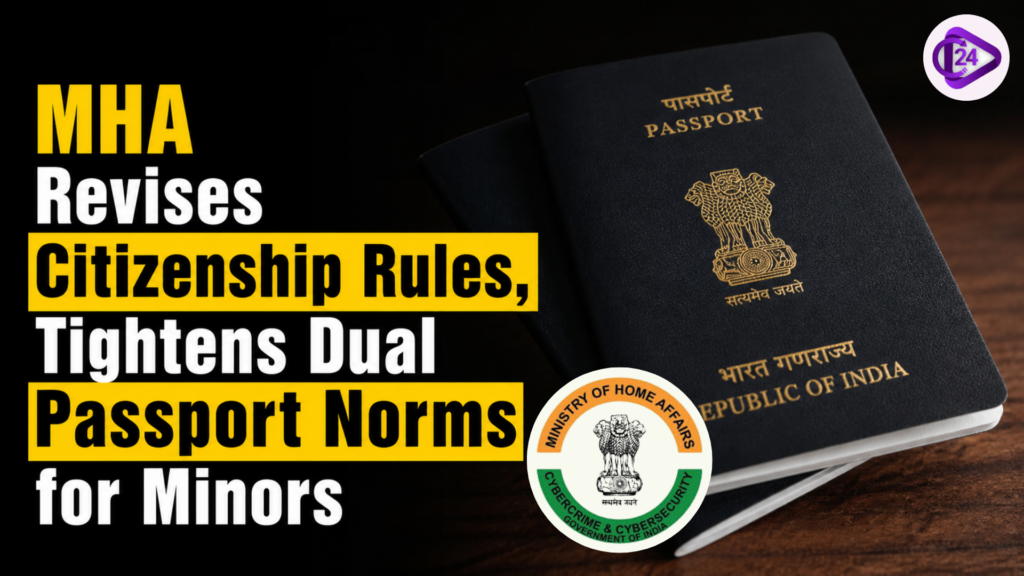
The Citizenship (Amendment) Rules, 2026, announcing the introduction of significant changes in the procedures and compliance with the Citizenship Rules, 2009, have been announced by the Ministry of Home Affairs (MHA). The update consolidates the norms on minor children by declaring that a child with an Indian passport cannot have a passport of a different country. The regulations also increase digital initiatives, such as online registration, renunciation, and electronic records, for Overseas Citizen of India (OCI) candidates. The reforms will enhance transparency, process simplification, and enhancement in adherence to the citizenship framework in India.
What Changed in India’s New Citizenship Rules for Minors in 2026
- These amendments revise the Citizenship Rules, 2009.
- One of the changes is the citizenship-related regulations of minor children.
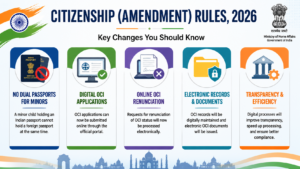
- The revised rule is that a minor child may not be in possession of a foreign passport in combination with an Indian passport.
- This is a strong provision that reinforces the status quo of India on dual citizenship.
- There is no legal provision for full dual citizenship in India.
- The new phrasing makes families overseas have more explicit compliance requirements.
- It might also have a special impact on children of Indian parents who were born overseas.
- New rules have to be followed by parents registering the birth of a child abroad.
- The previous rules dealt with statements upon registration.
- The recent amendment clearly prohibits having two passports at the same time.
- The regulations, as well as modernise Overseas Citizen of India (OCI) services.
- The decision to process OCI applications into the official portal will now be done electronically.
- Submission online intends to decrease paperwork and delays.
- The OCI renunciation requests will also be transferred to the electronic mode.
- The OCI records will be electronically held by the government.
- Electronic OCI documentation has been implemented, too.
- The reforms aim at increased administrative efficiency.
- Tracking and transparency can be enhanced with standardised online systems.
- Digital workflows will allow the applicants to be processed faster.
- The alterations apply to NRIs and OCI cardholders, as well as Indian families overseas.
- Being OCI is not equivalent to full Indian citizenship.
- OCI holders are entitled to lifelong visa privileges in the form of multiple entries, as well as being allowed access to some rights.
- This amendment does not affect the basic citizenship legislation on dual nationality in India.
- It primarily elucidates operations and reinforces enforcement standards.
- Official instructions of the MHA and OCI portals should also be considered by the affected families.
Important PYQs on Citizenship in India
| Exam / Year | Question | Options | Correct Answer |
| UPSC Prelims 2019 | Citizenship provisions in the Constitution of India are mentioned in which Part? | A) Part I B) Part II C) Part III D) Part IV | B) Part II |
| SSC CGL 2020 | Articles related to Citizenship in Indian Constitution are? | A) Article 1-4 B) Article 5-11 C) Article 12-18 D) Article 19-22 | B) Article 5-11 |
| UPSC CDS 2018 | Which Article deals with citizenship at the commencement of the Constitution? | A) Article 5 B) Article 6 C) Article 7 D) Article 11 | A) Article 5 |
| State PSC 2021 | Which Article deals with rights of citizenship of migrants from Pakistan to India? | A) Article 6 B) Article 7 C) Article 8 D) Article 9 | A) Article 6 |
| SSC GD 2022 | Which Article deals with migrants to Pakistan returning to India? | A) Article 6 B) Article 7 C) Article 8 D) Article 10 | B) Article 7 |
| Railway 2020 | Which Article deals with persons of Indian origin residing outside India? | A) Article 8 B) Article 9 C) Article 10 D) Article 11 | A) Article 8 |
| SSC CHSL 2021 | Which Article states that no person shall be citizen if he voluntarily acquires foreign citizenship? | A) Article 8 B) Article 9 C) Article 10 D) Article 11 | B) Article 9 |
| Bihar PCS 2017 | Which Article deals with continuance of citizenship rights? | A) Article 10 B) Article 11 C) Article 5 D) Article 7 | A) Article 10 |
| UPSC Prelims 2020 | Which Article empowers Parliament to regulate citizenship by law? | A) Article 11 B) Article 12 C) Article 13 D) Article 14 | A) Article 11 |
| SSC CPO 2019 | Citizenship Act in India was enacted in which year? | A) 1949 B) 1950 C) 1955 D) 1956 | C) 1955 |
| UPSC CAPF 2021 | Indian citizenship can be acquired by how many methods under Citizenship Act 1955? | A) 3 B) 4 C) 5 D) 6 | C) 5 |
| SSC MTS 2022 | Which of the following is NOT a method of acquiring citizenship? | A) Birth B) Descent C) Naturalisation D) Voting | D) Voting |
| UPSC Prelims 2016 | Citizenship by birth rules were significantly changed by which amendment? | A) 1986 Amendment B) 42nd Amendment C) 44th Amendment D) 52nd Amendment | A) 1986 Amendment |
| SSC CGL 2023 | Which amendment introduced the concept of illegal migrant in citizenship provisions? | A) 1992 B) 2003 C) 2015 D) 2019 | B) 2003 |
| UPSC 2022 | OCI (Overseas Citizen of India) provisions were introduced through which amendment? | A) 1986 B) 1992 C) 2005 C) 2019 | C) 2005 |
| State PSC 2022 | PIO and OCI schemes were merged through which amendment? | A) 2015 B) 2003 C) 2019 D) 1986 | A) 2015 |
| SSC GD 2024 | Citizenship Amendment Act (CAA) was passed in which year? | A) 2014 B) 2017 C) 2019 D) 2020 | C) 2019 |
| UPSC 2018 | India follows which type of citizenship system? | A) Dual Citizenship B) Single Citizenship C) State Citizenship D) Temporary Citizenship | B) Single Citizenship |
| Railway Group D 2021 | Which of the following is a way to lose Indian citizenship? | A) Renunciation B) Termination C) Deprivation D) All of these | D) All of these |
| SSC CHSL 2023 | A foreigner can acquire Indian citizenship mainly through long residence under which method? | A) Descent B) Registration C) Naturalisation D) Birth | C) Naturalisation |
Delhi–Dehradun Expressway Opened by PM Modi
Conclusion – MHA Issues New Citizenship Rules
The new citizenship regulations of MHA are to enhance compliance, enhance transparency and modernise the administrative procedures. The government has made the OCI application process more straightforward and efficient by imposing stricter requirements on issuing dual passports to minors and providing more digital services to individuals applying. Such revisions have high significance to Indian-origin families residing in foreign countries. The revised model is an indication of the emphasis on safe documentation, smooth services, and improved governance by retaining the current citizenship regulations and national policies.