

Daily Quizzes
Mock Tests
No tests attempted yet.
Select Category
RRB Normalization Method & Formula 2026: Easy Percentile Rule, Score Calculation & Merit Guide


Enquire Now
RRB Normalization Method and Formula 2026 is a great feature that all railway exam aspirer would need to clearlyunderstand before appearing in the Computer-Based Test (CBT). As the Railway Recruitment Board (RRB) examinations are conducted in multiple shifts with different question papers, normalization ensures that no candidate is at a disadvantage due to variation in difficulty level.
RRB Normalization Method and Formula 2026 helps create a fair scoring system by adjusting marks based on the performance of candidates across all shifts. This process enhances transparency and gives every candidate an equal opportunity to qualify for the next stage of recruitment. It also makes sure that candidates who deserve to get rewarded based on their true performance rather than exam shift difficulty.
RRB Normalization Formula & Method 2026 – Overview
The normalization process applies in cases where an exam is held in Multiple exam shifts. There are difficult questions that may be slightly tougher in some of the shifts and easier in others. To balance this difference, RRB applies a statistical formula that converts raw marks into normalized marks.
| Particular | Details |
|---|---|
| Exam Authority | Railway Recruitment Board (RRB) |
| Exam Mode | Computer-Based Test (CBT) |
| Reason for Normalization | Multiple exam shifts |
| Purpose | Ensure fairness in scoring |
| Marks Considered | Raw Marks & Normalized Marks |
| Impact | Final merit list is based on normalized marks |
Normalization Method and Formula PDF
The normalisation, percentile, minimum qualifying marks, and tie-breaking policy have been explained and released through an official PDF. Applicants should download the official PDF and check all details carefully to avoid confusion during the result stage.
RRB Normalization Method and Formula Released For All RRB Exams – Download PDF
What is Normalization in RRB Exams?
Normalization is a statistical process used to adjust candidate scores when the exam is held in multiple shifts. It removes the advantage or disadvantage caused by different difficulty levels.
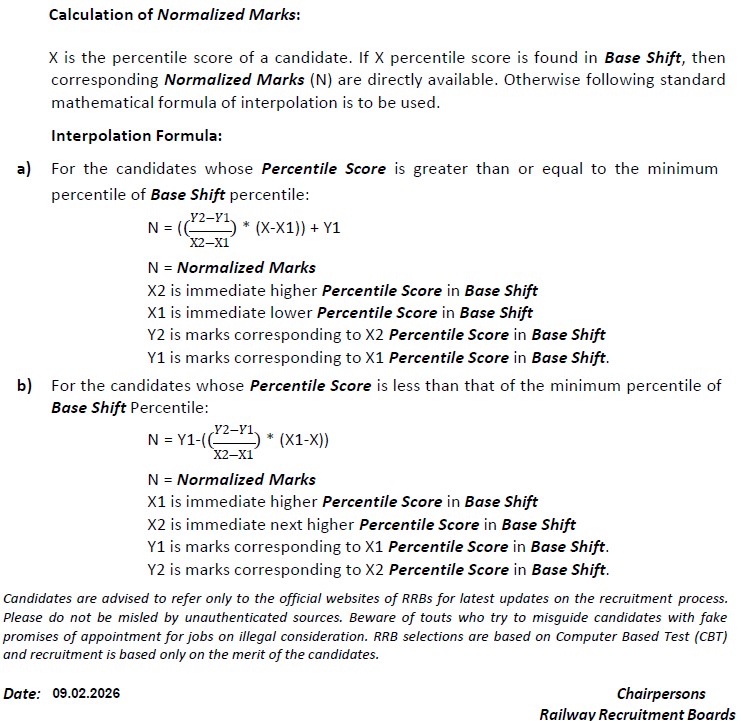
For example, if Shift 1 is harder than Shift 2, candidates in Shift 1 may score lower even though their performance is strong. Normalization increases their marks slightly to balance the evaluation.
Key Points to Remember:
- Normalization does NOT reduce marks unfairly.
- It balances difficulty differences.
- It is calculated using a standard mathematical formula.
- Final results always use normalized scores.
What is a Percentile Score?
Percentile scores reflect the relative performance of candidates in a particular shift. The percentile score serves as the RRB Score (RRC Score for Level-1 exam) and is used for merit preparation.

Key Points About Percentile:
- Marks are converted into a scale ranging from 0 to 100.
- The topper of each shift receives a percentile score of 100.
- The percentile score is not the same as the percentage of marks.
Percentile Formula
Percentile Score = (Number of candidates who appeared in the shift with raw score equal to or less than the candidate ÷ Total number of candidates who appeared in the shift) × 100
Detailed Step-by-Step Normalization Process
The normalization, percentile, minimum qualifying marks, and tie-breaking policy have been explained and released through the official RRB Normalization Method and Formula PDF. Candidates should understand each step to clearly know how the RRB normalization process works.
| Step | Process | Description | Key Outcome |
|---|---|---|---|
| Step 1 | Calculation of Raw Marks | The candidate’s raw score is calculated using total correct answers and negative marking. Raw Marks = (Number of Correct Answers × Marks per Question) – Negative Marks. | Provides the initial score before normalization begins. |
| Step 2 | Determining Shift-wise Statistics | RRB calculates statistical values for each shift including: Mean (Average) marks, Standard Deviation (SD), and total number of candidates. A lower mean indicates a tougher shift, while a higher mean suggests an easier shift. | Helps measure exam difficulty across shifts. |
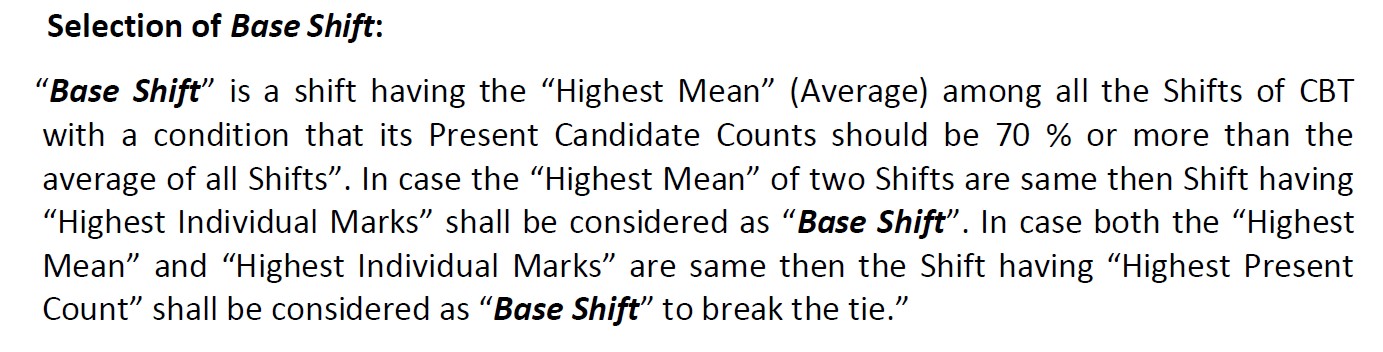
| Step 3 | Identifying the Base Shift | RRB selects a base shift for normalization, usually the shift with the highest mean marks, assuming it to be relatively easier. All other shifts are then adjusted in comparison to this base shift to maintain fairness. | Establishes a benchmark for fair comparison. |
| Step 4 | Applying the RRB Normalization Formula | A statistical formula is used to convert raw marks into normalized marks so that candidates from tougher and easier shifts are evaluated on a common scale. | Ensures fairness in scoring. |
| Step 5 | Rounding Off Normalized Marks | Normalized marks are rounded off up to two decimal places and treated as final for merit preparation and cut-off decisions. | Produces standardized final scores. |
| Step 6 | Preparation of Merit List | Candidates are ranked based on normalized marks (not raw marks). Category-wise cut-offs are prepared, and tie-breaking rules such as age preference or alphabetical order are applied if needed. | Final selection is based on normalized performance. |
How Normalization Works – Simple Example
Let us understand this with an easy example.
Suppose:
- Average marks of Shift 1 = 55
- Average marks of Shift 2 = 65
- Shift 1 was tougher
A candidate scoring 60 in Shift 1 actually performed better than someone scoring 60 in Shift 2.
After normalization:
- Shift 1 candidate marks may increase to around 64–66.
- Shift 2 candidate marks may remain similar.
Factors That Affect RRB Normalization
Several statistical elements influence normalized scores. Understanding these helps reduce unnecessary stress.
Major Factors Include:
- Difficulty level of the question paper
- Average performance of candidates
- Highest marks in the shift
- Distribution of scores
- Number of candidates
Note: Your performance compared to others in your shift matters more than the absolute paper difficulty.
Advantages
- Creates equal opportunity
- Reduces luck factor
- Rewards true performance
- Makes merit list more reliable
Does Every RRB Exam Use Normalization?
Most large-scale RRB exams apply normalization when multiple shifts are conducted. If the exam happens in a single shift, normalization is usually not required.
Examples of Exams Where Normalization is Used:
- RRB NTPC (Non-Technical Popular Categories)
- RRB Group D
- RRB ALP (Assistant Loco Pilot)
- RRB JE (Junior Engineer)
Raw Marks vs Normalized Marks
Many candidates get confused between these two terms. Understanding the difference is very important.
| Feature | Raw Marks | Normalized Marks |
|---|---|---|
| Definition | Actual score | Adjusted score |
| Calculated By | Direct evaluation | Statistical formula |
| Difficulty Considered | No | Yes |
| Used for Merit | No | Yes |
Always remember: Your selection depends on normalized marks, not raw marks.
Expert Tips about Normalization Method
Instead of worrying about formulas, concentrate on maximising your performance.
Smart Preparation Tips:
- Aim for high accuracy rather than blind attempts.
- Avoid excessive guessing due to negative marking.
- Practice mock tests regularly.
- Improve time management.
- Strengthen weak subjects early.
Common Mistakes in Normalization Method & Formula
Many aspirants misunderstand normalization and panic after the exam.
Avoid These Errors:
- Comparing raw marks with other shifts
- Believing rumours about huge mark reductions
- Ignoring accuracy
- Depending only on attempts
Important Link
Conclusion
RRB Normalization Method Rule & Formula 2026 is important in creating equity in the railway recruitment exams. Exams are conducted in various shifts, and normalization will ensure that they are not affected by paper difficulty and create equal competition. The best strategy is simple — prepare well, attempt questions with accuracy, and aim to score above average. When your fundamentals are strong, normalization will naturally support your final selection.