
Daily Quizzes
Mock Tests
No tests attempted yet.
Select Category
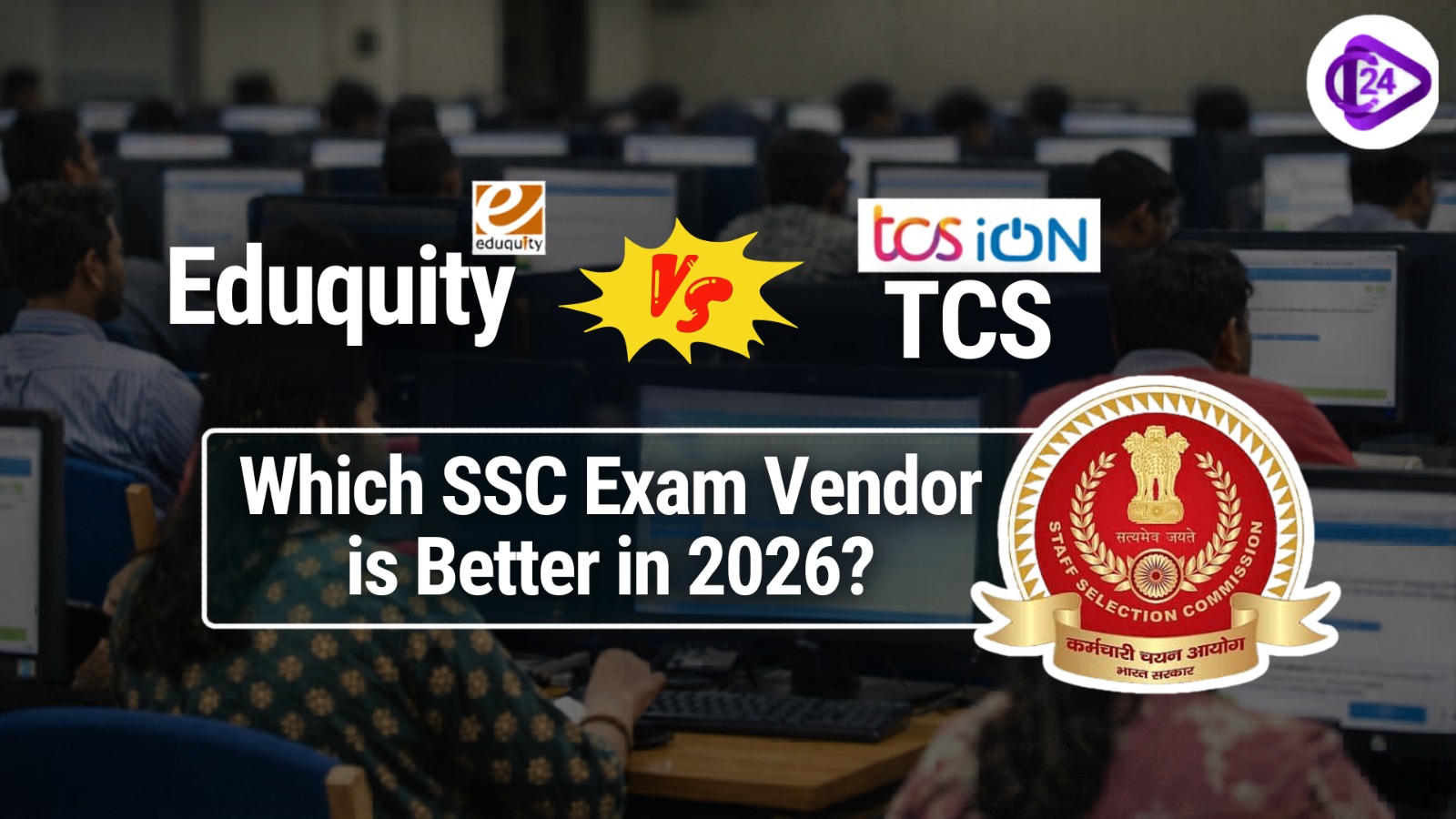
Eduquity vs TCS: Which SSC Exam Vendor is Better in 2026?
Enquire Now
Eduquity vs TCS, which SSC exam vendor is better, is one of the most commonly searched queries by candidates of government jobs in the year 2026. As the number of lakhs of candidates coming forward to take the SSC exams has grown over the years, the role of the exam conducting agency has become highly significant.
The Staff Selection Commission (SSC) holds such major exams as SSC CGL, CHSL, MTS, GD, JE, and so on. SSC is the recruiting authority, but the real Computer-Based Test (CBT) is administered to the candidates with the help of an outsourced exam vendor. SSC exams have been identified with two big names in recent years:
- Tata Consultancy Services (TCS)
- Eduquity Career Technologies (Eduquity)
SSC Exam Vendor 2026: Why It Matters?
The SSC exam provider is very important in running Computer-Based Tests without any complications. The vendor has direct influence on the experience of the candidates, whether it is server stability and exam center management, biometric verification of candidates and their answers, or the key processing. Minor technical snags can have an impact in competitive exams such as SSC CGL and CHSL 2026 and the reliability of vendors is of paramount importance in terms of fairness and transparency.
The vendor is responsible for:
- Conducting Computer-Based Tests (CBT)
- Managing exam centers
- Server and technical support
- Authentication and biometric checking.
- Response sheet and answer key management
Any technical glitch, server issue, or mismanagement directly affects candidates.
Who Will be the SSC Vendor for 2026?
As of now, the Staff Selection Commission (SSC) has not officially announced the exam conducting vendor for 2026. In previous years, companies like TCS and Eduquity have managed SSC exams, including SSC CGL, CHSL, and GD. The final decision will depend on the tender process and government approval. Aspirants should regularly check the official SSC website for updates.
TCS in SSC Exams: Track Record & Experience
For many years, Tata Consultancy Services handled SSC exams through its iON platform.
Strengths of TCS
- Strong IT Infrastructure – TCS is one of India’s largest IT companies with global experience.
- Stable Server Performance – Earlier SSC CGL and CHSL exams were conducted smoothly in most phases.
- Professional Exam Centers – Standardized CBT environment.
- Better Security Measures – Advanced biometric and digital monitoring systems.
Common Complaints Against TCS
- Slow login issues during peak hours
- Question paper translation errors (especially Hindi)
- Delays in result declaration in some cycles
Despite issues, many aspirants believe the TCS system was more stable overall.
Eduquity in SSC Exams: New Era or New Challenges?
Eduquity’s entry into SSC exams marks a significant shift in the examination process. While it promises improved technology, smoother online conduct, and better candidate support, initial transitions may bring technical glitches or coordination challenges. For aspirants, adaptation is key. Whether it becomes a new era of efficiency or faces operational hurdles will depend on execution and stability.
Strengths of Eduquity
- Faster Result Processing – Some exams saw quicker answer key releases.
- Improved Interface – Cleaner and more user-friendly CBT design.
- Better Hindi Font Support – Reduced language rendering issues.
- Cost-Effective Model – May help SSC conduct exams faster and more frequently.
Challenges Faced by Candidates
- Server lag in some centers
- Technical glitches during exam shifts
- Inconsistent center management quality
- Complaints about response sheet discrepancies
In 2026, discussions on social media suggest that while Eduquity is improving, consistency remains a concern.
Eduquity vs TCS: Direct Comparison (2026 Analysis)
| Feature | TCS | Eduquity |
|---|---|---|
| Experience | Very High | Moderate |
| Infrastructure | Strong & Established | Developing |
| Server Stability | Generally Stable | Mixed Feedback |
| Result Speed | Moderate | Faster in Some Exams |
| Candidate Trust | Higher | Improving |
| Technical Glitches | Fewer | Reported More Often |
SSC CGL, CHSL, GD 2026: Vendor Impact on Aspirants
For exams like:
- SSC CGL 2026
- SSC CHSL 2026
- SSC GD 2026
- SSC MTS 2026
The vendor plays a critical role in:
- Shift normalization accuracy
- Question paper quality
- System stability
- Transparency in answer key
In competitive exams where one mark can change ranks, system reliability becomes crucial.
Which SSC Exam Vendor is Better in 2026?
Choosing the better SSC exam vendor in 2026 depends on performance, technical stability, and candidate experience. TCS has a long track record of conducting large-scale exams smoothly, while Eduquity represents a newer, tech-driven approach. The better vendor will be the one ensuring fewer technical glitches, transparent processes, and seamless exam management for SSC aspirants.
Based on 2026 Trends:
- TCS appears stronger in infrastructure and long-term reliability.
- Eduquity appears faster in result processing but faces mixed reviews on technical consistency.
What is the New SSC Exam Pattern After Vendor Change?
After the vendor change, the SSC exam pattern remains largely the same in terms of syllabus, sections, and marking scheme. However, candidates may notice differences in interface design, navigation features, and system responsiveness during the Computer-Based Test (CBT). The update focuses on smoother technology integration, clearer instructions, and improved exam experience without altering core pattern elements.
Common Mistakes to Avoid About SSC Vendor Change
Common mistakes include assuming the SSC syllabus or pattern will completely change after a vendor switch. Many candidates believe rumors without checking official notifications. Ignoring mock tests on the new interface is another error. Staying updated through SSC notices and practicing regularly helps avoid confusion and unnecessary panic.
| Common Mistake | Why to Avoid It |
|---|---|
| Believing syllabus will change | Pattern usually remains same |
| Trusting social media rumors | Causes confusion and panic |
| Skipping mock tests | Reduces familiarity with interface |
| Ignoring official SSC notices | Leads to misinformation |
Key Allegations Against Vendors (TCS/Eduquity)
Key allegations against SSC vendors like TCS and Eduquity include technical glitches during exams, slow server performance, and login issues. Candidates also report question paper errors, inconsistent centre management, and delayed results. Language display problems and response sheet discrepancies have been cited. While both vendors aim for smooth conduct, these concerns highlight the need for better testing systems and transparency.
Important Links
| SSC Online Batch 2026 | Complete Current Affairs 2025-26 |
| SSC CPO SI Test Series 2026 | Science Advance Batch |
| SSC CGL Test Series 2026 | SSC CHSL Test Series 2026 |
Conclusion
concerns raised against SSC exam vendors such as TCS and Eduquity mainly revolve around technical efficiency, transparency, and exam-day management. While both vendors have experience in large-scale computer-based testing, addressing glitches, server stability, and candidate grievances remains crucial. Ultimately, consistent system upgrades, strict monitoring, and accountability are essential to ensure fair, smooth, and credible SSC examinations in 2026 and beyond.