

Daily Quizzes
Mock Tests
No tests attempted yet.
Select Category
National Mathematics Day: History, Significance & Facts

Enquire Now
National Mathematics Day: History, Significance, Srinivasa Ramanujan and Celebrations
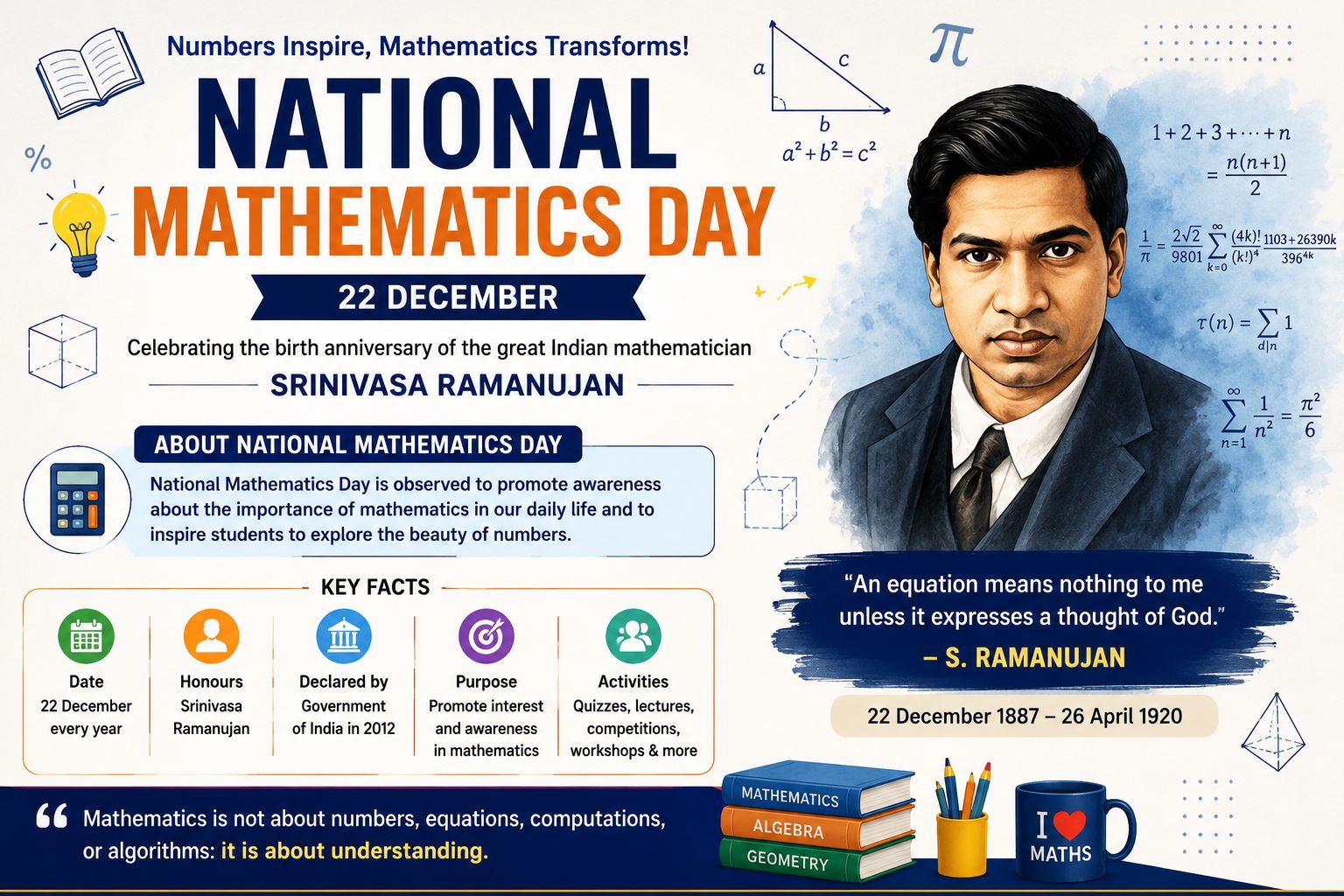
National Mathematics Day is celebrated every year in India on 22 December to honour the birth anniversary of legendary Indian mathematician Srinivasa Ramanujan. The day highlights the importance of mathematics in education, science, technology and everyday life.
The Government of India declared 22 December as National Mathematics Day in 2012. Since then, schools, colleges and educational institutions have marked the occasion through mathematics quizzes, exhibitions, competitions, workshops and other learning activities.
National Mathematics Day Overview
Before learning about its history and celebrations, students can check the key facts about National Mathematics Day, including its date, purpose and connection with Srinivasa Ramanujan.
| Particular | Details |
|---|---|
| Event | National Mathematics Day |
| Celebrated On | 22 December every year |
| Country | India |
| Dedicated To | Srinivasa Ramanujan |
| Ramanujan's Birth Date | 22 December 1887 |
| Birthplace | Erode, Tamil Nadu |
| First Announced | 2012 |
| Announced By | Government of India |
| Main Purpose | Promote awareness and interest in mathematics |
| Common Activities | Quizzes, competitions, workshops, exhibitions and lectures |
Why Is National Mathematics Day Celebrated?
National Mathematics Day is observed to recognise Srinivasa Ramanujan's remarkable contribution to mathematics and encourage students to understand the practical importance of the subject.
Mathematics is much more than calculations performed in a classroom. It plays an important role in engineering, economics, banking, computer science, statistics, medicine, astronomy and numerous other fields.
The day encourages students to look beyond formulas and explore how mathematical thinking can improve reasoning and problem-solving abilities.
Some important objectives of the celebration include:
- Creating interest in mathematics among students.
- Remembering Srinivasa Ramanujan and his mathematical work.
- Encouraging logical and analytical thinking.
- Making mathematics interesting through practical activities.
- Promoting mathematical research and learning.
- Helping students overcome unnecessary fear of mathematics.
History of National Mathematics Day in India
The history of National Mathematics Day is closely connected with Srinivasa Ramanujan. His extraordinary mathematical abilities earned recognition in India and internationally despite his relatively short life.
In 2012, the Government of India declared 22 December as National Mathematics Day to mark the 125th birth anniversary of Ramanujan. The year 2012 was also observed as the National Mathematics Year.
Choosing Ramanujan's birthday for this observance gives students an opportunity to learn about his life, achievements and contribution to mathematics.
Who Was Srinivasa Ramanujan?
Srinivasa Ramanujan was an Indian mathematician known for his extraordinary ability to discover mathematical relationships and formulas, often while working independently with limited formal resources.
Born on 22 December 1887 in Erode, Tamil Nadu, Ramanujan developed a strong interest in mathematics from an early age. His fascination with the subject became so intense that mathematics dominated much of his academic life.
His work eventually attracted the attention of British mathematician G. H. Hardy at the University of Cambridge. Their association became one of the best-known chapters in the history of modern mathematics.
Ramanujan worked in areas such as:
- Number theory
- Infinite series
- Continued fractions
- Mathematical analysis
- Partition functions
- Mathematical identities
Despite his short life—Ramanujan died in 1920 at the age of 32—his work continued to influence mathematical research long afterwards.
Srinivasa Ramanujan: Important Facts
The following table provides useful facts about Srinivasa Ramanujan that students can revise for school quizzes, general knowledge and competitive examination preparation.
| Fact | Details |
|---|---|
| Full Name | Srinivasa Ramanujan |
| Date of Birth | 22 December 1887 |
| Birthplace | Erode, Tamil Nadu |
| Nationality | Indian |
| Field | Mathematics |
| Major Interest | Number Theory |
| Associated Mathematician | G. H. Hardy |
| Institution | University of Cambridge |
| Fellow of the Royal Society | 1918 |
| Date of Death | 26 April 1920 |
| Age at Death | 32 years |
Major Contributions of Srinivasa Ramanujan to Mathematics
Ramanujan's achievements were remarkable because he developed many mathematical results independently. Several areas of his work later became important subjects of advanced mathematical research.
Number Theory
Number theory studies properties and relationships involving integers. Ramanujan made significant contributions to this field and discovered numerous identities and mathematical relationships.
Partition Function
Ramanujan worked extensively on integer partitions. A partition describes the different ways a positive integer can be expressed as a sum of positive integers.
His work with G. H. Hardy led to important results concerning the partition function.
Infinite Series
Ramanujan discovered several remarkable infinite series and formulas. Some of his results involving π later became important because of their rapid convergence.
Continued Fractions
He also produced important results involving continued fractions. Many of these formulas demonstrated his unusual ability to identify complex mathematical patterns.
Ramanujan Numbers
One of the most famous stories connected with Ramanujan involves the number 1729.
G. H. Hardy reportedly mentioned that the taxi number 1729 seemed uninteresting. Ramanujan immediately recognised its special mathematical property.
1729 is the smallest positive integer that can be expressed as the sum of two positive cubes in two different ways:
1729 = 1³ + 12³
1729 = 9³ + 10³
For this reason, 1729 is popularly known as the Hardy-Ramanujan number.
Importance of National Mathematics Day for Students
National Mathematics Day gives students an opportunity to experience mathematics beyond textbooks. Activities can demonstrate how mathematical concepts appear in ordinary situations and different careers.
Students use mathematical thinking more often than they may realise. Managing money, calculating discounts, measuring distances, reading graphs and comparing data all require some form of mathematics.
The occasion can help students:
- Improve problem-solving abilities.
- Develop logical thinking.
- Explore mathematical puzzles and patterns.
- Learn about famous mathematicians.
- Understand real-life applications of mathematics.
- Build confidence in solving numerical problems.
How Is National Mathematics Day Celebrated?
Schools, colleges, universities and other educational institutions organise different activities on National Mathematics Day to make mathematics more engaging and accessible for students.
Common activities include:
- Mathematics quiz competitions
- Mental maths challenges
- Mathematical model exhibitions
- Puzzle-solving contests
- Poster-making competitions
- Mathematics Olympiad activities
- Lectures on Srinivasa Ramanujan
- Workshops and seminars
- Number games
- Student presentations
- Mathematics-based debates
Teachers can also use practical examples involving shopping, sports statistics, architecture, technology and personal finance to show how mathematics works outside the classroom.
Why Mathematics Matters in Everyday Life
Mathematics is present in many routine activities, even when people are not consciously solving textbook problems. Understanding basic mathematics can support better everyday decision-making.
| Daily Activity | Use of Mathematics |
|---|---|
| Shopping | Calculating prices, discounts and savings |
| Banking | Interest, deposits and transactions |
| Cooking | Measurements, ratios and quantities |
| Travelling | Distance, speed, time and fuel |
| Construction | Area, volume, angles and measurements |
| Technology | Algorithms, coding and data |
| Sports | Scores, averages and statistics |
| Business | Profit, loss, tax and budgeting |
These examples demonstrate why mathematical skills remain valuable even for students who do not plan to pursue mathematics as their main academic subject.
National Mathematics Day and Competitive Exams
National Mathematics Day is also useful from a General Awareness and GK perspective. Questions related to the date, Srinivasa Ramanujan and the Hardy-Ramanujan number can appear in competitive examinations.
Students should remember these quick facts:
- National Mathematics Day – 22 December
- Celebrated in – India
- Birth anniversary of – Srinivasa Ramanujan
- Ramanujan was born in – 1887
- Famous Hardy-Ramanujan number – 1729
- National Mathematics Day was declared – 2012
- Ramanujan became a Fellow of the Royal Society – 1918
These facts can be particularly useful while preparing static GK and important-days sections.
How Students Can Improve Their Mathematics Skills
Improving mathematics does not necessarily require solving difficult questions for several hours every day. Regular practice and understanding mistakes usually produce better results.
Students can begin by strengthening basic concepts before attempting advanced questions. Instead of memorising every formula without context, understand when and why it is used.
A simple approach is to:
- Understand the basic concept.
- Study solved examples.
- Solve easy questions independently.
- Move towards moderate and difficult problems.
- Check incorrect answers carefully.
- Maintain a notebook of formulas and mistakes.
- Revise regularly.
Even 30–45 minutes of focused daily practice can be more useful than irregular, lengthy study sessions.
Conclusion
National Mathematics Day is celebrated on 22 December to commemorate the birth anniversary of Srinivasa Ramanujan and recognise the importance of mathematics. His journey remains one of the most remarkable stories in Indian mathematical history.
For students, the day is not simply about remembering a date. It is an opportunity to explore numbers, patterns and problem-solving differently. From managing money to developing modern technology, mathematics continues to play an important role in everyday life and scientific progress.
Frequently Asked Questions