
World Hindi Day, or Vishwa Hindi Diwas, is annually held on 10 January to recognize the significance and dissemination of the Hindi language worldwide. This is the day that the first World Hindi Conference was held on 10 January 1975 in Nagpur, where Hindi scholars and enthusiasts throughout the world joined in order to spread the language to other countries. In 200,6 the Government of India officially started celebrating this day in order to identify and promote the use of Hindi in the world, to appreciate its cultural diversity, and to make its presence more prominent on the global platform with activities such as speeches, cultural shows, and discussions.
Significance of World Hindi Day 2026
-
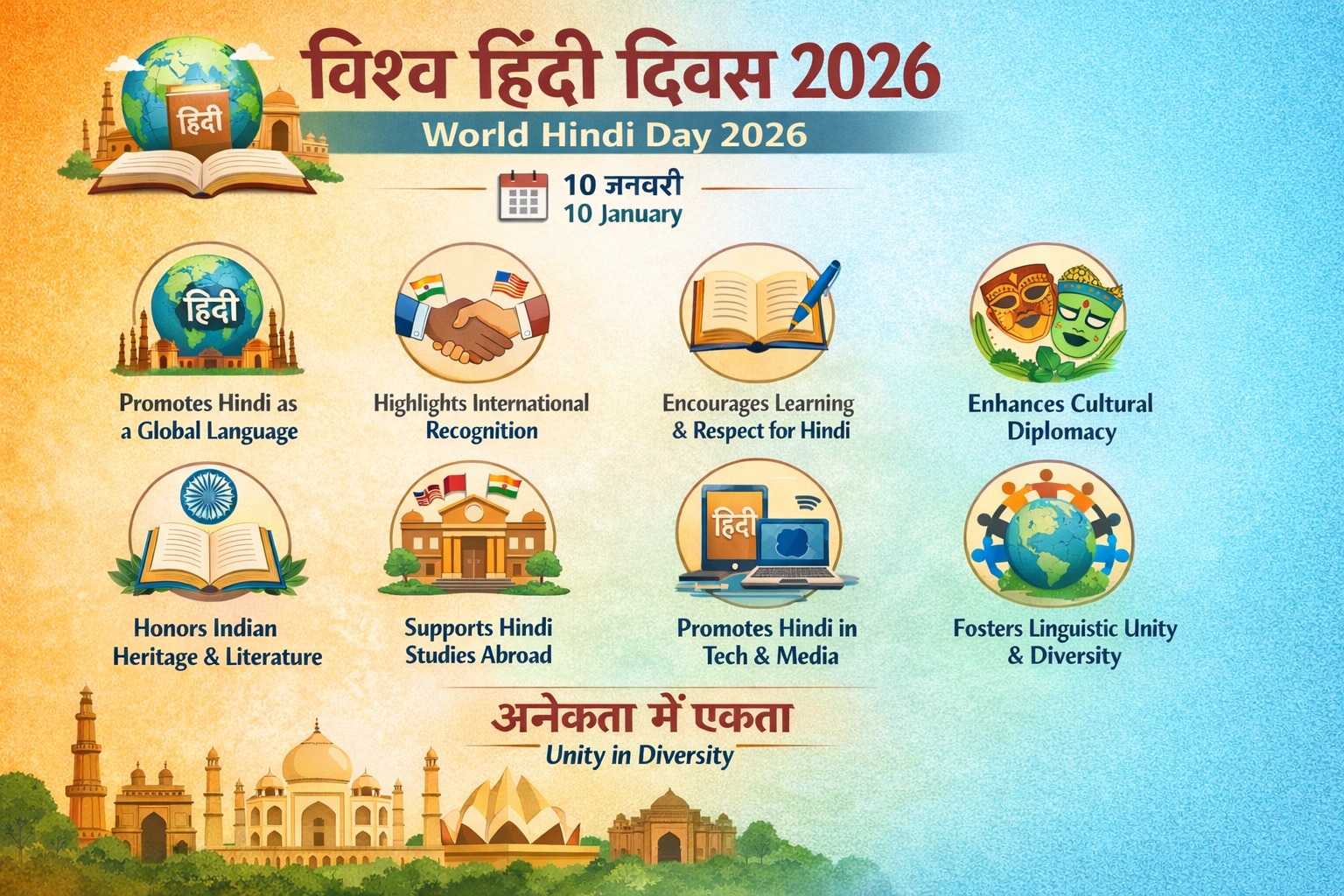
Advocates the Hindi language as an international one, not just in India.
-
Point out the foreign recognition and level of acceptance of Hindi in other nations.
-
Promotes the use, learning, and respect of Hindi all over the world.
-
Enhances cultural diplomacy by linking countries together using language.
-
Praises the Indian heritage and literature as well as history.
-
Favors the proliferation of Hindi studies in other universities and institutions abroad.
-
Encourages the Indian diaspora not to forget their language background.
-
Promotes Hindi in technology, media, and on the digital platform.
-
Creates consciousness of the need to have linguistic diversity and unity in the world.
World Hindi Day 2026 Theme
The theme of World Hindi Day 2026 is called Hindi: Traditional Knowledge to Artificial Intelligence, which illustrates the idea of how Hindi made its way to the digital and AI age. Its 2025 theme was Hindi: A Global Voice of Unity and Cultural Pride, and its international cultural relations and cohesion.
Expected Questions for World Hindi Day
When was World Hindi Day officially started by the Government of India?
A) 1995
B) 2000
C) 2006
D) 2010
Answer: C — The Government of India began formally observing it from 2006.
World Hindi Day is observed on 10 January because it marks:
A) Adoption of Hindi as the Official Language
B) First World Hindi Conference inauguration
C) Formation of Central Hindi Directorate
D) Publication of Hindi dictionary
Answer: B
Explanation: 10 January 1975 was the inaugural day of the first World Hindi Conference at Nagpur.
Q. Which institution mainly acts as the nodal agency for World Hindi Day celebrations abroad?
A) Ministry of Education
B) Sahitya Akademi
C) Indian Council for Cultural Relations
D) Ministry of External Affairs
Answer: D
Explanation: Indian embassies and missions under the Ministry of External Affairs coordinate global events.
Q. Which statement best distinguishes World Hindi Day from Hindi Diwas?
A) One is cultural, the other is political
B) One is global, the other is national
C) One is academic, the other is administrative
D) One is literary, the other is religious
Answer: B
Explanation: World Hindi Day promotes Hindi globally; Hindi Diwas focuses on its national status.
Q. Which of the following conferences directly led to the institutionalisation of World Hindi Day?
A) Second World Hindi Conference
B) Fourth World Hindi Conference
C) Seventh World Hindi Conference
D) First World Hindi Conference
Answer: D
Explanation: The first conference in 1975 laid the foundation for global Hindi promotion.
Q. World Hindi Day primarily contributes to India’s:
A) Soft power diplomacy
B) Trade diplomacy
C) Military diplomacy
D) Space diplomacy
Answer: A
Explanation: Language and culture are instruments of soft power.
Conclusion (World Hindi Day 2026)
World Hindi Day 2026 has been embracing the Hindi language as a living and global language that unites cultures, communities, and generations. It emphasises the increasing global aspects of Hindi and its contribution to cultural diplomacy, education, and digital communication, as well as encourages the people of the world to observe, study, and foster linguistic diversity and harmony.