

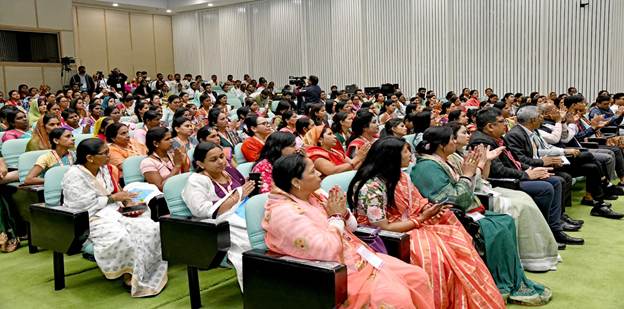
The Ministry of Panchayati Raj organized the National Convention on Model Women-Friendly Gram Panchayats on 5th March 2025 in New Delhi to commemorate International Women’s Day 2025 celebrations. The convention worked towards creating a minimum one Model Women-Friendly Gram Panchayat for each District. The event gathered more than 1500 representatives and officials who took part both in person and online.
Key Announcements:
-
Targets establishment of one Model Gram Panchayat to be allocated in each District.
-
Real-Time Dashboard Launched for Monitoring Women-Friendly Panchayats’ Progress.
-
Women Sarpanchs received a call to lead the execution of Central Government Schemes throughout the nation.
Major Initiatives Unveiled:
-
Virtual Training Programs for Model Women-Friendly Gram Panchayats.
-
A real-time monitoring dashboard tracks the participation and welfare of women through a system for grassroots tracking.
-
A special Mahila Gram Sabha meeting organized across the country will take place on 8th March 2025 to implement fundamental goals of the initiative at local levels.

Digital Initiatives for Panchayati Raj Institutions (PRIs)
Through the RGSA scheme the Ministry of Panchayati Raj executes the MMP-ePanchayat as a Mission Mode project which delivers e-Panchayats for PRIs to boost efficiency and transparency along with digital governance.
Key Digital Initiatives:
-
eGramSwaraj Portal (egramswaraj.gov.in)
-
The system enables decentralized planning as well as progress reporting and financial management and work-based accounting.
-
-
AuditOnline Platform (auditonline.gov.in)
-
Technology provides Panchayat account officials with real-time auditing capabilities which creates a transparent and accountable system.
-
The audit reports generated through online audit operations reached 2.42 lakh reports during the auditing period 2021-22.
-
-
Integration with Public Financial Management System (PFMS)
-
Through the eGramSwaraj-PFMS Interface (eGSPI) Panchayats can make instant payments to their service and vendor providers.
-
Through eGramSwaraj-PFMS Interface (eGSPI) all transactions processed amount to Rs. 1.74 lakh crore.
-
-
Integration with Government e-Marketplace (GeM)
-
Facilitates seamless procurement and financial tracking for Panchayats.
-
Constitutional & Legal Framework for Panchayati Raj
-
Panchayats as State Responsibility
-
State Panchayati Raj Acts govern Panchayats because the Constitution classifies them under the category of local government which belongs to the state level.
-
-
Reservation for Women & Marginalized Communities
-
According to Article 243D of the Indian Constitution all Panchayats must reserve positions for Scheduled Tribes, Scheduled Castes, Backward Classes alongside Women.
-
Twenty-one Indian States along with two Union Territories completely comply with the recommendation to give women 50% representation in the Panchayat system.
-
-
Special Provisions for Scheduled Areas
-
Through Panchayats (Extension to the Scheduled Areas) Act, 1996 Gram Sabhas receive authorities to defend both tribal culture alongside tribal subsistence.
-
-
Women Empowerment Through Advisory Support
-
The Ministry creates advisory documents that promote increased female attendance at Ward Sabha, Mahila Sabha, and Gram Sabha meetings.
-
The policy promotes women to become active participants during program planning and the implementation of schemes.
-
Key Challenges Identified
-
Lack of Political Experience
-
The beginner-level political knowledge of newly voted female officials creates obstacles for them to perform their duties efficiently.
-
-
Gender-Based Discrimination
-
Meetings allocate little attention to women while male representatives control most decisions.
-
-
Patriarchal Socio-Cultural Norms
-
Traditional gender-based beliefs and social constraints prevent women from an active role in government.
-
-
Political Pressure and Threats
-
Women experience harassment through intimidation and the improper implementation of No Confidence Motions which leads to their removal from office.
-
-
Socio-Economic and Cultural Disadvantages
-
Women from underrepresented social groups find it difficult to maintain home life while fulfilling their political duties.
-
-
Lack of Training and Mentorship
-
Gender equality suffers because women usually lack adequate opportunities to train for leadership positions thus their self-assurance and political performance declines.
-
-
Rotational Reservation System
-
A five-year term limits women’s ability to develop appropriate leadership skills and build their authority as leaders.
-
-
Weak Legal Deterrence
-
Current legislation does not stop males from using alternative persons to make choices on behalf of women.
-
Recommendations & Way Forward
-
The establishment of training programs and legal education systems should be strengthened to benefit women representatives.
-
The extension of reservation length should become a structural reform to guarantee sustained leadership performance.
-
The implementation of formal punishments should occur against those who act as proxies for males.
-
Capacity Building: Enhance mentorship and leadership skill programs.
-
Awareness Campaigns: Promote gender sensitization at all levels of governance.
Conclusion
The Ministry of Panchayati Raj develops initiatives that serve to transform Panchayati Raj Institutions into bodies that deliver efficient transparent governance while being inclusive to all stakeholders. Through the combination of Women-Friendly Gram Panchayats with digital governance structures and community leadership development initiatives the way becomes clear for women to lead local development activities.