

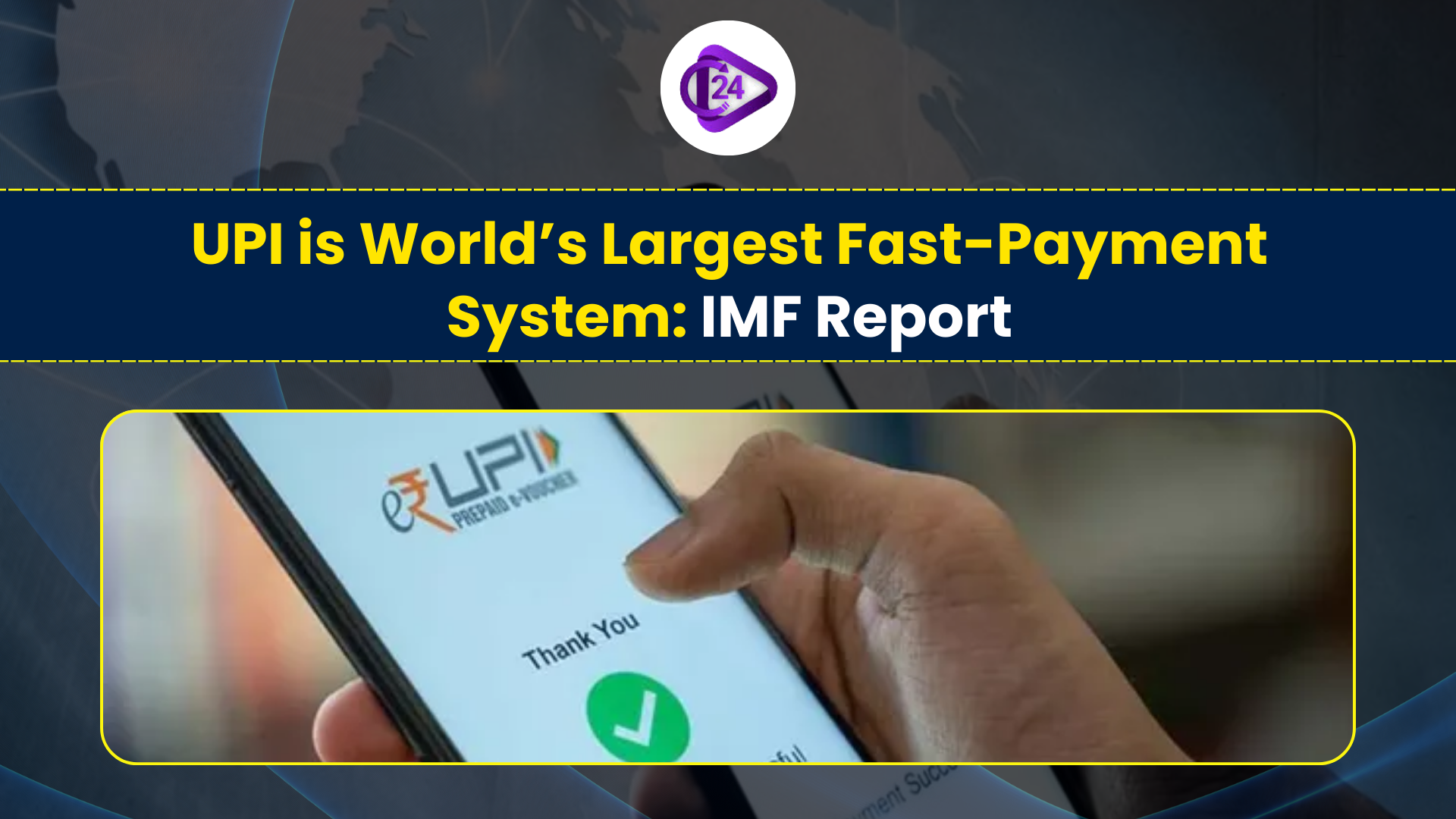
The International Monetary Fund 2025, the Unified Payments Interface (UPI) of India has been identified as the largest in the world in terms of volume of transactions related to fast payment systems. As the report indicates, UPI can be said to handle almost 50 per cent of all real-time digital payment transactions in the world, handling over 129 billion payments within a year. UPI is the concept that has been created by the National Payments Corporation of India (NPCI) to provide instant, secure, and interoperable bank-to-bank transfers on mobile applications. Its high level of adoption, deep digital standing, and favourable policy landscape have made India a global leader in real-time payments and a model of digital financial innovation globally.
UPI Declared World’s Largest Fast-Payment System by IMF Report
-
IMF has stated that the Unified Payments Interface (UPI) in India is the largest fast-payment system in the world.
-
UPI has almost fifty per cent of the total real-time transactions in the world in terms of digital payments.
-
It made more than 129 billion payments within one year.
-
UPI is a technology that allows bank-to-bank transactions to be carried out safely, in a hassle-free and instant way. The technology was developed by NPCI.
-
Interoperability and ease of use have led to enormous usage of the system.
-
The rapid expansion of UPI demonstrates the Indian innovation in the sphere of digital payments globally.
UPI & NPCI – PYQs Asked in Exams
| Exam Name | Year | Question | Options | Correct Answer |
|---|---|---|---|---|
| IBPS PO | 2022 | What does UPI stand for? | A) Unified Payment Interface B) Universal Payment Initiative C) Unique Payment Infrastructure D) United Payment India |
A) Unified Payment Interface |
| SSC CGL | 2021 | Which organisation developed UPI in India? | A) RBI B) NPCI C) SEBI D) NITI Aayog |
B) NPCI |
| SBI PO | 2020 | Which of the following is an interoperable real-time payment system in India? | A) NEFT B) RTGS C) UPI D) ECS |
C) UPI |
| IBPS RRB | 2019 | NPCI is responsible for which of the following? | A) Managing stock exchanges B) Payment and settlement systems C) Regulating insurance D) Tax collection |
B) Payment and settlement systems |
| SSC CHSL | 2018 | In which year was UPI launched in India? | A) 2014 B) 2016 C) 2018 D) 2020 |
B) 2016 |
| RBI Grade B | 2017 | Which system allows instant bank-to-bank transfers through mobile applications in India? | A) NEFT B) RTGS C) UPI D) IMPS |
C) UPI |
| RRB NTPC | 2019 | NPCI stand for? | A) National Payments Corporation of India B) National Postal Corporation of India C) National Policy for Commerce in India D) None of these |
A) National Payments Corporation of India |
| SSC GD | 2020 | Which of the following is used for real-time payments and is widely adopted in India? | A) UPI B) IMPS C) NEFT D) RTGS |
A) UPI |
Expected Questions about UPI, NPCI, NEFT, RTGS, IMPS
Question: When was UPI launched in India?
Options:
A) 2014
B) 2016
C) 2018
D) 2020
Answer: B) 2016
Description: UPI was launched in 2016 by NPCI to simplify digital payments and improve financial inclusion.
Question: What is NEFT used for?
Options:
A) Instant mobile payments
B) Real-time international transfers
C) Electronic fund transfer between banks on a deferred settlement basis
D) Cash withdrawal
Answer: C) Electronic fund transfer between banks on a deferred settlement basis
Description: NEFT allows individuals and businesses to transfer funds between banks electronically, settled in batches.
Question: Which system allows immediate fund transfer 24×7 through mobile or online banking?
Options:
A) NEFT
B) RTGS
C) IMPS
D) UPI
Answer: C) IMPS
Description: Immediate Payment Service (IMPS) enables instant interbank transfers via mobile and internet banking any time.
Question: Which system is mostly used for high-value transactions exceeding ₹2 lakh?
Options:
A) NEFT
B) RTGS
C) IMPS
D) UPI
Answer: B) RTGS
Description: RTGS is used for large-value payments and ensures real-time, gross settlement of funds.
Conclusion
India excelled in digital payments because the IMF listed UPI as the largest fast-payment system in the world. UPI has proven to be secure, instant and interoperable banking with a billion transactions being processed each year. Its mass following and strong infrastructure have become a standard of real-time payment systems and financial innovation throughout the world.