

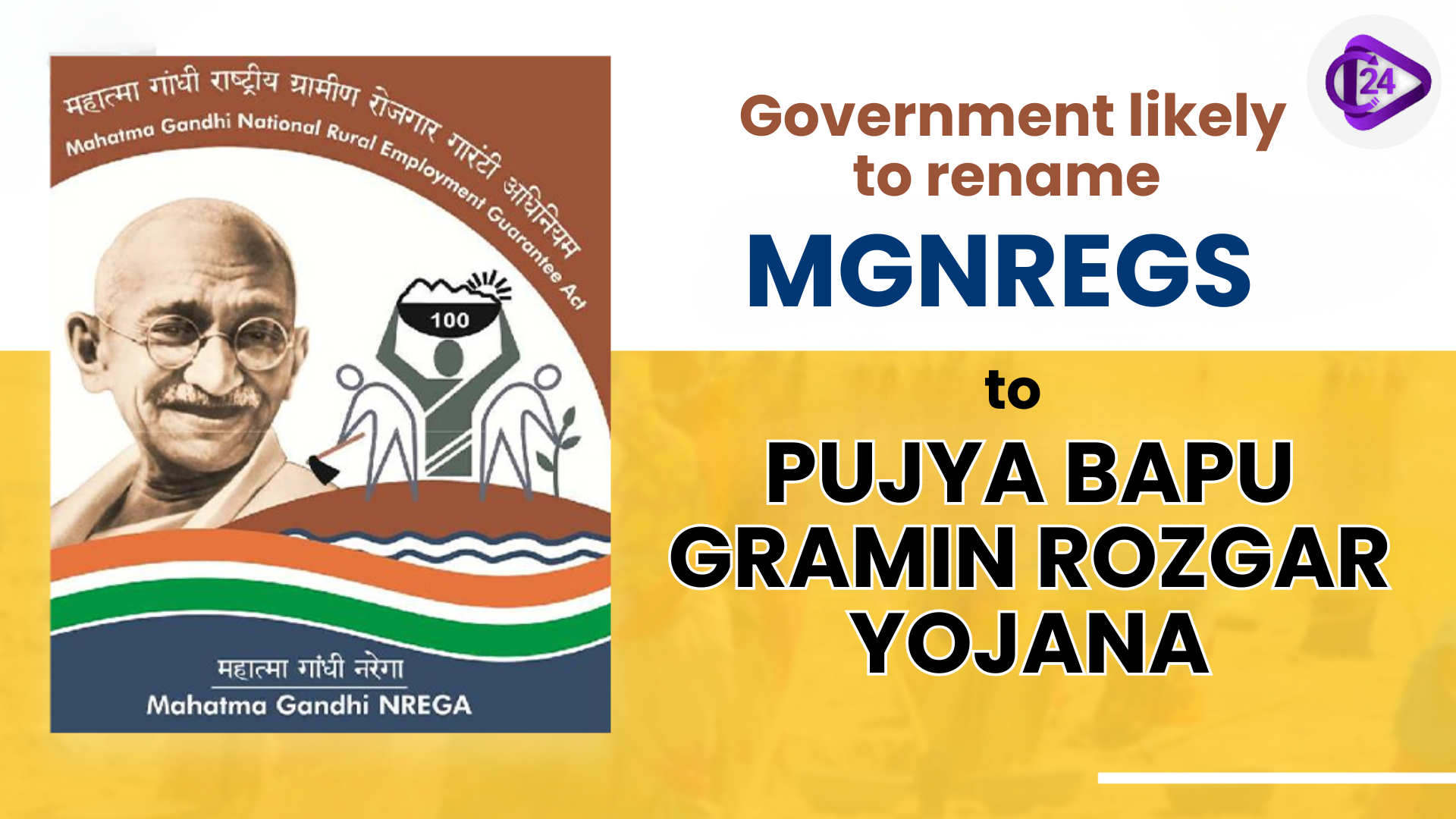
The renaming of the Mahatma Gandhi National Rural Employment Guarantee Act (MGNREGA) to the Pujya Bapu Gramin Rozgar Yojana has been officially approved by the central government. A bill to implement this change was passed by the Union Cabinet, marking one of the major updates to India's flagship rural employment scheme. Along with the renaming, the government increased the guaranteed rural workdays from 100 to 125 days per year and reformed minimum wages to secure the livelihoods of rural populations. These relocation measures continue efforts to empower the rural unemployed, as the scheme's core objectives are acknowledged.
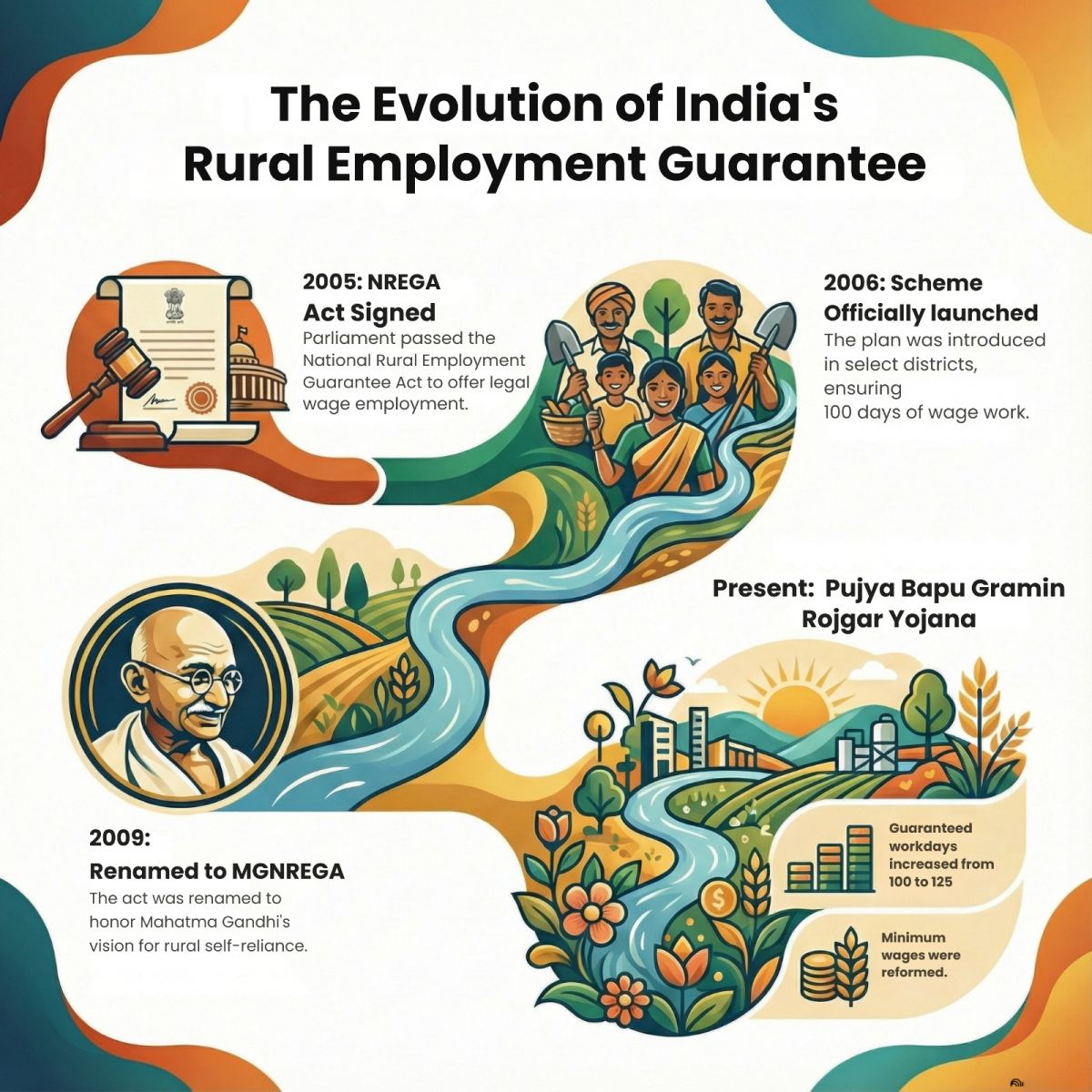
Complete Journey of NREGA to MGNREGS
-
In 2005, Parliament signed the National Rural Employment Guarantee Act (NREGA) to offer legal wage employment.
-
It was then officially introduced on 2 February 2006 in selected districts.
-
The plan ensured 100 days of wage work for the countryside families.
-
In the year 2009, NREGA had a change of name to the Mahatma Gandhi National Rural Employment Guarantee Act (MGNREGA).
-
The renaming was in honour of the self-reliance of the rural areas envisaged by Mahatma Gandhi.
-
MGNREGS was expanded at the national level, but its aim was on livelihood security, asset creation and development of the rural areas.
Asked Question Based on MGNREGS (PYQs)
| Exam Name | Year | Question Asked | Correct Answer |
|---|---|---|---|
| SSC CGL | 2018 | Under which Act is MGNREGS implemented? | Mahatma Gandhi National Rural Employment Guarantee Act, 2005 |
| UPSC Prelims | 2016 | MGNREGS guarantees employment for how many days in a year? | 100 days of wage employment |
| SSC CHSL | 2019 | Which ministry implements MGNREGS? | Ministry of Rural Development |
| UPSC Prelims | 2020 | MGNREGS mainly aims to provide employment to which population? | Rural households |
| RRB NTPC | 2021 | In which year was NREGA renamed as MGNREGA? | 2009 |
| SSC GD | 2022 | When was MGNREGS launched across India? | 2 February 2006 |
| UPSC Prelims | 2017 | Who bears the cost of unskilled wages under MGNREGS? | Central Government |
| State PSC | 2023 | MGNREGS is a scheme based on which type of guarantee? | Legal employment guarantee |
Expected Question for Upcoming Exam About MGNREGS
Consider the following statements regarding MGNREGS:
-
It provides a legal guarantee of wage employment to rural households.
-
The scheme ensures employment only to Below Poverty Line (BPL) families.
Which of the statements given above is/are correct?
A. 1 only
B. 2 only
C. Both 1 and 2
D. Neither 1 nor 2
Correct Answer: A
Explanation: MGNREGS provides a legal employment guarantee to all rural households, not only BPL families.
Which ministry is responsible for implementing MGNREGS?
A. Ministry of Labour and Employment
B. Ministry of Panchayati Raj
C. Ministry of Rural Development
D. Ministry of Finance
Correct Answer: C
Description: MGNREGS is administered by the Ministry of Rural Development.
If employment is not provided within 15 days under MGNREGS, what is payable?
A. Bonus
B. Compensation
C. Unemployment allowance
D. Incentive
Correct Answer: C
Description: Beneficiaries receive an unemployment allowance as per the Act.
Consider the following statements regarding MGNREGS and the Indian Constitution:
-
MGNREGS is based on the principle of the Right to Work.
-
Article 41 of the Indian Constitution directs the State to provide the Right to Work.
Which of the statements given above is/are correct?
A. 1 only
B. 2 only
C. Both 1 and 2
D. Neither 1 nor 2
Correct Answer: C
Explanation: Article 41 (DPSP) directs the State to secure the Right to Work, forming the constitutional basis of MGNREGS.
With reference to MGNREGS, consider the following statements:
-
The scheme provides a legal guarantee of employment through an Act of Parliament.
-
Article 21 of the Constitution directly mandates rural employment schemes like MGNREGS.
Which of the statements is/are correct?
A. 1 only
B. 2 only
C. Both 1 and 2
D. Neither 1 nor 2
Correct Answer: A
Explanation: MGNREGS is backed by law, while Article 21 ensures the Right to Life, not a direct employment mandate.
Conclusion
The fact that the Centre is revamping MGNREGS into Pujya Bapu Gramin Rozgar Yojana is a symbolic change in policy without changing the very essence of the scheme, which is to offer guaranteed rural employment. The proposed change is also a continuity of strengthening livelihood security, rural development and employment rights of the millions of rural households in India.