


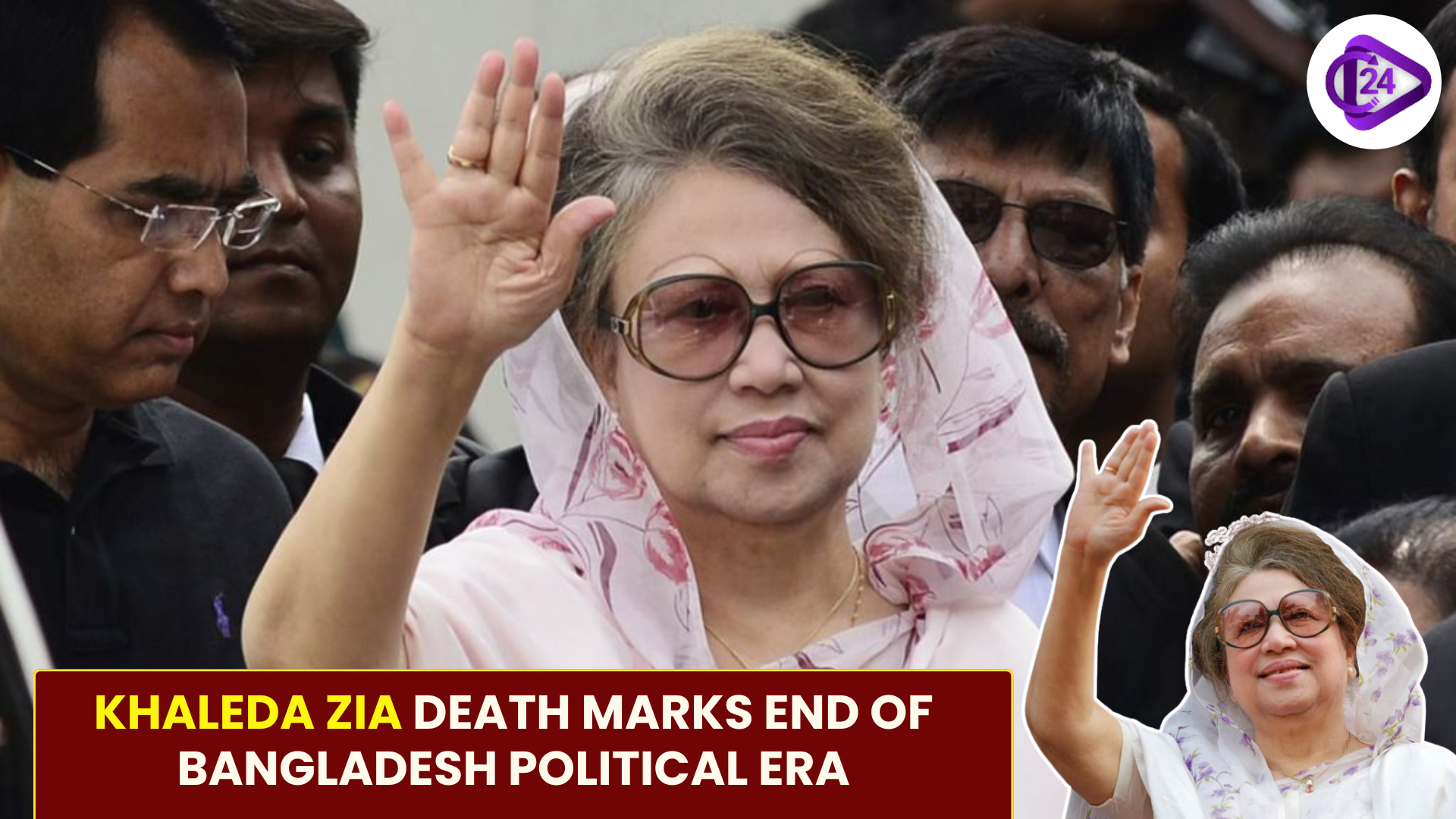
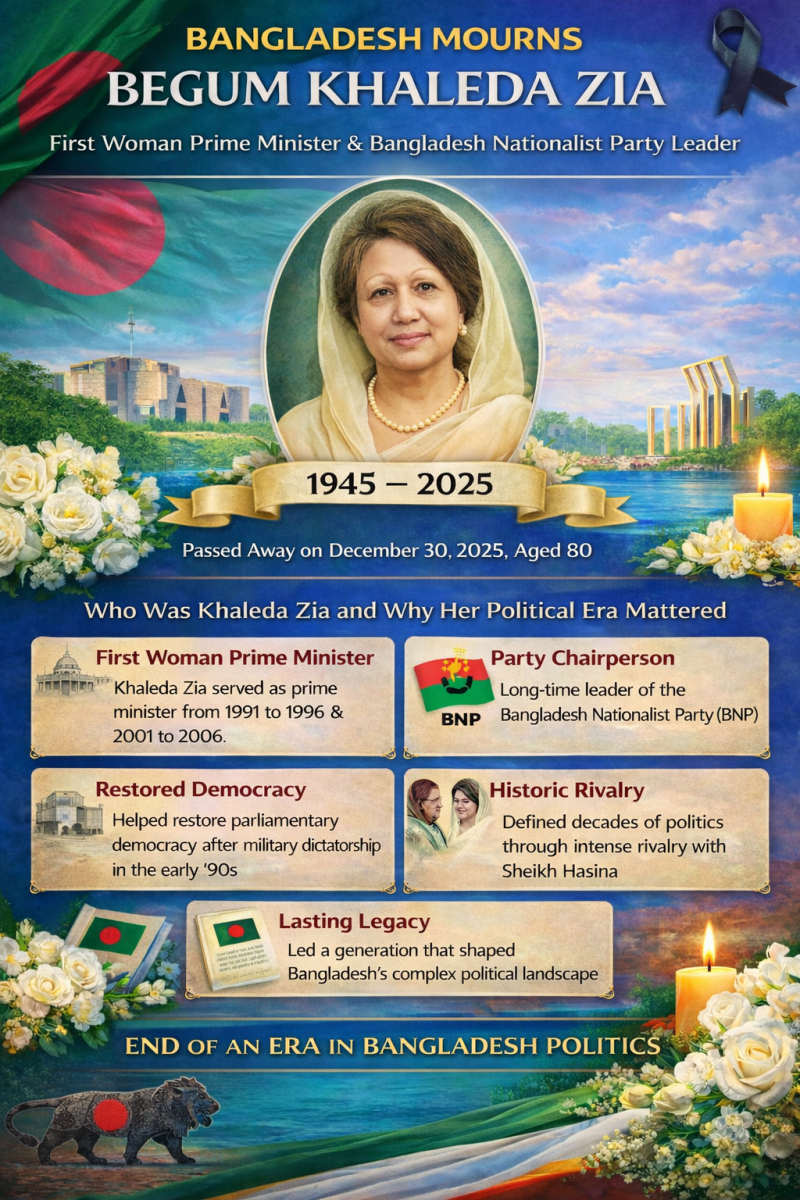
Bangladesh is grieving the loss of Begum Khaleda Zia, the first woman to serve as prime minister of Bangladesh and a legendary figure in the country's history, who died on 30 December 2025 at the age of 80, her party reported. Zia was the head of the Bangladesh Nationalist Party (BNP) and, over the past thirty years, dominated national politics and elections, shaping the country's policies. Her lifelong rivalry with Sheikh Hasina defined political life in Bangladesh. The three-day national mourning announced by the interim government has highlighted her great influence on the country's democratic development and marked the end of a significant political era.
Who Was Khaleda Zia and Why Her Political Era Mattered
-
First Woman Prime Minister: Khaleda Zia was the first woman prime minister in Bangladesh; she held office between 1991 and 1996 and 2001 and 2006.
-
Party Chairman: She was long time chairperson of the Bangladesh nationalist party (BNP) and one of the most powerful political figures in the nation.
-
Restored Democracy: She also significantly helped to restore the parliamentary democracy following several years of military dictatorship in the early 1990s.
-
Historic Rivalry: The national elections and the policies were developed over decades and governed by the historic political rivalry between Sheikh Hasina and her.
-
Lasting Legacy: Her generation led to development as well as political polarisation, creating a complicated yet historic legacy in the political history of Bangladesh.
PYQs on India–Bangladesh
| Exam Name | Year | Question | Answer |
|---|---|---|---|
| UPSC Prelims (GS) | 2013 | What is the total length of the India–Bangladesh border? | 4,096 km |
| SSC CGL Tier-1 | 2017 | Which international border is the longest for India? | India–Bangladesh border |
| RRB NTPC CBT-1 | 2016 | How many Indian states share a border with Bangladesh? | Five |
| SSC CHSL | 2018 | Which Indian state shares the longest border with Bangladesh? | West Bengal |
| State PCS (WBPSC) | 2015 | Name the Indian states that share a boundary with Bangladesh. | West Bengal, Assam, Meghalaya, Tripura, Mizoram |
| UPSC Prelims | 2019 | The exchange of enclaves between India and Bangladesh took place under which agreement? | Land Boundary Agreement (2015) |
| UPSC Mains (GS-2) | 2020 | How did the Land Boundary Agreement improve India–Bangladesh relations? | It resolved enclaves, clarified borders, and improved security and cooperation. |
| SSC MTS | 2017 | Which is the first integrated check post on the India–Bangladesh border? | Agartala |
| Banking Exams (IBPS PO) | 2021 | Bangladesh shares a land border with which two countries? | India and Myanmar |
| RRB Group D | 2019 | Which Indian state does NOT share a border with Bangladesh? | Manipur |
Advanced Expected Questions: India–Bangladesh Boundary
Q.1 The India–Bangladesh boundary is an outcome of which of the following historical agreements?
A. Radcliffe Award, 1947
B. Nehru–Noon Agreement, 1958
C. Indira–Mujib Treaty, 1974
D. Shimla Agreement, 1972
Correct Answer: C. Indira–Mujib Treaty, 1974
Explanation: The basic framework of the India–Bangladesh boundary was finalised through the Indira–Mujib Treaty.
Q2. Which of the following best explains the term “adverse possession” in the India–Bangladesh boundary context?
A. Land illegally occupied by smugglers
B. Land owned by one country but controlled by another
C. Land under military control
D. Land used for border trade
Correct Answer: B. Land owned by one country but controlled by another
Explanation: Adverse possession refers to land legally belonging to one country but administered by the other before LBA 2015.
Q3. The exchange of enclaves under the 2015 Land Boundary Agreement primarily affected which Indian state?
A. Tripura
B. Assam
C. West Bengal
D. Mizoram
Correct Answer: C. West Bengal
Explanation: Most enclaves were located in the Cooch Behar district of West Bengal.
Q4. The fencing of the India–Bangladesh border faces maximum difficulty in which terrain?
A. Desert
B. Riverine and marshy areas
C. High mountains
D. Dense urban areas
Correct Answer: B. Riverine and marshy areas
Explanation: Rivers like the Padma and Brahmaputra cause frequent erosion and shifting channels.
Q5. The “Teen Bigha Corridor” connects mainland Bangladesh with which area?
A. Rangpur
B. Dahagram–Angarpota enclave
C. Sylhet
D. Chittagong Hill Tracts
Correct Answer: B. Dahagram–Angarpota enclave
Explanation: The corridor provides access between Bangladesh and its enclave, which India surrounds.
Q6. Which river forms part of the India–Bangladesh boundary?
A. Teesta
B. Feni
C. Brahmaputra
D. Barak
Correct Answer: B. Feni
Explanation: The Feni River forms part of the boundary near Tripura.
Q7. Which one of the following agencies jointly manages the boundary with India on the Bangladeshi side?
A. Bangladesh Army
B. Border Guard Bangladesh (BGB)
C. Bangladesh Police
D. Rapid Action Battalion
Correct Answer: B. Border Guard Bangladesh (BGB)
Explanation: BGB is Bangladesh’s border guarding force, coordinating with India’s BSF.
Q8. Which factor makes the India–Bangladesh border uniquely complex?
A. Length only
B. Enclaves and adverse possessions
C. High altitude passes
D. International river disputes only
Correct Answer: B. Enclaves and adverse possessions
Explanation: No other international border had such a large number of enclaves.
Q9. The Land Boundary Agreement was ratified by India through which constitutional mechanism?
A. Ordinary legislation
B. Presidential ordinance
C. 100th Constitutional Amendment Act
D. Supreme Court directive
Correct Answer: C. 100th Constitutional Amendment Act
Explanation: The amendment allowed the transfer of territory to implement the LBA.
Q10. The India–Bangladesh boundary contributes most directly to which of the following policy objectives?
A. Strategic military dominance
B. Regional connectivity and stability
C. Maritime security
D. Nuclear deterrence
Correct Answer: B. Regional connectivity and stability
Explanation: Settlement of the boundary improved relations, trade, and security cooperation.
Conclusion (Khaleda Zia’s Death)
The demise of Khaleda Zia was the death of a political era in Bangladesh's history. Being one of the pioneering leaders and a former prime minister, she influenced decades of democratic transitions, political competition, and national discourses. Her life will be remembered for shaping the politics, the culture of leadership, and the democratic process in Bangladesh.