
On January 29, 2026, the Supreme Court of India granted an interim stay on the Promotion of Equity in Higher Education Institutions Regulations, 2026, issued by the University Grants Commission, even though the promulgation of some of its provisions was scheduled to occur before the next hearing. Some of the clauses of the new equity system were found to be ambiguous and subject to abuse by the top court, especially the tight definition of caste-based discrimination, which does not cover all the groups, and there was the fear of social fragmentation. The previous UGC Equity Regulations, 2012, will persist until the issue is finally ruled. The case will be put on a hearing, in detail, on March 19, 2026, with stakeholders crafting their arguments of constitutional validity.
What Are the Key Issues in UGC Equity Regulations 2026?
-
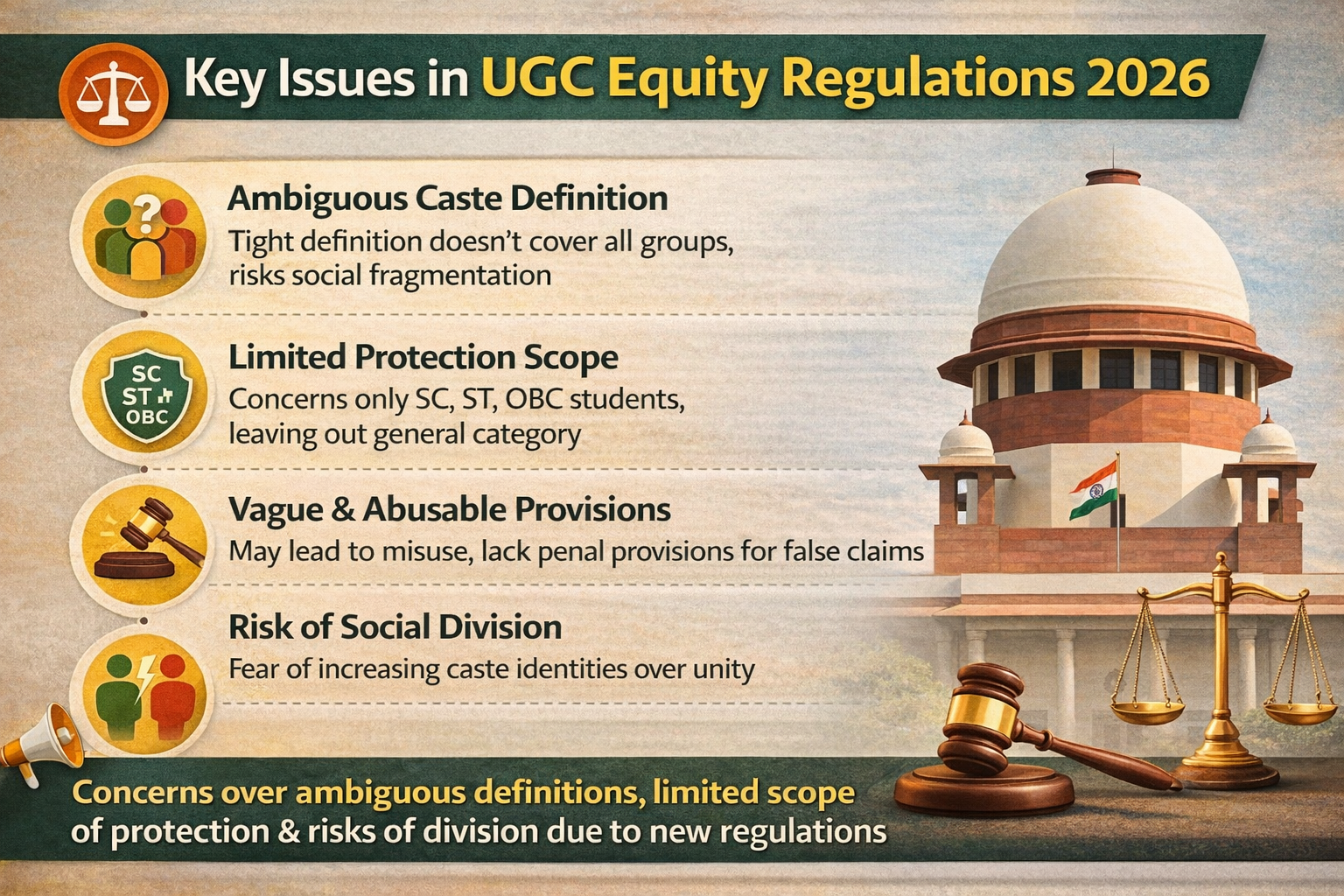
The caste-based discrimination idea stipulated in the 2026 Regulations has been described as ambiguous and imprecise, with the possible issue concerning the scope of what can be deemed as covered and how it can be implemented.
-
The Regulations restrict protection only to SC, ST and OBC students under a certain provision, which raises a doubt that general category students would not even get protection on the same platform through the grievance.
-
The detractors complain that the general and empty-handed words may be abused, and vague words may allow misuse or unfair delegation.
-
Certain definitions are confusingly related to the established discrimination law, which makes people question the need to have caste-based distinct categories.
-
Conflict is feared in the case of social division or segregation, in case the Regulations are applied without more comprehensive protection, and the fear that it may focus on places more on caste identities than on unity.
-
This has not included explicit penal provisions on false/malicious claims, and this has been criticised because it could encourage empty or vindictive claims.
-
Another one that has been identified by the Supreme Court as causing concern is the omission of certain matters, like ragging, in the 2026 framework, since it is an important issue on campus.
-
The refinements in the rules are being done to be more precise and constitutional, and at least the current Regulations of 2012, which are still in force as of today, have been retained by the court pending its next hearing.
Important Asked PYQs on the Supreme Court
| Question | Options | Answer |
|---|---|---|
| When was the Supreme Court of India established? | A) 26 January 1950 B) 20 January 1952 C) 15 August 1947 D) 30 August 1948 |
A) 26 January 1950 |
| Which Article defines the original jurisdiction of the Supreme Court? | A) Article 129 B) Article 130 C) Article 131 D) Article 132 |
C) Article 131 |
| Who appoints the Chief Justice of India? | A) Judges of SC & HC B) Prime Minister C) President in consultation with senior judges D) President alone |
C) President in consultation with senior judges |
| The power of judicial review relates to which action? | A) Advise the President B) Declare laws unconstitutional C) Review the judiciary organisation D) Prepare laws |
B) Declare laws unconstitutional |
| Appointment of district judges is made by the Governor in consultation with: | A) Attorney General B) Advocate General C) Supreme Court D) High Court |
D) High Court |
| Which High Court has jurisdiction over the Andaman & Nicobar Islands? | A) Calcutta High Court B) Delhi High Court C) Madras High Court D) Andhra Pradesh HC |
A) Calcutta High Court |
Conclusion (UGC Equity Regulations 2026)
The temporary suspension of UGC Equity Regulations 2026 allowed by the Supreme Court raises the risks of confusing definitions and misuse of this tool in many ways, as well as the division of society on campuses. The 2012 regulations will persist till the end of the last hearing, guaranteeing continuity of grievance redressal and equity provisions, although a review of the rules is necessary to reflect the rules in the constitutional and legal standards.