


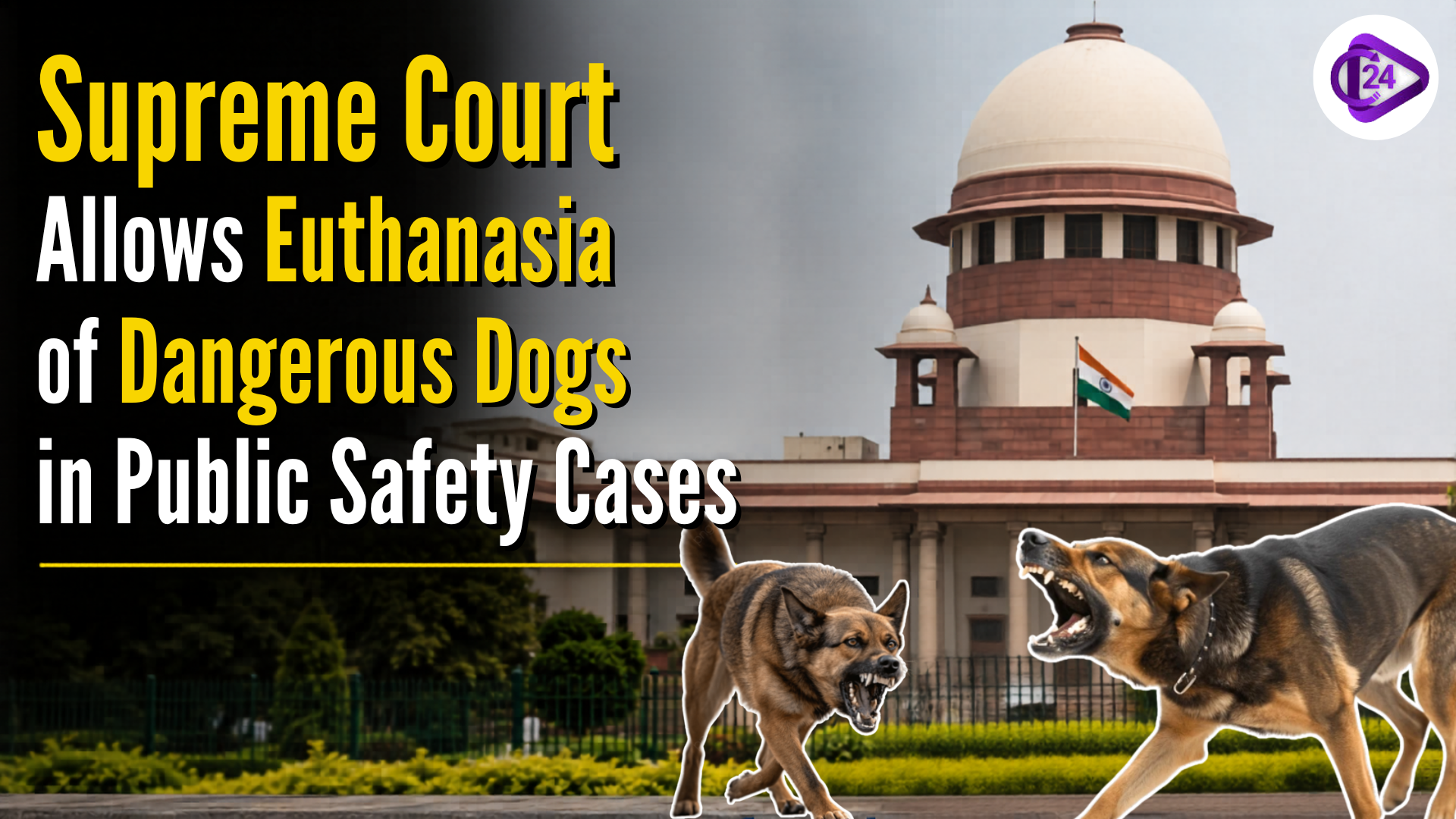
The Supreme Court of India has allowed authorities to carry out euthanasia of rabid, incurably ill, and demonstrably dangerous stray dogs in exceptional cases related to public safety. The decision came during hearings on the growing menace of stray dog attacks across India. The Court observed that the increasing number of dog bites, especially those involving children and elderly citizens, cannot be ignored. However, the Court clarified that euthanasia must strictly follow the provisions of the Prevention of Cruelty to Animals Act, 1960, and the Animal Birth Control Rules, 2023. The judgment attempts to balance animal welfare with the protection of human life and public safety.
SC Allows Euthanasia of Dangerous Dogs, Cites Public Safety
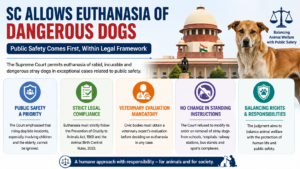
- The Supreme Court only allowed euthanasia of dogs which were rabid, incurable or dangerous and aggressive.
- The Bench of Justice Vikram Nath, Justice Sandeep Mehta and Justice N.V. Anjaria gave a ruling.
- Building public safety and protecting human life are foremost priorities, the Court said.
- Authorities have statutory rules to take “legally permissible measures”.
- Civic bodies have to seek veterinary experts’ evaluation as a whole before deciding to euthanise.
- The trial was heard in a sua sponte proceeding over stray dog attacks and rabies issues.
- The Court rejected attempts to change its Standing Instruction dated August 26, which concerns the removal of stray dogs from schools, hospitals, railway stations, bus stands, and sports complexes.
- Sensitive public spaces are not suitable for wasteland violence in the form of the release of sterilised stray dogs.
- It highlighted the need to adhere to the Prevention of Cruelty to Animals Act, 1960.
- The rules governing the control of stray dogs, as contained in the Animal Birth Control Rules, 2023, constitute the basis for stray dog management.
- The Court pointed to an increase in dog biting cases in Indian cities and towns.
- It is looking to balance animal rights with concerns for public safety.
PYQs Related to Animal Welfare and Fundamental Duties
| Exam Name | Year | Question | Options | Answer |
| UPSC Prelims | 2020 | Which Article of the Indian Constitution deals with the protection and improvement of the environment and the safeguarding of forests and wildlife? | A. Article 32 B. Article 48A C. Article 21 D. Article 370 | B. Article 48A |
| SSC CGL | 2021 | The Prevention of Cruelty to Animals Act was enacted in which year? | A. 1950 B. 1955 C. 1960 D. 1972 | C. 1960 |
| UPSC Prelims | 2017 | Which organisation implements the Animal Birth Control Rules in India? | A. RBI B. Municipal Authorities C. Election Commission D. NITI Aayog | B. Municipal Authorities |
| State PSC | 2022 | Rabies is primarily caused by which type of organism? | A. Fungus B. Bacteria C. Virus D. Protozoa | C. Virus |
| SSC CHSL | 2019 | Which Fundamental Duty mentions compassion for living creatures? | A. Article 51A(g) B. Article 14 C. Article 19 D. Article 32 | A. Article 51A(g) |
Conclusion
The decision on the euthanasia of dangerous stray dogs by the Supreme Court is a pivotal step in India’s broader efforts to advance public safety and animal welfare. The Court is attempting to “balance” what it terms “animal compassion” with the protection of citizens by permitting euthanasia under very unusual circumstances, like rabid or dangerous dogs. The judgment further puts municipal bodies, vets, and statutory norms on a pedestal with respect to the round-up of stray dogs, thereby making the provisions of scientific and legal control in dog control. The judgment serves as a reminder of the importance of the reinforcement of India’s vaccination, sterilisation and shelter management norms in a growing rate of dog attack incidents, which is witnessed in some areas of the country.