


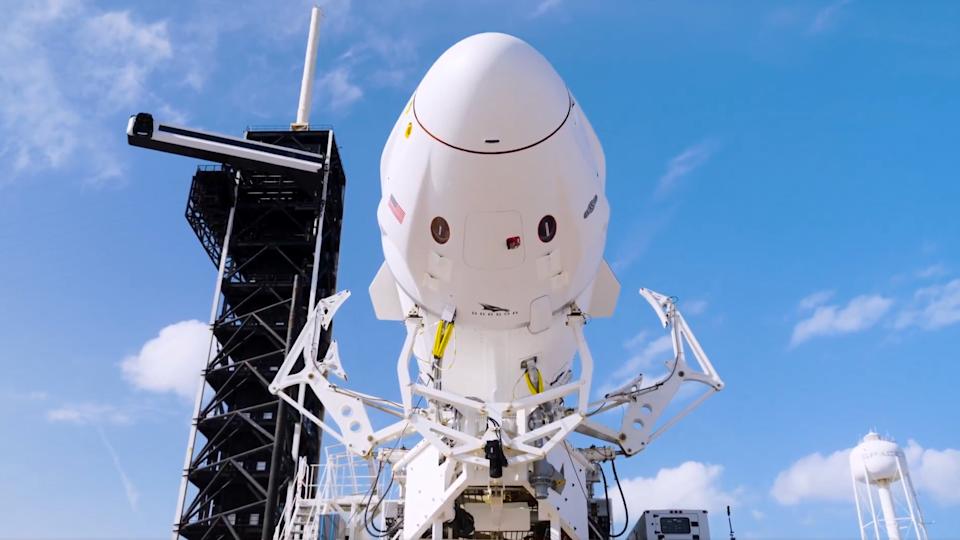
The Fram2 mission from SpaceX reached the remarkable achievement of operating the inaugural flight carrying human passengers in orbital space from one pole to another. A Falcon 9 rocket launched the civilian crew from Kennedy Space Center into a 90-degree polar orbit where they will spend 3 to 5 days completing research that includes the initial space x-ray alongside microgravity mushroom and other experiments.
Launch Details & Orbital Path
-
The mission will launch on March 31, 2025 at 9:46 PM (ET).
-
The launch occurred from Kennedy Space Center in Florida.
-
Vehicle: Crew Dragon Resilience atop a Falcon 9 rocket.
-
This spacecraft enters orbit ninety degrees above the horizon from the Earth's surface while flying at an altitude of 267 miles (430 km).
-
Duration: 3 to 5 days, with each orbit lasting 46 minutes.

Historic Firsts Achieved
-
First human spaceflight to traverse Earth’s poles.
-
First-ever x-ray taken in space.
-
The mission tried cultivating mushrooms while floating in weightlessness for the first time.
-
First SpaceX Dragon crew recovery on the U.S. West Coast.

Mission Crew & Roles
|
Astronaut |
Role |
Background |
|
Chun Wang |
Mission Commander |
Maltese Cryptocurrency Entrepreneur |
|
Jannicke Mikkelsen |
Vehicle Commander |
Norwegian Film Director & Cinematographer |
|
Rabea Rogge |
Pilot |
German Robotics Researcher |
|
Eric Philips |
Mission Specialist & Medical Officer |
Australian Polar Adventurer |
Scientific Research & Experiments
-
The crew successfully executed the initial X-ray scanning procedures for human physiology under weightless conditions.
-
The investigation examines how space exploration affects human muscles together with the skeletal system.
-
Growing mushrooms in space as a potential food source.
-
A special vantage allowed scientists to monitor atmospheric processes happening on Earth.
Landing & Recovery
-
Estimated Return: April 4-5, 2025 (TBD).
-
Landing Site: Pacific Ocean, off the Southern California coast.
-
Capsule Reuse: Crew Dragon Resilience on its fourth flight.
Conclusion:
The mission known as Fram2 represents a major advancement for space exploration because it extends scientific progress and enhances human space exploration capacity. The mission establishes new standards that will support deep-space exploration and commercial space flight through its implementation of both polar orbital delivery and innovative scientific studies.