

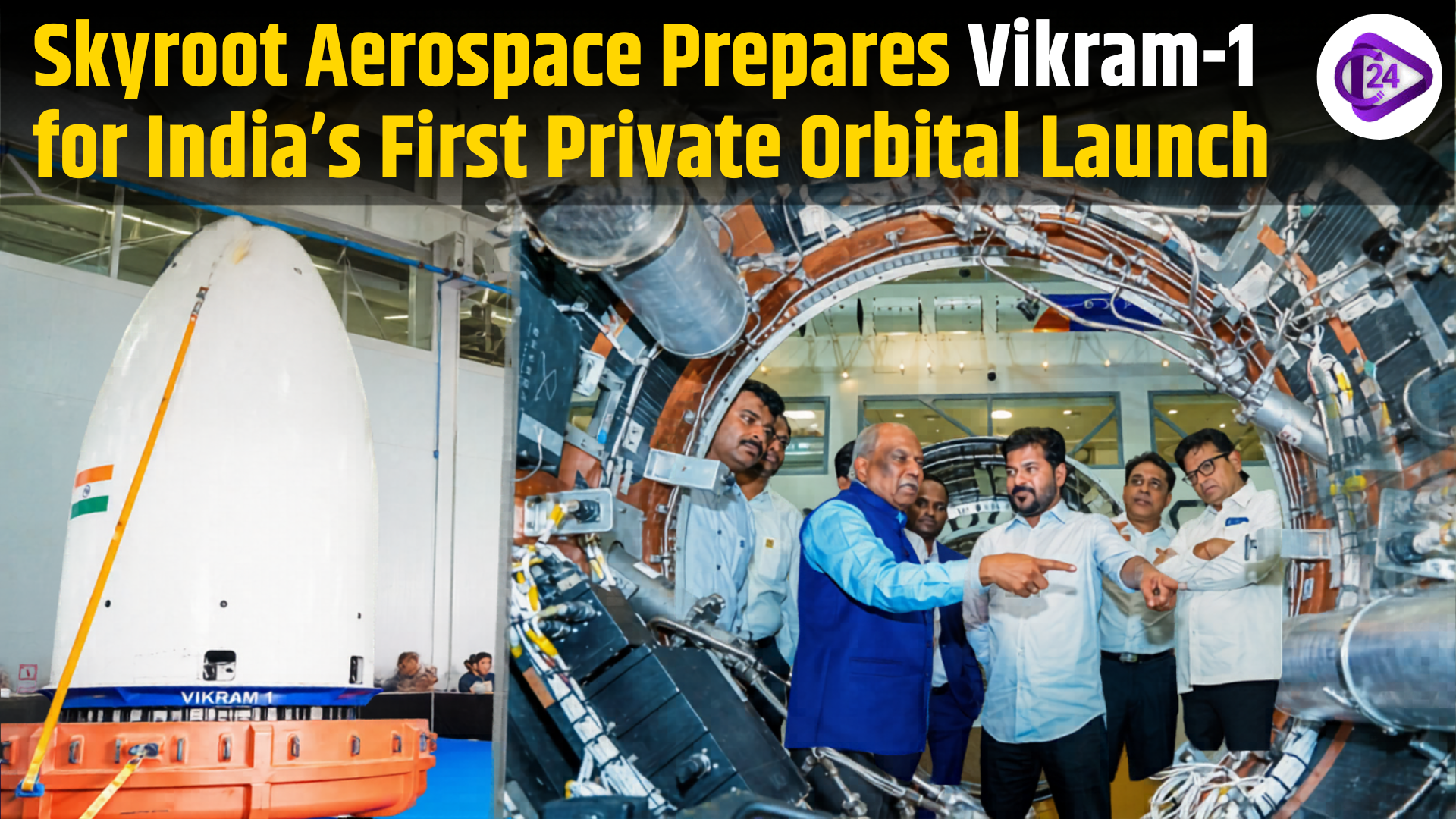
Skyroot Aerospace launches its Vikram-1 rocket, the nation’s first privately built rocket to reach orbit. The rocket has been shipped to the Satish Dhawan Space Centre for integration and launch preparations, marking a key milestone in the transition from the lab to the launch pad. The rocket is built to launch small satellites into low Earth orbit, paving the way for commercial space activity in the country. This launch exemplifies the increasing contributions of startups in driving India’s space and innovation agenda.
Vikram-1 Launch 2026 – Key Highlights of India’s First Private Orbital Mission
-
Skyroot Aerospace’s Vikram-1 is a significant achievement in the Indian space industry, as it is the first privately developed orbital rocket in India.
-
The rocket has been shipped to the Satish Dhawan Space Centre (SDSC) for integration, testing, and launch.
-
It is a three-stage rocket that will place a satellite weighing up to 350 kg into low Earth orbit.
-
Vikram-1 features carbon-composite structures and 3D-printed engines, enhancing performance and affordability.
-
It will be launched in 2026 after integration and regulatory clearances.
-
The launch is taking place under the approval of India’s private space regulator (IN-SPACe) and with the facilities of the Indian Space Research Organisation (ISRO).
-
The Vikram-1 mission aims to provide dedicated and demand-driven launches of satellites, with an emphasis on the global small-satellite market.
-
The rocket is a member of the Vikram family, named after the father of the Indian space programme, Vikram Sarabhai.
-
Skyroot has already successfully demonstrated its technology with the suborbital Vikram-S rocket in 2022.
-
The mission will see Skyroot become India’s first private firm to shut down a rocket in space and will create opportunities for other companies.
-
The launch reflects the move towards affordable commercial launches in India.
-
The launch of Vikram-1 will take India’s space economy to new heights and enhance its private aerospace sector.
Previous Year Questions on Space Technology
Q. What is the primary function of a geostationary satellite?
A. Weather forecasting
B. Remains fixed over one point on Earth
C. Moves from pole to pole
D. Used only for navigation
Answer: B
Explanation: A geostationary satellite orbits at the same rotational speed as Earth, appearing stationary over a fixed location.
Q. The Indian Space Research Organisation (ISRO) was established in which year?
A. 1962
B. 1969
C. 1975
D. 1980
Answer: B
Explanation: ISRO was established in 1969, replacing INCOSPAR.
Q. Which of the following is India’s navigation satellite system?
A. GPS
B. GLONASS
C. NavIC
D. Galileo
Answer: C
Explanation: NavIC (Navigation with Indian Constellation) is India’s regional navigation system.
Q. Which orbit is best suited for Earth observation satellites?
A. Geostationary Orbit
B. Polar Orbit
C. Elliptical Orbit
D. Transfer Orbit
Answer: B
Explanation: Polar orbits allow satellites to scan the entire Earth as the planet rotates.
Q. What is the full form of PSLV?
A. Polar Satellite Launch Vehicle
B. Public Satellite Launch Vehicle
C. Primary Space Launch Vehicle
D. Polar Space Launch Vessel
Answer: A
Explanation: PSLV is one of ISRO’s most reliable launch vehicles.
Q. Which mission made India the first country to reach Mars orbit in its first attempt?
A. Chandrayaan-1
B. Mangalyaan
C. Gaganyaan
D. Aditya-L1
Answer: B
Explanation: Mangalyaan (Mars Orbiter Mission) achieved this milestone in 2014.
Q. Skyroot Aerospace is associated with which rocket?
A. PSLV
B. GSLV
C. Vikram-1
D. LVM3
Answer: C
Explanation: Skyroot Aerospace is developing Vikram series rockets, including Vikram-1 for orbital launches.
Q. What is the purpose of reusable launch vehicles (RLVs)?
A. Increase satellite size
B. Reduce launch cost
C. Improve communication speed
D. Replace astronauts
Answer: B
Explanation: Reusable rockets reduce the cost of space missions significantly.
Q. IN-SPACe is related to:
A. Defence satellites
B. Private sector participation in space
C. Weather monitoring
D. Nuclear research
Answer: B
Explanation: IN-SPACe promotes and regulates private sector involvement in India’s space sector.
Q. Which of the following is a solar mission of India?
A. Chandrayaan-3
B. Aditya-L1
C. RISAT
D. GSAT
Answer: B
Explanation: Aditya-L1 studies the Sun and is India’s first solar mission.
Home Ministry Notifies 14 More Seaports for E-Visa Entry
Conclusion – Skyroot Vikram-1 Set for India’s First Private Orbital Launch
Skyroot Aerospace’s Vikram-1 launch is a milestone in India’s space sector, ushering in the era of private involvement in space activities. With India nearing its first private rocket launch, this achievement symbolises increased innovation, cost-effectiveness and competitiveness. Backed by the Indian Space Research Organisation and regulatory authorities, Vikram-1 has the potential to enable satellite launches and boost India’s presence in the global space sector.