


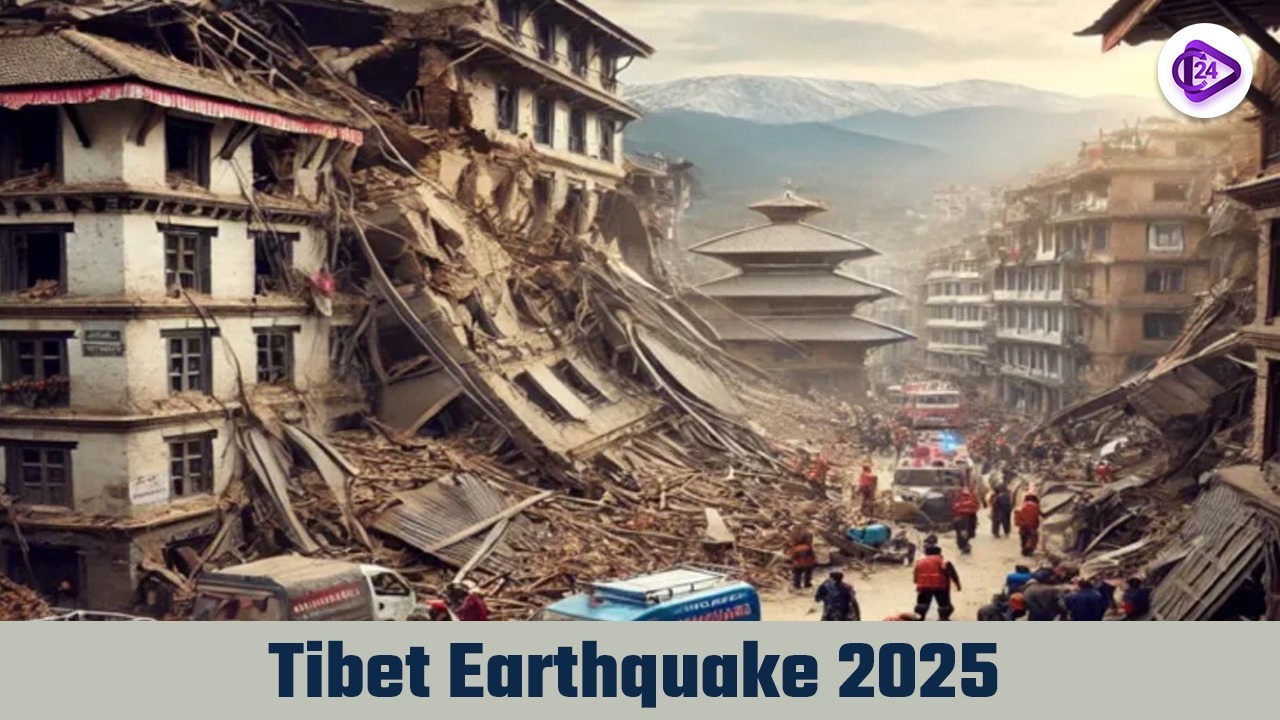
The earthquake with a magnitude of 6.8 hit northeast India near Tibet’s Lhasa city on the early morning of January 7, 2025, and left at least 126 people dead, as per a Chinese media report. The earthquake occurred in Dingri County in Shigatse City, Tibet immediately after 9 a.m. local standard time and had a focal depth of 10 kilometers according to the China Earthquake Networks Centre.
According to the U.S. Geological Survey (USGS), the earthquake registered at a 7.1 magnitude, making it recurrent seismicity on the Southern Tibetan Plateau region owing to the East-India tectonic plate’s continued interaction with the Eurasian plate.
USGS observed that the region had heavy earthquakes in the recent past with 10 earthquakes of magnitude 6 and above recorded around a 250 km radius of the epicenter within the past century.
Going by the current statistics, the death toll has continued to rise, with more than 188 persons injured while over 3,600 houses have been demolished. In the neighboring countries there were shaken, even such cities as Kathmandu (Nepal), Thimphu (Bhutan), and Kolkata (India).
Earthquake Hazard and Mitigation in India
-
Definition: Earthquakes are sudden shaking or trembling of the Earth’s surface resulting from the movement of tectonic plates or through an eruption of volcanic rocks.
-
India's Vulnerability: It may be noted that approximately 59%of the total geographical area of the country is threatened by moderate to severe levels of seismicity.
-
Impact Mitigation: Reduction of consequences through using code-approved and designing structures and employing them to reinforce existing structures.
The vulnerability and risk of earthquake in India
Seismic Zones:
The least seismic area of India is categorized into four zones that are Zone II to Zone V.
Zone V: High Impact/Very High Damage Risk (Kashmir, Northeast, Andaman & Nicobar).
Zone IV: High Damage Risk (e.g., Delhi, parts of Himachal, Bihar, Gujarat).
Zone III: Low to moderate Flood damage risk states include; Low risk – Kerala and Goa; moderately low risk – parts of TN and KA.
Zone II: Low Damage Risk (Other areas of the country).
High-Risk Areas:
-
Himalayas: Sensitive because of the occurrence of the Indian Plate that is subducting beneath the Eurasian Plate.
-
Peninsular India: Geophysical features include risk from intraplate faults and paleo rift zones that are poorly understood but for which examples can be quoted such as the Kachchh and the Narmada-Son rifts.
-
Notable Earthquakes: Kaiser I, Shillong 1897, Kangra 1905, Bihar-Nepal 1934, Assam-Tibet 1950.
Aggravated Risk:
This phenomenon is caused by such factors as the speed of the urbanization process, infrastructure development in dangerous zones, and other developmental works.
Impacts
-
Structural Damage: It is noteworthy that most of the deaths are caused simultaneously by building collapses.
-
Surface Rupture: Ground displacement results in the destruction of infrastructure.
-
Tsunamis: Some of the earthquakes that occur along submarine trenches are capable of causing tsunamis.
-
Liquefaction: Saturated deposits have properties similar to liquids and hence undermine the foundations.
-
Fires: Broken pipelines cause fires same as when electrical systems are wrecked.
-
Economic Disruption: decline in sources of income and closure of industrial establishments.
Mitigation and strategies
-
Building Codes: Ensuring compliance with the matters concerning earthquake-resistant construction.
-
Land Use Planning: Staying away from areas in the construction of risky structures.
-
Public Awareness: A few examples of informative topics are: Earthquake education among the populace.
-
Disaster Preparedness: Communications and alerts as well as equipment preparatory stocks and management plans.
-
Risk Assessment: Annual review of seismic risks in cities and towns.
India’s Preparedness
-
National Centre for Seismology: Sensors of earthquakes and gives timely alarm.
-
National Earthquake Risk Mitigation Project: Emphasizes the development of legal capacities, roles, and the role of the public.
-
Seismic Micro-Zonation: Helps to determine dangerous areas in large cities in order to promote effective planning of cities.
-
Awareness Campaigns: Activities such as sensitization are weekly exercises conducted by NDMA.
-
Building Regulations: Requirements as provided by BIS and other related agencies for the design and construction of structures that would stand the ravages of disasters.
Challenges
-
High Seismic Activity: Retrofitting costs are high.
-
Unplanned Urbanization: Weak structures most especially in the areas that are prone to natural disasters.
-
Tourism Expansion: Increases pressure in the areas that are prone to seismism.
-
Regulation Lapses: It is important to also note that most buildings fail to meet statutory requirements regarding construction codes.
-
Public Awareness: People are not very aware of how to protect themselves and their belongings when an earthquake occurs.
-
Financial Constraints: Lack of funds to put into practice the measures that are taken to isolate the infected animals.
Way Forward
-
Proactively enhance the implementation of constructing codes.
-
Inform the population and prepare them.
-
Increase the financial funding for research and renovation of infrastructure.
-
Promote more persons who are seismic-proof for urban structures.
-
Ensure that there are enough sources of funding required in the management of disasters as well as the responses.
Looking Ahead
The earthquake calls for a better disaster preparedness program, improved study on earthquakes, and strong structures in the Himalayan region. This is why governments and global institutions need to enhance cooperation to enhance the early warning systems, raise construction standards for large projects like the Yarlung Tsangpo dam, and subsequently develop plans for how to prevent environment-related disasters that are linked to such huge projects.
While this region is still in the process of recovering from this awful earthquake, there is a dire necessity for sustainable measures to save the lives, income sources, and resources of millions of people living in the shadow of the great Himalayas.
Conclusion
The earthquake in Tibet highlights the vulnerability of earthquake-prone regions and the need for improved disaster preparedness and seismic resilience in the Himalayas. Enhanced building codes, public awareness, and better emergency response plans are essential to mitigate future risks.