



Neolithic relics at Lakkundi village in the Gadag district of Karnataka, through recent archaeological excavations, point to the early antiqueness of the site. These finds were found around the Kote Veerabhadeshwara Temple, highlighting the layer-cake cultural history of Lakkundi on top of its notorious medieval culture. The uncovered Neolithic artefacts are not only helpful to reinforce the argument about the prehistoric importance of the region, but they can also be used to expand the general understanding of the early settlements in southern India. The continuing research is still trying to find something that can be added to the knowledge on the ancient life in the subcontinent.
Lakkundi Excavation Unearths Neolithic Artifacts: Historical Importance
-
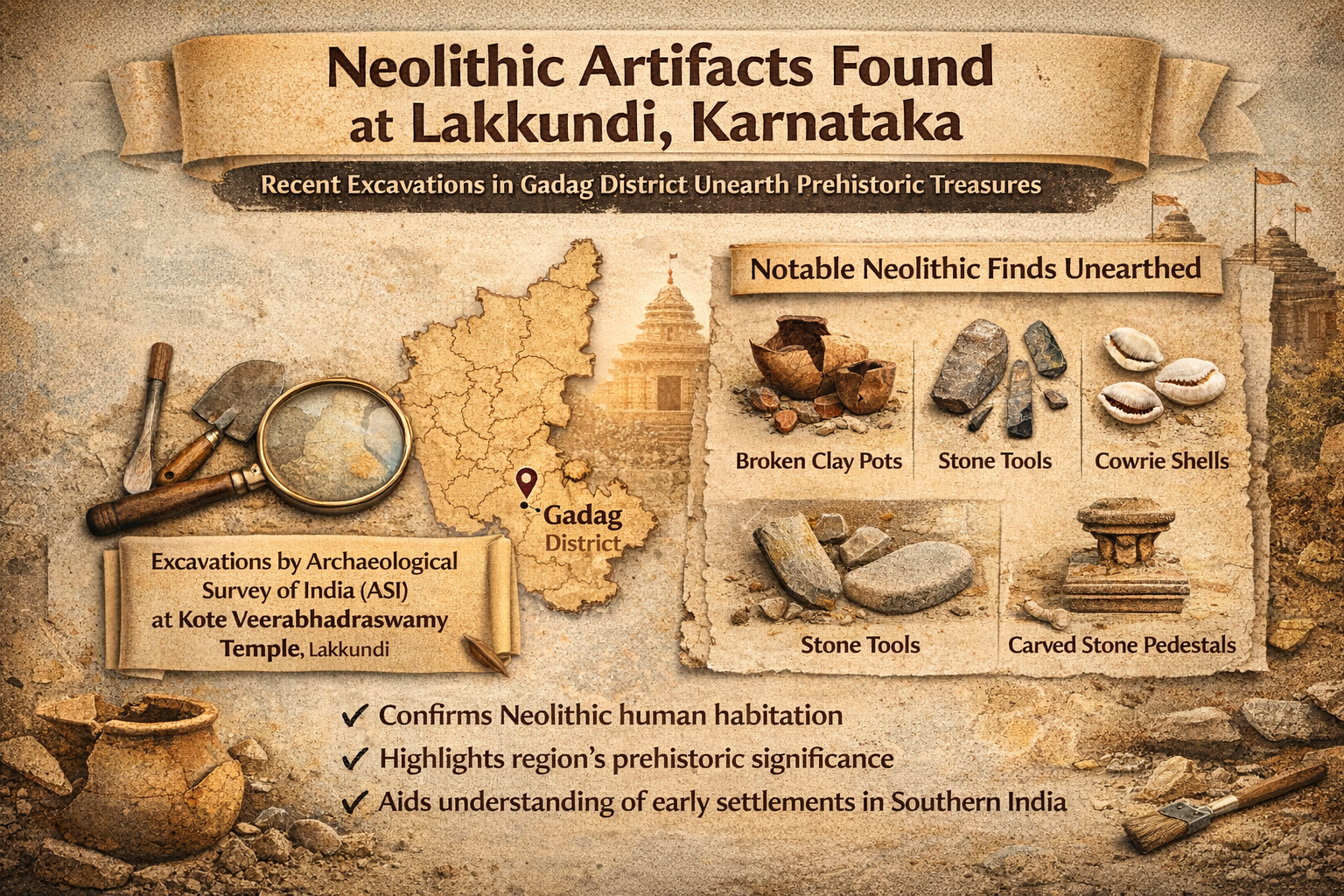
The Lakkundi archaeological excavation covered in the Gadag district, Karnataka, has revealed Neolithic period remains of broken clay pots, stone tools, cowrie shells and carved stone pedestals, which point to the existence of human habitation in the prehistoric period.
-
Such findings were found as a result of excavation under the tutelage of the Archaeological Survey of India (ASI) at the Kote Veerabhadraswamy Temple complex, where systematic excavation was carried out to a depth of approximately five feet.
-
The Neolithic artefacts indicate that the history of Lakkundi must rely on the already established medieval structures, but it should have been due to the existence of previously established people in the area.
-
This provides an important period to the long history of Lakkundi, as the period between the prehistoric and later status as a leading place of occupation by the Chalukya, Rashtrakuta and Hoysala dynasties, as evidenced by inscriptions and temples.
-
The discoveries enhance the argument of Karnataka to be included in the UNESCO World Heritage List since a lot more than the medieval structures are revealed to the world through the findings, which represent a further intricate layer of the human presence and operation.
-
Artefacts discovered are under investigation and conservation that will lead to a larger insight into incipient life, the habitation and culture development in southern India.
-
The findings make Lakkundi a key location in an anthropocentrally continuous human habitation that can be of great use in the work of historians, archaeologists, and even scholars explaining the prehistoric and medieval transitions in India.
-
The excavation has helped to raise the profile of the rich archaeological heritage of Karnataka and has led to more research and to the preservation of other sites, such as Lakkundi.
Best Previous Year Questions for the Neolithic Age
| Exam | Year | Question | Answer |
|---|---|---|---|
| UPSC CSE Mains – History | 2010 | To what extent are archaeological materials useful in understanding the progress of Neolithic man in India? | They help reconstruct the Neolithic economy, agriculture, tools, settlement and culture. |
| UPSC CSE Mains – History | 2016 | Delineate and account for the regional characteristics of the Neolithic period in India. | Regional traits include Burzahom pit dwellings, Koldihwa rice farming and southern pastoral-agricultural evidence. |
| UPSC CSE Mains – History | 2023 | “The Neolithic Age represents a revolution due to significant changes that took place during this period.” Examine. | A shift to agriculture and domestication, polished tools and settled villages mark a civilisational revolution. |
| SSC CGL | Various | What significant changes marked the Neolithic Age? | Introduction of pottery, agriculture and domestication of cattle. |
| SSC CGL | Various | What types of tools were used in the Neolithic Age? | Polished stone tools such as celts and bone tools. |
| SSC / Bank / Railway GK | Various | In the Neolithic Age, human communities were mainly engaged in ______? | Agriculture. |
| SSC / Bank / Railway GK | Various | Which is a Neolithic site? | Burzahom or Mehrgarh. |
Conclusion (Neolithic Relics Found at Lakkundi)
The Neolithic relics were found at Lakkundi, Karnataka, which is a testament to the prehistoric importance of this area, showing evidence of early human habitation, tools, and pottery. These facts help fill the void between the prehistoric and the medieval periods and develop our perception of ancient life, settlement systems, and cultural development. Lakkundi has now become one of the main archaeological sites.