

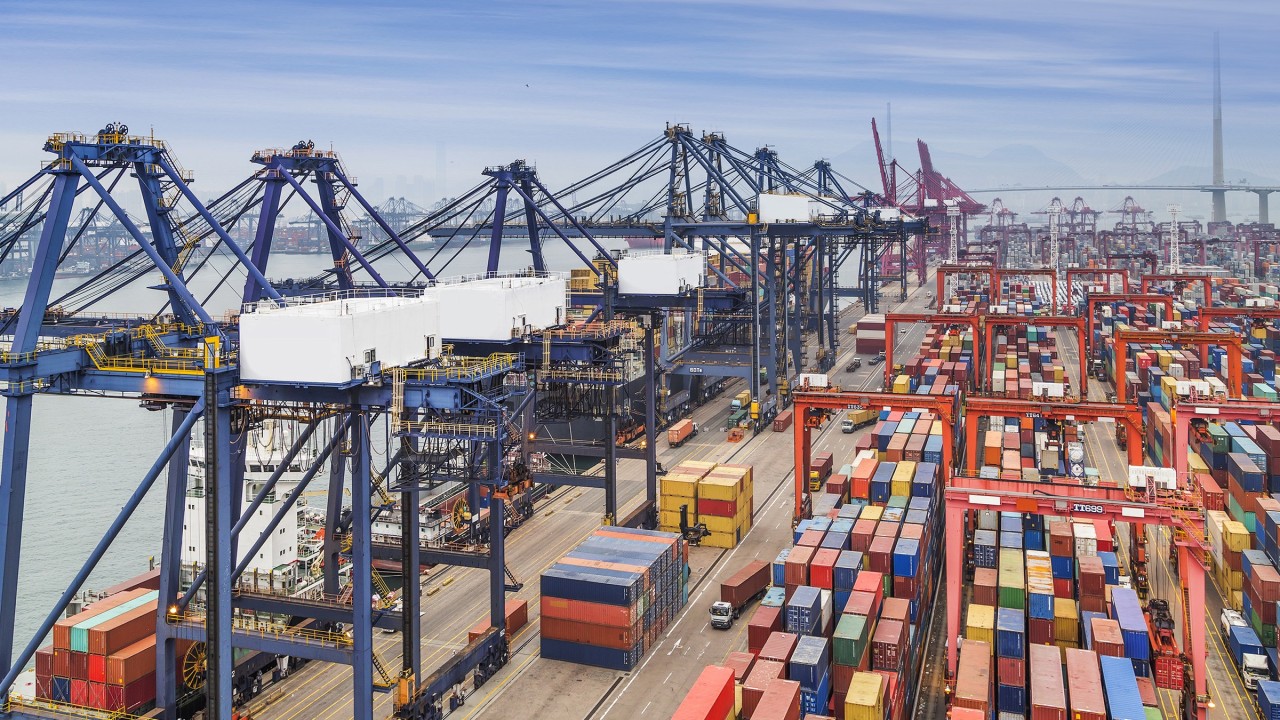
Prime Minister Narendra Modi activated India’s first deep-water semi-automated container transshipment port at Vizhinjam port town while reinstituting its global maritime significance. Facing international shipping lanes at only 10 nautical miles away, Vizhinjam Port gives India important access to global markets and freedom from foreign transshipment sites such as Colombo and Singapore. Through a cooperation model involving the Center, State and private-sector initiatives Vizhinjam Port seeks to drive Kerala's economic growth and strengthen India's worldwide maritime position.
Summary:
-
Vizhinjam Port represents India's inaugural greenfield deep-sea transshipment port which occupies a special position to access international shipping lanes and diminish dependence on overseas port terminals.
-
The port seeks to establish itself as a worldwide economic and logistics center through joint efforts by state authorities and the central government and private organizations yet needs swift address of existing infrastructure challenges and policy restrictions.

Key Points:
Strategic Location & Maritime Potential:
-
The port maintains the best position as an Indian port to reach international shipping lanes through a 10 nautical mile distance.
-
The natural 20-meter-deep water draft lets it harbor large ultra-class container vessels.
-
Mediterranean Shipping Company includes this location as a part of its worldwide shipping network.
Project Details:
-
The project costs Indian taxpayers ₹8,867 crore where ₹5,595 crore is Kerala government funding alongside ₹2,454 crore from Adani Ports coupled with ₹817.8 crore as part of Central government VGF.
-
A new India-based deepwater transshipment port with semi-automated systems operates from greenfield territory.
-
Between 6 and 8 lakhs TEU units were efficiently handled during the first year of operations which surpassed all expectations.

Innovation & Inclusivity:
-
India’s first port with a skilled women-led crane operation team.
-
A skill training center named Community Skill Park prepares professionals for maritime operations under the PPP business model.
Economic & Global Significance:
-
India has the opportunity to develop into its equivalent of Shenzhen.
-
Proposal for a Special Investment Region (SIR) under discussion.
-
The port seeks to establish itself as the worldwide leading center for providing bunkering services using hydrogen and ammonia as green fuels.
-
The brand redefinition includes changing the name to Trivandrum International Seaport Ltd.
Challenges:
-
The completion of NH 66 rail along with ICP and ORR infrastructure has caused project delays.
-
Absence of permanent Port Health Office and integrated check post.
-
The return of VGF investment to government bodies may rise as high as ₹10,000 crore.
-
Competition from Colachel port nearby—threat to economic viability.
Steps Taken:
-
The project appeared as a global showcase during WEF and Invest Kerala 2025.
-
The completion timeline for Phases II & III is set to reach its target by 2028.
-
Environmental approval is in place while businesses are investing ₹20,000 crore.
Ports in India

Types of Ports in India:
Port Classification Based on Geographical Area:
-
Major Ports in India (13):
-
The 13 major ports function under the Central Government through the application of both the Indian Ports Act (1908) and the Major Port Trust Act (1963).
-
Control terminals are distributed between Mumbai, Chennai, Kochi, Kolkata, Mangalore, and Visakhapatnam.
-
The Port Trusts rely on boards of trustees which are chosen by the Central Government to handle their management operations.
-
|
Coast |
State |
Port |
|
Eastern Coast |
Tamil Nadu |
Chennai |
|
Western Coast |
Kerala |
Kochi (Cochin) |
|
Eastern Coast |
Tamil Nadu |
Ennore |
|
Eastern Coast |
West Bengal |
Kolkata (Haldia) |
|
Western Coast |
Gujarat |
Kandla |
|
Western Coast |
Karnataka |
Mangalore |
|
Western Coast |
Goa |
Mormugao |
|
Western Coast |
Maharashtra |
Mumbai Port Trust |
|
Western Coast |
Maharashtra |
Jawaharlal Nehru Port Trust (JNPT) |
|
Western Coast |
Maharashtra |
Vadhavan Port |
|
Eastern Coast |
Odisha |
Paradip |
|
Eastern Coast |
Tamil Nadu |
Tuticorin (V.O. Chidambaranar Port) |
|
Eastern Coast |
Andhra Pradesh |
Visakhapatnam |
-
Minor Ports (205):
-
Managed by State Governments through Port Departments or State Maritime Boards.
-
The states of Gujarat, Maharashtra and Tamil Nadu together with Andhra Pradesh and West Bengal form the major port regions in India.
-
Port Classification Based on Cargo Handled:
-
Business-oriented ports receive and dispatch both general cargo and passenger services.
-
Industrial Ports: Specialize in bulk cargo like minerals, chemicals, and oil.
-
Such ports provide service for handling bulk as well as general cargo shipments.
Port Classification Based on Location:
-
Several ports inside India operate as inland facilities beyond its coastal areas and maintain river connections.
-
Out Ports: Deep-water ports like Vadhavan that support larger vessels.
Governance Models:
-
The Service Port Model involves port authorities that operate as landowners alongside equipment control while running all activities.
-
Under the Landlord Port Model the public holds port infrastructure ownership and operations run through private sector management including terminal operations and cargo handling activities.
Strategic Importance of Ports:
-
Foreign trade together with logistics fundamentally relies on India's ports for its operational success.
-
The Mumbai region maintains the status as India's greatest natural harbor facility.
-
The Maritime India Vision 2030 targets port infrastructure modernization alongside operation efficiency boost through advanced measures.
Economic Contribution:
-
The Indian ports give substantial economic impact to the GDP through their management of extensive container cargo volume at major shipping locations.
-
JNPT(Jawaharlal Nehru Port Trust) and Paradip act as crucial locations for handling containerized cargo and Kochi and Tuticorin focus on handling bulk cargo.
Conclusion:
The development of Vizhinjam Port brings about revolutionary changes to India's industry-driven port growth strategy. South Asian dominance in both maritime and logistics sectors can be attained by the development of strategic infrastructure alongside supportive policy initiatives. The project's complete realization requires stakeholders to collaborate quickly and better financial resources as well as rules that advance economic viability and sustainability and geopolitical strength.