


The Unified Payments Interface (UPI) in India is a decade-long milestone that has changed the digital payments environment in the country. UPI, which was introduced in 2016 by the National Payments Corporation of India, has facilitated real-time, safe, and smooth bank-to-bank payments using mobile-based devices. It has transformed the way people, corporations, and even small sellers use money, eliminating the need to carry cash and credit cards in the last decade. UI has made headlines in the global fintech innovation space thanks to features such as QR payments, real-time transfers, and interoperability, fueling financial inclusion and encouraging India to become a less-cash and digitally empowered economy.
UPI completes 10 years: Key achievements and impact
-
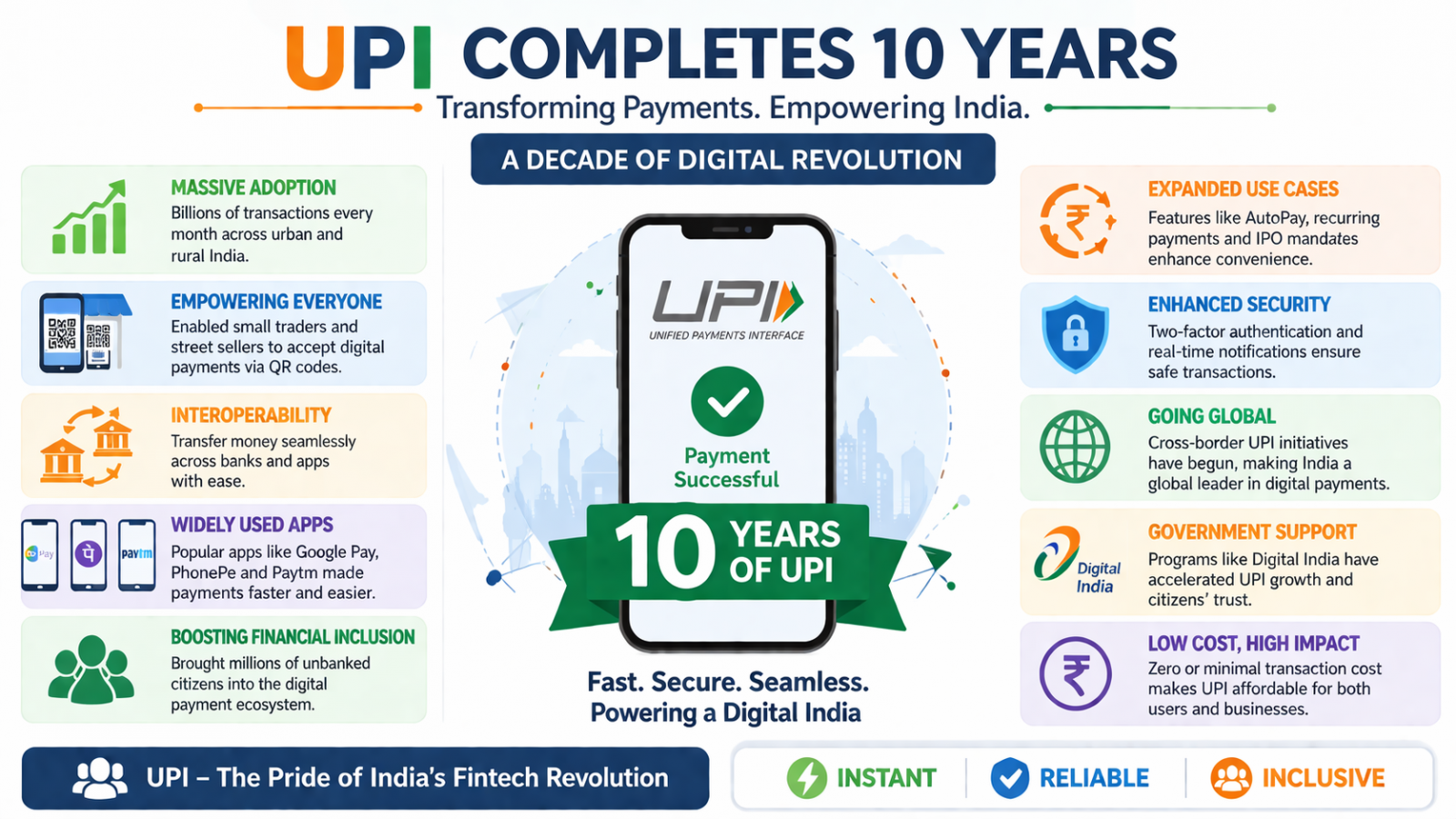
Billions of transactions have been done through UPI each month, with the scale of its adoption being massive across urban and rural India.
-
It allowed small traders and street sellers to easily accept digital payments through QR codes and eliminate the reliance on cash.
-
With interoperability, users can move money in and out of various banks and apps with ease.
-
Popular applications, such as Google Pay, PhonePe, and Paytm, have made the process of taking payments faster.
-
UPI has made a substantial impact on financial inclusion, introducing the unbanked population to the digital realm.
-
The platform allows such features as autopay, recurring payments, and IPO mandates, broadening its use cases.
-
It has also improved the security of transactions by having two-factor authentication and real-time notifications.
-
The implementation of cross-border UPI has already started, making India a leading nation in the digital payment process.
-
Government programs such as Digital India have increased the UPI growth and citizens’ trust in it.
-
The zero or the lowest transaction cost has rendered it appealing to both consumers and businesses.
-
UPI has minimized the physical infrastructure, such as POS machines.
-
Other incorporations with bill payments, e-commerce, and services have developed a complete digital ecosystem.
-
Its scalability has also helped it to absorb peak transaction levels without significant interruptions.
-
UPI has enabled innovation in digital banking and fintech startups.
Conclusion – India’s Unified Payments
Unified Payments Interface (UPI) in India has transformed the Indian financial ecosystem faster and greater than ever before in the last 10 years. It has established new standards of convenience, security and accessibility in digital transactions, developed by the National Payments Corporation of India. With innovations such as global expansion and integration of credit to enhance UPI, its contribution to enhancing financial inclusion and economic growth is of the essence. The UPI story is a representation of the Indian digital ambition, and its success case can be viewed as an example of countries around the world that want to modernize their payment systems and have a successful example to follow.