



The National Health Policy (NHP) target of 100 deaths per one lakh live births has successfully been achieved in India. The decline rate of MMR from 1990 to 2020 reached 83% marking a substantial improvement over global numbers according to Union Health Minister J.P. Nadda. The country experienced significant progress in reducing both Infant Mortality Rate (IMR) and Under-5 Mortality Rate statistics. The Indian government continues its commitment to improve health infrastructure and run health programs to maintain present achievements while simultaneously working on fulfilling United Nations Sustainable Development Goals (SDGs) targets for maternal health care.
What is the Maternal Mortality Ratio (MMR)?
-
The Maternal Mortality Ratio (MMR) counts the number of deaths from pregnancy or childbirth-related causes among 100,000 live born babies.
-
Definition: MMR refers to the number of maternal deaths per 1,00,000 live births due to pregnancy or childbirth-related complications.
Global and National Targets:
-
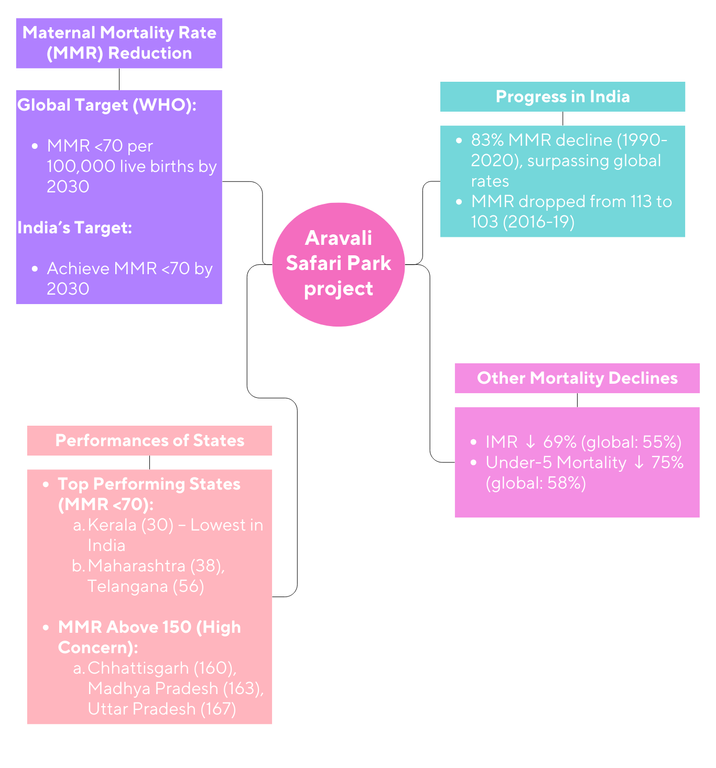
WHO Global Target: Reduce MMR to less than 70 per 1,00,000 live births by 2030 under the Sustainable Development Goals (SDGs).
-
India’s National Target: Reduce MMR to below 70 by 2030.
Decline in Maternal Mortality Rate
-
During 1990 to 2020 India showed an 83% decrease in MMR which exceeded worldwide decline rates.
-
According to data from the Registrar General of India the MMR decreased from 113 to 103 during the period 2016-18 to 2017-19.
-
The SDG target for MMR below 70 per 100,000 live births has already been reached by Kerala along with Maharashtra, Telangana and Tamil Nadu Andhra Pradesh together with Jharkhand.
-
A 69% decrease of Infant Mortality Rate (IMR) surpassed global declines which reached 55%.
-
The Under-5 Mortality Rate decreased by 75% in a manner exceeding the global decline rate of 58%.
Fertility Rate and Its Impact
-
The Total Fertility Rate (TFR) stands as the measurement which calculates the predicted number of offspring women will have between the ages of 15 to 49 years.
Categories of Fertility Rates:
-
High Fertility: TFR > 2.1 (replacement level); common in many developing nations.
-
The replacement level of fertility corresponds to a TFR of 2.1 which demonstrates a population that has reached equilibrium for stable growth.
-
Low Fertility: TFR < 2.1; results in population decline over time.
Fertility Trends in India and Globally:
-
The national Total Fertility Rate in India stands at 2.0 according to NFHS-5 from 2019-21 thus showing almost-replacement level fertility.
-
Japan with TFR 1.3 and South Korea with TFR 0.81 illustrate the difficulties that arise when population fertility stays low for a prolonged period.
Consequences of Declining Fertility Rates
-
The reduction of live births has an impact on increasing MMR while maternal deaths stay stable.
-
The aging population demographics in Kerala will create strain on both healthcare infrastructure along with public social programs.
-
Lower birth rates decrease the active workforce and diminish economic potential thus affecting development.
-
Social views about marriage, family and childbearing patterns evolve which negatively influences population growth over long periods.
MMR Trends Across Indian States
-
The SDG target has become achievable in seven states beyond the initial five states
-
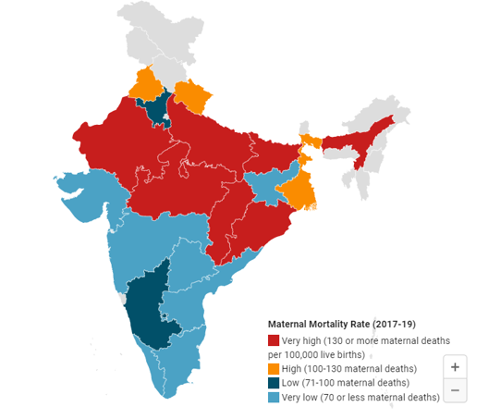
Kerala (30), Maharashtra (38), Telangana (56), Tamil Nadu (58), Andhra Pradesh (58), Jharkhand (61) and Gujarat (70).
-
The MMR rate in Kerala stands at 30 which represents the lowest mark ever recorded surpassing the overall national standard of 103.
-
Additional States Achieving NHP MMR Target: Karnataka (83) and Haryana (96).
-
-
States with MMR between 100-150:
-
Uttarakhand (101), West Bengal (109), Punjab (114), Bihar (130), Odisha (136), Rajasthan (141).
-
-
States with MMR above 150:
-
Chhattisgarh (160), Madhya Pradesh (163), Uttar Pradesh (167), Assam (205).
-
Major Causes of Maternal Mortality
-
The World Health Organization (WHO) identifies maternal deaths arising from pregnancy or childbirth and post-termination care during the 42-day period as maternal mortality.
Key causes include:
-
Severe bleeding (postpartum hemorrhage)
-
Infections
-
High blood pressure during pregnancy
-
Anemia
-
Unsafe abortions
-
Delivery complications
-
Social cultural factors including child marriages along with early pregnant conditions and financial limitations work as barriers to receiving proper maternal healthcare services.
Government Initiatives to Reduce Maternal Mortality Ratio (MMR)
-
Free antenatal care with complete quality benefits pregnant women through Pradhan Mantri Surakshit Matritva Abhiyan.
-
POSHAN Abhiyaan operates to advance nutritional results for expecting mothers.
-
The Direct Benefit Transfer (DBT) scheme Pradhan Mantri Matru Vandana Yojana (PMMVY) provides monetary assistance to pregnant women.
-
Surakshit Matritva Anushasan (SUMAN) provides pregnant women with dignified healthcare services that are free of any costs.
-
Labour Room & Quality Improvement Initiative (LaQshya): Enhances the quality of care in labor rooms, maternity operation theatres, and obstetrics ICUs.
Rise in Institutional Deliveries
-
The number of births in Indian institutions reached 95.5% during the 2020-21 period.
-
94% in rural areas
-
98% in urban regions
-
-
National births showed an enhanced improvement during 2020-21 since institutions handled 95.5% of deliveries while the 2019-21 total stood at 88.6%.
Strategies to Further Reduce MMR
-
The healthcare infrastructure requires expansion to provide better services across all rural and remote areas.
-
The training programs for healthcare providers include basic obstetric care training alongside comprehensive obstetric care training to improve maternal health services.
-
The implementation of awareness initiatives should promote hospital-based delivery service and actively combat dangerous community norms.
-
Regular monitoring through Maternal Death Surveillance and Response (MDSR): Enables timely interventions and corrective measures.
Conclusion
India accomplished its Maternal Mortality Rate goal because it demonstrated public health commitment through well-designed policy execution. The commitment to public health and effective policy implementation needs to keep going in order to both maintain current achievements and fulfill the UN Sustainable Development Goal of MMR reduction under 70 per 100,000 live births by 2030. Frontline healthcare worker empowerment coupled with healthcare system strengthening and barrier elimination from cultural society will drive enhanced maternal and child health results.