

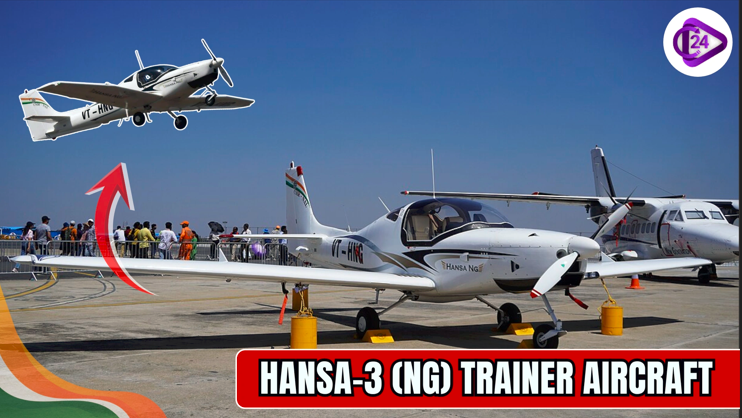
The Hansa-3 (NG) is a two-seat, next-generation trainer aircraft developed indigenously by CSIR-National Aerospace Laboratories (CSIR-NAL), Bengaluru. It was designed as an improved version of the original Hansa series, featuring a modern glass cockpit display, a lightweight all-composite airframe, better aerodynamics, and a bubble canopy to improve visibility. The aircraft is equipped with a Rotax 912 iSc3 engine that is fuel-efficient and has electronically controlled flaps, making it suitable for training pilots in the early stages. Certified in India in 2023 to operate as a flight-training aircraft, the Hansa-3 (NG) helps foster India's aviation ecosystem and reduces dependence on foreign trainers.
Key Features of CSIR-NAL Hansa-3
-
The aircraft is a low-wing, two-seat, all-composite fibreglass and carbon airplane, with low weight, durability and lower maintenance.
-
Planned with a modern glass-cockpit digital avionics suite, which improves situational awareness for trainee pilots.
-
Energetic Rotax 912 iSc3 engine, which offers efficient operation and reduces the cost of operation.
-
Flaps are electrically operated, and the design features a bubble canopy to enhance handling, visibility, and comfort for the pilot.
-
The range and endurance of up to 620 nautical miles and 7 hours, as per the offers, are suitable for long-term training missions.
PYQs-Based Exam Dedicated Questions
| Exam & Year | Question Asked | Options | Correct Answer |
|---|---|---|---|
| UPSC Prelims 2023 | The Council of Scientific and Industrial Research (CSIR) functions under which ministry? | A. Ministry of Education B. Ministry of Science & Technology C. Ministry of Commerce D. PMO |
B. Ministry of Science & Technology |
| SSC CGL 2022 | CSIR was established in which year? | A. 1930 B. 1942 C. 1955 D. 1960 |
B. 1942 |
| RRB JE 2021 | Where is the headquarters of CSIR-National Aerospace Laboratories (NAL)? | A. Pune B. Bengaluru C. Hyderabad D. Delhi |
B. Bengaluru |
| SSC CHSL 2023 | CSIR mainly works in which field? | A. Defence research B. Industrial & scientific R&D C. Agriculture only D. Banking |
B. Industrial & scientific R&D |
| UPSC Prelims 2021 | Which of the following is a laboratory under CSIR? | A. ISRO-VSSC B. NAL C. DRDO-DEAL D. BARC |
B. NAL |
| State PCS 2023 | CSIR has how many national laboratories? | A. 10 B. 17 C. 37 D. 50 |
C. 37 |
| SSC CPO 2022 | CSIR operates under which type of body? | A. Statutory body B. Autonomous body C. Constitutional body D. PSU |
B. Autonomous body |
| RRB NTPC 2020 | The full form of CSIR is: | A. Centre for Scientific Industrial Research B. Council of Scientific and Industrial Research C. Council of Science Research D. Centre for Science & Industry Research |
B. Council of Scientific and Industrial Research |
Expected Question for Hansa-3
1. Hansa-3 (NG) trainer aircraft is developed by which organisation?
A. DRDO
B. HAL
C. CSIR–NAL
D. ISRO
✔ Answer: C. CSIR–NAL
Explanation: Hansa-3 (NG) is an indigenously developed two-seat trainer aircraft built by CSIR–National Aerospace Laboratories in Bengaluru.
2. What is the primary use of the Hansa-3 (NG) aircraft?
A. Cargo transport
B. Surveillance
C. Pilot training
D. Passenger service
✔ Answer: C. Pilot training
Explanation: The aircraft is specifically designed as an ab-initio trainer for PPL and CPL pilot training.
3. Hansa-3 (NG) uses which type of engine?
A. PT6 Turboprop
B. Rotax 912 iSc3
C. Shakti Engine
D. Kaveri Engine
✔ Answer: B. Rotax 912 iSc3
Explanation: It uses a fuel-efficient Rotax engine that improves performance and reduces operating costs.
4. Which of the following features is a major upgrade in Hansa-3 (NG)?
A. Analog instrument panel
B. Bubble canopy design
C. Wooden airframe
D. Manual flaps
✔ Answer: B. Bubble canopy design
Explanation: The new bubble canopy provides wider field visibility—important for training pilots.
5. Hansa-3 (NG) is made using which airframe material?
A. Steel
B. Aluminium alloy
C. Composite materials
D. Titanium
✔ Answer: C. Composite materials
Explanation: The aircraft uses lightweight composite materials to reduce weight and improve efficiency.
6. What is the seating capacity of Hansa-3 (NG)?
A. 1
B. 2
C. 4
D. 6
✔ Answer: B. 2
Explanation: It has a two-seat arrangement—one instructor and one trainee.
7. Which of the following describes the cockpit of Hansa-3 (NG)?
A. Fully analog
B. Semi-digital
C. Full glass-cockpit
D. No cockpit display
✔ Answer: C. Full glass-cockpit
Explanation: The aircraft features a digital glass-cockpit display for improved situational awareness.
8. Hansa-3 (NG) was certified for pilot training use in which year?
A. 2020
B. 2021
C. 2023
D. 2025
✔ Answer: C. 2023
Explanation: Regulatory authorities approved it for training operations in 2023.
9. What is the average flight endurance of the Hansa-3 (NG)?
A. 1 hour
B. 3 hours
C. 7 hours
D. 10 hours
✔ Answer: C. 7 hours
Explanation: Its long endurance makes it suitable for extended training sorties.
10. Hansa-3 (NG) is mainly built to help India reduce dependence on which of the following?
A. Foreign trainer aircraft
B. Satellite imports
C. Rocket engines
D. Fighter jets
✔ Answer: A. Foreign trainer aircraft
Explanation: It is part of India’s effort to strengthen indigenous aviation training capabilities.
Conclusion
The Hansa-3 (NG) trainer by Minister Dr. Jitendra Singh in Bengaluru marks a significant step in India's aerospace progress. The fully indigenous next-generation aircraft boosts the country's training capacity, reduces reliance on external trainers, and showcases CSIR-NAL's growing expertise in developing modern, affordable aviation technology.