

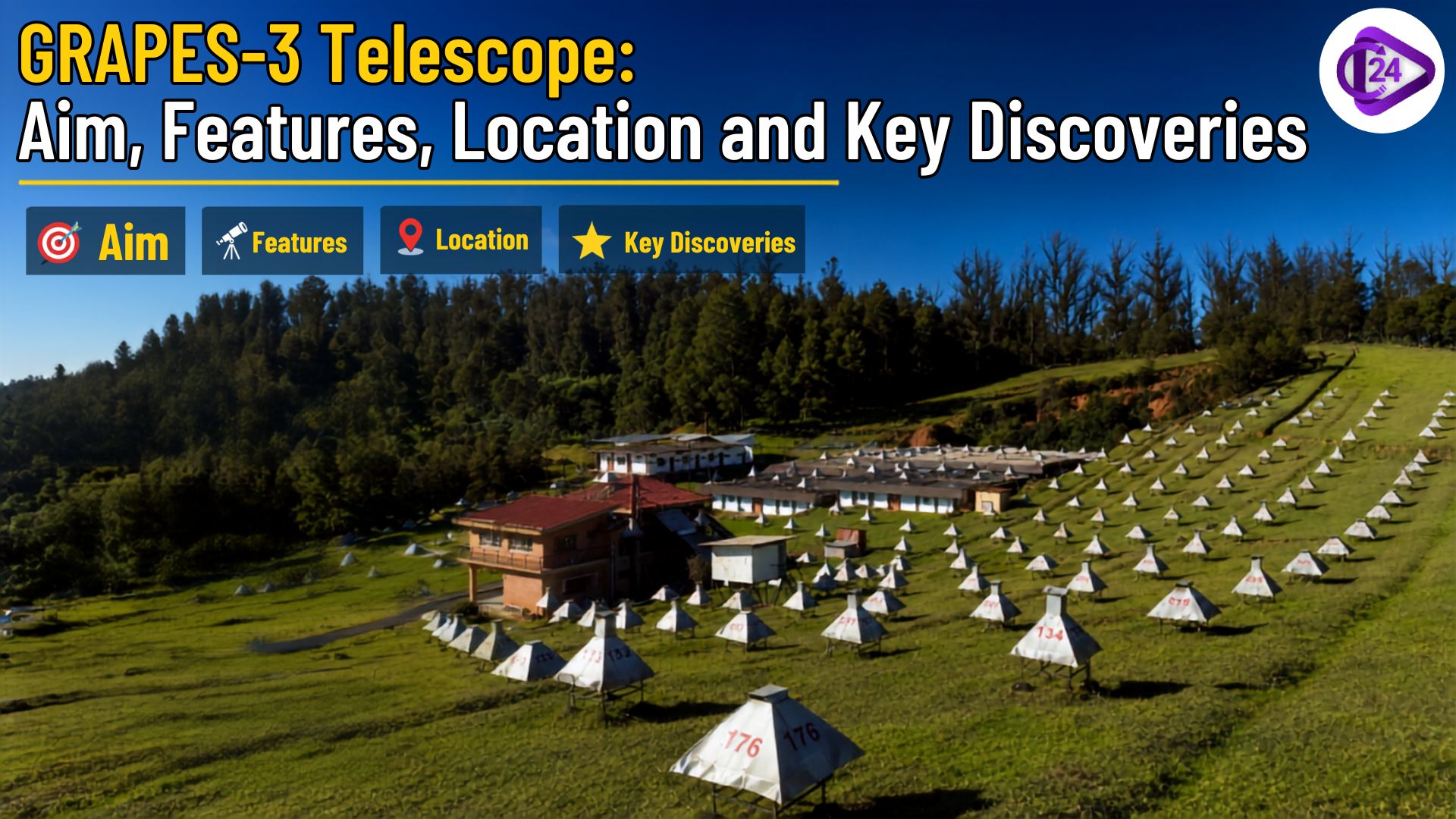
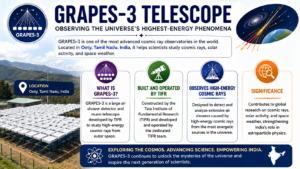
GRAPES-3 Telescope is one of the most modern and sophisticated cosmic ray observatories for observing cosmic ray of high energy source in outer space. Located in Ooty, Tamil Nadu, India, this scientific facility plays a crucial role in understanding cosmic rays, solar activity, and space weather.
The GRAPES-3 Telescope is a telescope constructed by the Tata Institute of Fundamental Research (TIFR) and is being developed and operated by the TIFR team. GRAPES-3 is a massive air shower detector and muon telescope which is being used to study some of the highest-energy phenomena in the universe. It has made important contributions to global research on cosmic rays and improved India’s position in astroparticle physics over the years.
Key Characteristics of GRAPES-3 Telescope
- At Ooty in Tamil Nadu, India.
- Tata Institute of Fundamental Research (TIFR) operates it.
- It is the third generation in 2000 of the GRAPES experiment.
- Researches phenomena and high-energy cosmic rays.
- Constructs the world’s largest muon telescope.
- Picks up large air showers produced by cosmic rays.
- Assists in observing space weather and geomagnetic storms.
- Supports research in astrophysics at the international level.
What is the GRAPES-3 Telescope?
GRAPES is a Gamma-Ray Astronomy Phase-3, with an emphasis on peV energy. The observatory is especially suited to explore teraelectronvolt (TeV) to petaelectronvolts (PeV) cosmic rays.
Primary high-energy cosmic particles penetrate the atmosphere and collide with molecules of the air, creating cascades of secondary particles called extensive air showers. The GRAPES-3 Telescope is able to detect and analyse these showers to trace back the origin, energy and properties of cosmic rays.
It combines cutting-edge particle detection technologies with sophisticated data analysis systems, allowing scientists to conduct research with precision on galactic and solar phenomena.
GRAPES-3 Telescope: Overview Table
| Particulars | Details |
| Full Name | Gamma Ray Astronomy PeV EnergieS Phase-3 |
| Popular Name | GRAPES-3 Telescope |
| Location | Ooty, Tamil Nadu, India |
| Altitude | Approximately 2,200 metres above sea level |
| Operating Institution | Tata Institute of Fundamental Research (TIFR) |
| Year of Commissioning | 2000 |
| Primary Objective | Study of cosmic rays and space weather |
| Major Components | Air shower array and muon telescope |
| Detection Range | TeV to PeV energy range |
| Scientific Field | Astroparticle Physics |
The goal and objectives of the GRAPES-3 Telescope
The first goal of the GRAPES-3 Telescope is to gain knowledge about high energy cosmic rays nature and origin. Besides that, it aims at enhancing the understanding of the nature of solar activity and how it affects the Earth.
Major Objectives of GRAPES-3 Telescope
- Explore the sources and acceleration mechanisms of cosmic rays.
- Observe the distribution of energy and types of cosmic particles.
- Study extensive air showers produced in Earth’s atmosphere.
- Observe solar flare/geomagnetic storm variations.
- Discuss space weather phenomena that can impact satellites and power systems.
- Look for signatures of physics that are new to theory.
Previous Year Questions (PYQs)
| Year | Exam | Question | Answer |
| 2024 | UPSC CSE Prelims | With reference to the Giant Metrewave Radio Telescope (GMRT), consider the following statements:1. It is located near Pune in Maharashtra.2. It is operated by the National Centre for Radio Astrophysics.3. It is used for observing radio waves from celestial objects. Which of the statements given above are correct? (a) 1 and 2 only(b) 2 and 3 only(c) 1 and 3 only(d) 1, 2 and 3 | (d) 1, 2 and 3 |
| 2020 | UPSC CSE Prelims | The term “Thirty Meter Telescope” sometimes seen in the news refers to:(a) A space-based infrared observatory(b) A next-generation ground-based optical telescope(c) A radar system used for asteroid tracking(d) A deep-sea observatory | (b) A next-generation ground-based optical telescope |
| 2016 | UPSC CSE Prelims | The term ‘Event Horizon’, often seen in the news, is associated with:(a) Black holes(b) Exoplanets(c) Asteroids(d) Comets | (a) Black holes |
| 2015 | UPSC CSE Prelims | LIGO, which is often in the news, is associated with the detection of:(a) Neutrinos(b) Dark matter(c) Gravitational waves(d) Cosmic rays | (c) Gravitational waves |
| 2013 | UPSC CSE Prelims | Which of the following pairs is/are correctly matched? 1. Astronomical Observatory — Kodaikanal2. Radio Telescope — Arecibo3. Optical Telescope — Mount Abu Select the correct answer using the code given below:(a) 1 only(b) 1 and 2 only(c) 2 and 3 only(d) 1, 2 and 3 | (d) 1, 2 and 3 |
US-Iran Deal Ends War; Strait of Hormuz Set to Reopen
Conclusion on GRAPES-3 Cosmic Ray Telescope
GRAPES-3 Telescope is an unprecedented scientific facility which revolutionized cosmic ray research in India. Due to its strategic location, sophisticated muon detector system, and 24/7 monitoring, it is one of the indispensable observatories for measuring and tracking space weather and high-energy particles. The GRAPES-3 Telescope is poised to be a key player in the field of cosmic ray studies and our understanding of solar-terrestrial interactions in the coming years as scientists delve deeper into the secrets of the universe.