
The Government of India delivers substantial backing to Classical Languages to sustain their existence along with their enhancement through institutional entities and educational endowments and academic chairs establishing centers of excellence. Presently the government recognizes Tamil and Sanskrit alongside Telugu, Kannada, Malayalam, and Odia and has expanded its support to cover Marathi, Pali, Prakrit, Assamese, and Bengali. The Ministry of Education advances research together with development projects in selected languages.
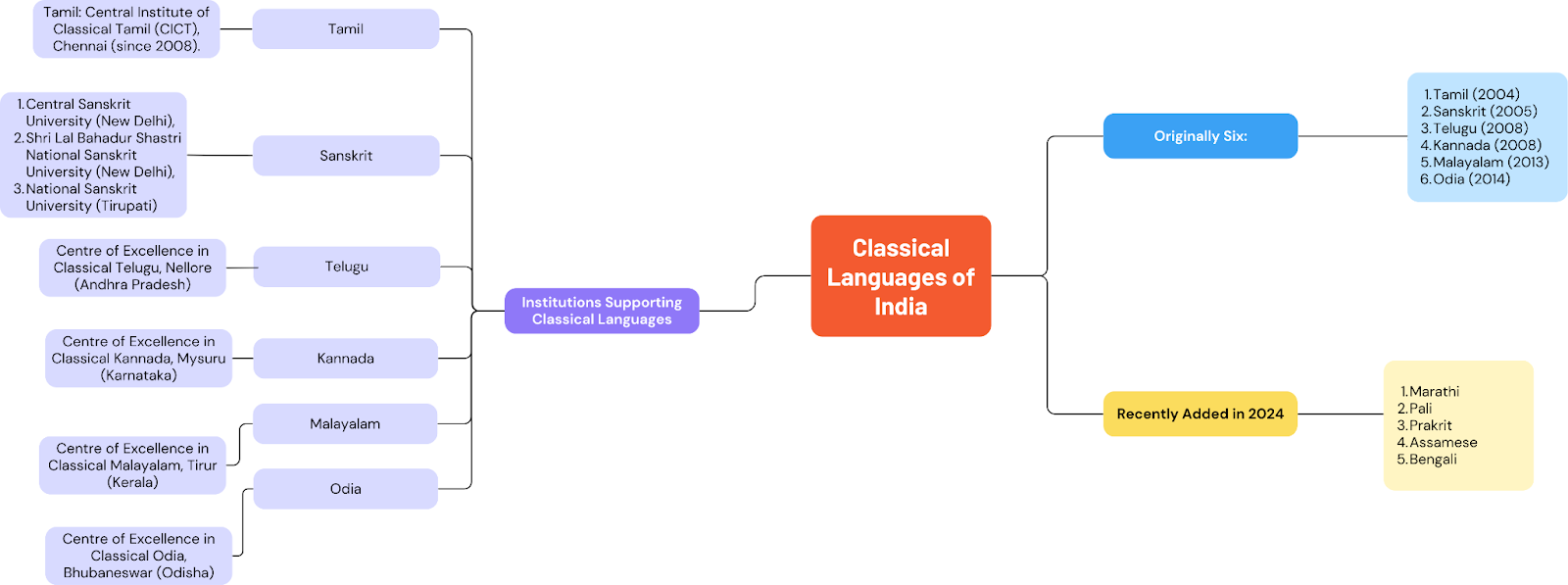
Classical Languages Recognized:
-
Tamil: 2004
-
Sanskrit: 2005
-
Telugu: 2008
-
Kannada: 2008
-
Malayalam: 2013
-
Odia: 2014
Recently added new languages:
-
The government of India introduced new classical languages starting from Marathi, Pali, Prakrit, Assamese, and Bengali.
Support Provided
-
The award system recognizes individuals who make exceptional research achievements in Classical Language studies.
-
Excellence Research Centers act as institutional bases for classical language research and development.
-
The establishment of professional chairs at central universities functions to develop language proficiency.
Institutions Supporting Classical Languages
-
Tamil: Central Institute of Classical Tamil (CICT), Chennai (since 2008).
-
Sanskrit: Promoted through Central Sanskrit University (New Delhi), Shri Lal Bahadur Shastri National Sanskrit University (New Delhi), and National Sanskrit University (Tirupati).
-
Telugu: Centre of Excellence in Classical Telugu, Nellore (Andhra Pradesh).
-
Kannada: Centre of Excellence in Classical Kannada, Mysuru (Karnataka).
-
Malayalam: Centre of Excellence in Classical Malayalam, Tirur (Kerala).
-
Odia: Centre of Excellence in Classical Odia, Bhubaneswar (Odisha).
Conclusion
Government departments support Classical Languages through recognition because it demonstrates their dedication to national linguistic heritage and the study of ancient languages.