

Conserving the Immortal Marks of Archaeological Sites: Conservation Amidst Modern Challenges

The archaeological sites Khajuraho, Hampi, and Somnath in India encounter multiple threats from environmental changes, pollution, and development into urban areas. ASI started its operation in 1861 to monitor 3,698 monuments under the Ancient Monuments and Archaeological Sites and Remains Act of 1958. The funding for conservation measures reached ₹443.53...

Conserving the Immortal Marks of Archaeological Sites: Conservation Amidst Modern Challenges

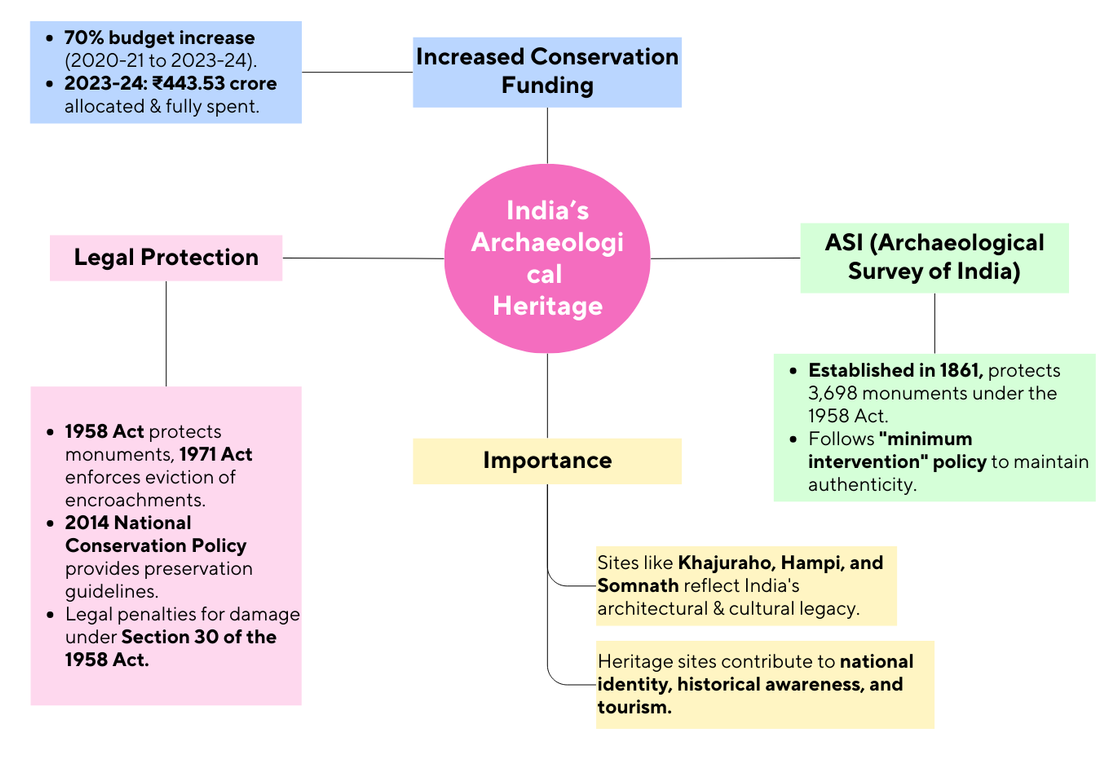
The archaeological sites Khajuraho, Hampi, and Somnath in India encounter multiple threats from environmental changes, pollution, and development into urban areas. ASI started its operation in 1861 to monitor 3,698 monuments under the Ancient Monuments and Archaeological Sites and Remains Act of 1958. The funding for conservation measures reached ₹443.53 crores during 2023-24 after authorities increased their budget by 70%. ASI employs climate-resilient strategies, Automated Weather Stations (AWS) with ISRO, air pollution monitoring, and disaster preparedness under NDMA guidelines. Through legal guidelines, the state implements both encroachment prevention measures and security measures. India safeguards its cultural heritage through the National Conservation Policy which was established in 2014. The combined efforts of proactive conservation activities stop past historical landmarks from disappearing as ancestors view them.

Importance of India’s Archaeological Heritage

  • The nation possesses multiple internationally renowned archaeological sites along with Khajuraho, Hampi, and Somnath Temple among them.

  • The historic sites in India showcase three primary dimensions of the nation's background bestowing architectural supremacy and cultural richness between the Himalayas and Kanyakumari regions.

  • The archaeological sites serve as vital components that both support national identity develop historical awareness and draw tourists.
Threats to Archaeological Sites

  • Extreme environmental changes through rising sea levels combined with extreme temperatures, torrential rains, forest fires, and strong winds quicken the natural decay of archaeological sites.

  • Environmental dangers consisting of pollution and encroachments and urbanization and quarrying operations create hazards for monuments.

  • Archaeological sites face degradation issues because of how well materials were produced and what building methods were used plus natural catastrophic events.

Role of the Archaeological Survey of India (ASI)

  • The Archaeological Survey of India was established in 1861 to guard 3,698 nationally important monuments.

  • Monuments are safeguarded via two legal acts including the Ancient Monuments Preservation Act (1904) and the Ancient Monuments and Archaeological Sites and Remains Act (1958).

  • The maintenance strategy follows the principle of doing only essential work to protect site authenticity.

  • The organization utilizes 37 Circle offices together with 1 Mini Circle to manage conservation programs at specific sites across the nation.

Increased Funding for Conservation

  • The government budget for the ASI experienced a 70% growth from 2020-21 to 2023-24.

  • 2020-21: ₹260.90 crores allocated, ₹260.83 crores spent.

  • The conservation program for monuments received ₹443.53 crores in funding during both the 2023-24 fiscal years and spent all the allocated amount.

Climate-Resilient Conservation Measures

  • A comprehensive system of regular site checks exists for the detection of damage from climate change.

  • Weather-resisting scientific strategies maintain architectural structures in their original state.

  • ISRO operates Automated Weather Stations (AWS) to monitor heritage site wind speeds and rainfall and environmental temperatures.

  • Two pollution labs equipped at the Taj Mahal (Agra) and Bibi Ka Maqbara (Aurangabad) track the level of air pollution.

  • ASI works with government bodies to establish complete preservation strategies through coordination efforts.

  • ASI engages in disaster management workshops among other activities through its participation with UNESCO and NDMA facilities.

  • The National Disaster Management Guidelines have been developed to ensure preparedness at cultural heritage sites.

Legal and Security Safeguards

  • Monuments receive protection from the Ancient Monuments and Archaeological Sites and Remains Act 1958.

  • Superintending Archaeologists are authorized to exercise eviction powers through the Public Premises Act of 1971 for encroachment control.

  • Specific monuments receive protection through combined forces of CISF and private security staff.

  • The 2014 National Conservation Policy functions as the main direction for protected site preservation activities.

  • Section 30 of the 1958 Act imposes legal penalties on those who misuse or destroy monuments according to the Act.

Conclusion

  • Conducting ongoing environmental regulations plus substantial legal protocols and security measures is necessary to safeguard India's cultural heritage.

  • ASI guides these historical treasure protection efforts together with government bodies and international organizations.

  • India’s culture will stay safeguarded for the next generations through forward-thinking conservation strategies.


India-US, Quad Push Critical Minerals Partnership Amid China Curbs
Historic Book on India’s First Olympic Gold Released
Chhattisgarh’s Kopra Reservoir Shines as New Biodiversity Hotspot
President Murmu to Confer Padma Awards on 66 Recipients
Indian Army Launches Advanced AI Platforms Kautilya, Q-FORCE
Bengaluru to Host India’s First National AI & Digital Water Summit 2026

Start Learning Today with Class24

Class24 Mobile Application

Class24 also has a mobile application so that it becomes easily accessible and convenient. This can be downloaded on an Android device. Users have appreciated this app and the content provided as 4.1 out of 5 is its rating in the App Store. People loved it because Class24 is giving content which is extremely rich in every sense. The app comprises a wide variety of features for smooth learning:

  • User-Friendly Interface: The app is categorized into various sections so that students can navigate and access various resources with ease.
  • Offline Access: The study materials can be downloaded and the student can access them even when not connected to the internet.
  • Inbuilt eBook Reader: There is a lightning-fast reader for eBooks within the app, so reading is seamless.
  • Progress Tracking: The app tracks student’s progress in preparation and keeps them organized and focused.

Courses and Subjects Offered

The total syllabus will be covered, and there are in-depth practice materials so as to give deep preparation in the courses designed to each one of them. All the subjects come under the aegis of courses offered by Class24 to meet different needs of various aspirants such as:

Preparation Tips for All Exams

Preparation tips for all exams mentioned below:

  • Previous Year Papers: Try to attempt at least 5-10 years of question papers to know the pattern of questions, how much difficulty one would face while answering, and how many frequently asked topics were in the examination.
  • Take Mock Tests: Attempt Mock Tests regularly in order to time and accuracy. You may analyze the performance and make an improvement for weak areas.
  • Focus on Time Management: Solve questions in the given time to make a habit of having speed and efficiency. Allocate time sensibly between Paper 1 and Paper 2, while appearing in the examination.
  • Current Affairs: For Current Affairs and TET exams, be updated about current affairs, teaching aptitude, and general awareness.
  • Regular Revision: Spend your daily and weekly time for revisions to not forget concepts and formulas. Use flashcards or do self-summary notes for quick revisions.
  • Understand the Exam Pattern and Syllabus: Understand the pattern of your exam paper and syllabus very well. Both Current Affairs and CSIR NET examinations are two-tier ones and involve both Paper 1, which consists of general aptitude and Paper 2 that involves specific aptitude subjects.
  • Make a Study Plan: Divide the preparation time into three phases of concept building, revision, and mock tests. Allocate more time to weaker areas while maintaining equilibrium with stronger sections.
  • Online Coaching or Study Groups: Enroll in online coaching programs like Class24 to get proper guidance and a structured approach to the study. Study groups will be useful to discuss doubts and share resources.
  • Stay Consistent and Motivated: Maintain a steady study schedule. Stay motivated by making small achievable goals.
  • Use Quality Study Materials: Suggested study material refers to a textbook, a set of previously published question papers, and web sources such as Class24.

Conclusion

Class24 is a one stop solution for aspirants preparing for Current Affairs, CSIR NET, SET, UP PGT English, UP TGT PGT, UPHESC Assistant Professor, TET, IGNOU B.Ed and other competitive exams. There are structured courses, live classes, mock tests along with the guidance of experts to assist candidates in achieving success in their respective fields.

Get success in your hand. Start study anytime anywhere.

The journey becomes simple and enjoyable when you start taking interest in it. And through our app “Class24”, we will be your trusted partners in developing that interest.

Daily Quizzes
Mock Tests
Ongoing

No ongoing tests right now.