
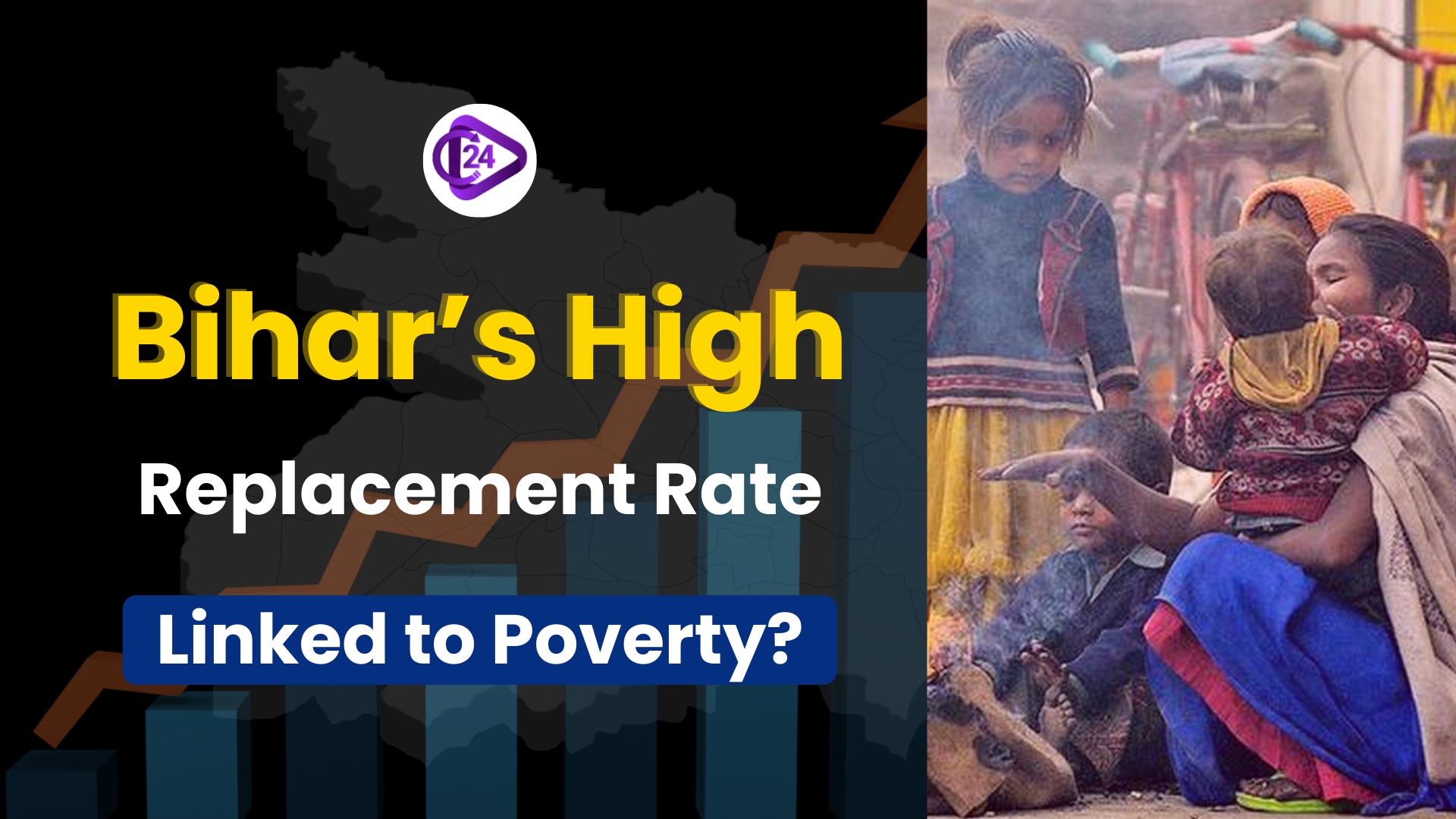
Is Bihar’s High Replacement Rate a Consequence of Poverty?

The latest SRS data shows that India is experiencing significant demographic change. While the average number of children per woman in India is now at the replacement level (2.0), Bihar’s rate is much higher at 3.0. The high rate of population growth in Bihar makes one ask, is the issue...

Is Bihar’s High Replacement Rate a Consequence of Poverty?

The latest SRS data shows that India is experiencing significant demographic change. While the average number of children per woman in India is now at the replacement level (2.0), Bihar’s rate is much higher at 3.0. The high rate of population growth in Bihar makes one ask, is the issue just poverty-related, or are there other forces, both cultural and economic, affecting it?

Introduction:

  • People in Bihar have an average of 3.0 kids each (TFR for 2021), which is much higher compared to India’s average (2.0), as well as to Delhi and West Bengal (both ~1.4).

  • It brings into question whether the high fertility rates of Bihar can be tied solely to poverty.

Key Points and Analysis

High and Persistent Fertility Rate:

  • There has been little movement in TFR in Bihar, which has remained close to 3.0, and replacement fertility of 2.1 will only be reached by Bihar around the year 2039.

  • The number of infant deaths has gone down (from 42 to 27 out of 1,000 births), women now finish more years at school, but the total fertility rate stays high.

Poverty Linkage is Partial:

  • Even though, in general, more poverty means more children, the area of Bihar has seen its poverty drop but not much change in fertility, according to NITI Aayog’s Multidimensional Poverty Index.

  • It is not only poverty that determines how many children a family has. Culture and the accepted social standards have a major effect on a person’s choice to have children.

Cultural Preferences and Fertility:

  • In Bihar, 50% of women consider an ideal family to be two children, less than the 67% of women who think this elsewhere in India.

  • Many families in farming and landholding professions still prefer having sons and a large family since they are able to provide labor and care for property.

  • Women usually make fertility decisions willfully, influenced by the local culture.

Urban-Rural Disparity and Puzzling Urban High Fertility

  • Bihar’s TFR in urban areas is 2.3, which is much higher than India’s urban average of 1.6, meaning families that live in cities and have more education and income like to have large families.

  • This runs against the common view that urbanization leads to lower fertility.

Role of female education and employment

  • In the year 2011, the figure of female literacy in Bihar was 53%.

  • Learning increases the number of years between births; even so, many women do not freely decide about childbirth.

  • Certain studies have found that many families with a mother-in-law authority often control the access women have to family planning.

Economic and Employment Factors:

  • With so many people looking for jobs and not much industry, Bihar has fewer opportunities for people to make a living.

  • When families are financially unsure, many prefer to have more children as backup support and help.

Political and Demographic Implications:

  • High fertility has resulted in UP, MP, and Bihar making up a bigger share of India’s population than expected.

  • This change in demography will affect how much population each parliamentary constituency has and the amount of resources each state gets after delimitation, potentially causing those with fewer people and families to get less representation and financial support.

  • To correct inequalities among different parts of the population, it is necessary to adjust policies and strengthen democratic equality.

Conclusion:

People in Bihar have more children for several reasons linked to the economy, culture, and society, not just because of poverty. It is important to have policies that support female education, improving their lives, helping them gain different work skills, and reforming society. It is very important to tackle demographic inequality to ensure democracy is open and fair for all.


Cabinet approves Emergency Credit Line Guarantee Scheme 5.0
Cabinet Approves Increase in Supreme Court Judge Strength to 37
Union Cabinet Approves Mission for Cotton Productivity in India
Vande Mataram Insult to Become Punishable Offence, Cabinet Clears Amendment
UDGAM Portal Update: 30 Banks Integrated to Help Legal Heirs Trace Unclaimed Funds
Malcolm Adiseshiah Award 2026, Raghav Das Gaiha Honoured
07 May 2026
06 May 2026
05 May 2026
04 May 2026
02 May 2026
01 May 2026
30 April 2026
29 April 2026
17 April 2026
16 April 2026

Start Learning Today with Class24

Buy a course

SSC

Railway

Banking

Teaching Exams

Rajasthan Exams

K12 Courses

Class24 Mobile Application

Class24 also has a mobile application so that it becomes easily accessible and convenient. This can be downloaded on an Android device. Users have appreciated this app and the content provided as 4.1 out of 5 is its rating in the App Store. People loved it because Class24 is giving content which is extremely rich in every sense. The app comprises a wide variety of features for smooth learning:

  • User-Friendly Interface: The app is categorized into various sections so that students can navigate and access various resources with ease.
  • Offline Access: The study materials can be downloaded and the student can access them even when not connected to the internet.
  • Inbuilt eBook Reader: There is a lightning-fast reader for eBooks within the app, so reading is seamless.
  • Progress Tracking: The app tracks student’s progress in preparation and keeps them organized and focused.

Courses and Subjects Offered

The total syllabus will be covered, and there are in-depth practice materials so as to give deep preparation in the courses designed to each one of them. All the subjects come under the aegis of courses offered by Class24 to meet different needs of various aspirants such as:

Preparation Tips for All Exams

Preparation tips for all exams mentioned below:

  • Previous Year Papers: Try to attempt at least 5-10 years of question papers to know the pattern of questions, how much difficulty one would face while answering, and how many frequently asked topics were in the examination.
  • Take Mock Tests: Attempt Mock Tests regularly in order to time and accuracy. You may analyze the performance and make an improvement for weak areas.
  • Focus on Time Management: Solve questions in the given time to make a habit of having speed and efficiency. Allocate time sensibly between Paper 1 and Paper 2, while appearing in the examination.
  • Current Affairs: For Current Affairs and TET exams, be updated about current affairs, teaching aptitude, and general awareness.
  • Regular Revision: Spend your daily and weekly time for revisions to not forget concepts and formulas. Use flashcards or do self-summary notes for quick revisions.
  • Understand the Exam Pattern and Syllabus: Understand the pattern of your exam paper and syllabus very well. Both Current Affairs and CSIR NET examinations are two-tier ones and involve both Paper 1, which consists of general aptitude and Paper 2 that involves specific aptitude subjects.
  • Make a Study Plan: Divide the preparation time into three phases of concept building, revision, and mock tests. Allocate more time to weaker areas while maintaining equilibrium with stronger sections.
  • Online Coaching or Study Groups: Enroll in online coaching programs like Class24 to get proper guidance and a structured approach to the study. Study groups will be useful to discuss doubts and share resources.
  • Stay Consistent and Motivated: Maintain a steady study schedule. Stay motivated by making small achievable goals.
  • Use Quality Study Materials: Suggested study material refers to a textbook, a set of previously published question papers, and web sources such as Class24.

Conclusion

Class24 is a one stop solution for aspirants preparing for Current Affairs, CSIR NET, SET, UP PGT English, UP TGT PGT, UPHESC Assistant Professor, TET, IGNOU B.Ed and other competitive exams. There are structured courses, live classes, mock tests along with the guidance of experts to assist candidates in achieving success in their respective fields.

Get success in your hand. Start study anytime anywhere.

The journey becomes simple and enjoyable when you start taking interest in it. And through our app “Class24”, we will be your trusted partners in developing that interest.

Daily Quizzes
Mock Tests
Ongoing

No ongoing tests right now.