


India is launching the first people-centred cab service, Bharat Taxi, which aims to be the first cooperative-based taxi company in the ride-hailing industry. The service is incorporated under the Multi-State Cooperative Societies Act, 2002, and is intended to make the drivers cooperative with the same, rather than being commission-based partners. Bharat Taxi uses zero-commission and no-surge pricing, which provides drivers with decent proceeds and fares that are affordable to passengers. The social security benefits will include insurance and retirement benefits to the drivers who will be referred to as Sarathis. The project is aimed at facilitating independence and transparency, all-inclusive development, and providing an indigenous alternative to the current private cab aggregators in India.
Key Objectives of Bharat Taxi Cab Service
-
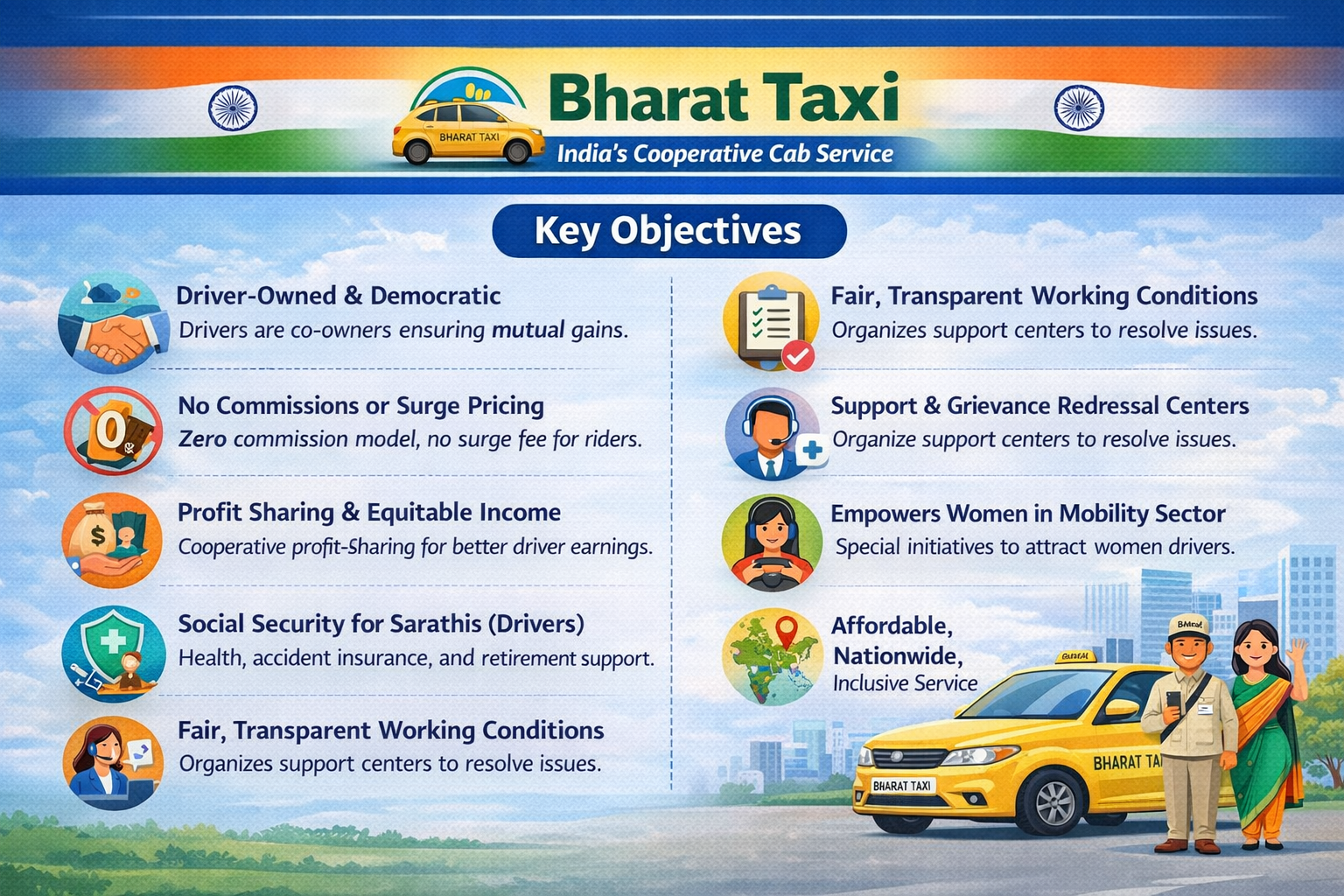
To create a driver-focused collaborative ride-hailing application where drivers are part of it and co-owners to guarantee democratic inclusion and mutual gains.
-
To offer an indigenous, cooperative-based solution to the private cab aggregators with profit-motivated designs.
-
In order to exist on a zero commission and surge pole cost plan, allowing drivers to keep the largest possible income while providing the passengers with cheaper deals.
-
To provide equitable income distribution by means of direct profit sharing amongst the cooperative members.
-
To enable social security for drivers (Sarathis) through offering them health insurance, accident insurance and retirement assistance.
-
To advance fair working conditions and the dignity of labour among taxi drivers through organised welfare systems.
-
To put in place support and grievance redress centres to take care of operational assistance, safety, and emergency response.
-
To enable drivers to work on multiple platforms freely without the constraints of exclusivity, it is necessary to increase flexibility and livelihood.
-
To popularise women in the mobility sector through special initiatives to attract women drivers.
-
To develop the service across the country, including urban and semi-urban districts, by using cooperative networks.
-
To merge services with online public infrastructure to facilitate a smooth booking, payment and monitoring.
-
To correspond with the aims of the government schemes of livelihood and self-activity, including micro-credit and social support for small workers.
-
To create an open, participatory, and sustainable mobility system premised on both collaborative values and civic health.
Conclusion (Bharat Taxi)
Bharat Taxi is a revolution in the Indian ride-hailing ecosystem with a cooperative concept of driver-first. Its price is fair with zero commission, and great social security makes the initiative inclusive of growth, driver empowerment, and provides passengers with a transparent, affordable, and sustainable mobility alternative in the country.