

The water sharing disagreement between Punjab and Haryana has grown critical after the Bhakra Beas Management Board announced on April 23, 2025, that it would provide Haryana with 8,500 cusecs of extra water, even though Punjab strongly opposes this measure. The disagreement between Punjab and Haryana originated because Punjab says it distributed enough water, but Haryana insists it lacks a sufficient water supply. A dispute exists between Punjab and Haryana that affects legal matters, environmental resources and politics, leading both states to contemplate court action as a solution. The Bhakra-Nangal water management system is the main control point for the complicated water distribution dispute.
Context:
-
The issue emerged when the Bhakra Beas Management Board decided to provide Haryana with additional water allocation of 8,500 cusecs, triggering protests from Punjab due to its water shortage.
-
The legal and political dispute between Punjab and Haryana has reached a critical point because the first state continues to block water releases while the second requests Supreme Court involvement for equal water distribution.
Key Points:
Background of the Dispute:
-
Bhakra-Nangal Project: The Bhakra-Nangal Project is a vital river valley development scheme that functions under the Bhakra Beas Management Board (BBMB) as a joint operation between Punjab and Haryana and Himachal Pradesh. The Sutlej river management depends heavily on this project as its main function.
-
Water Allocation: BBMB allocates water to Punjab, Haryana, Rajasthan, and Himachal Pradesh at the start of each year. Water officials have established the 2025 water distribution to be 5.512 million acre-feet for Punjab and 2.987 million acre-feet for Haryana along with 3.318 million acre-feet for Rajasthan.
Current Crisis:
-
Haryana requested another 4.500 cusecs beyond their regular water supply allocation (8.500 cusecs total) on April 23, 2025, because three districts Hisar, Sirsa, and Fatehabad, needed water quickly for drinking purposes.
-
Punjab denies it has exceeded its water distribution limits while stating that decreased Himalayan snowfall led to vital dam water shortages.
About Bhakra Nangal Dam:

-
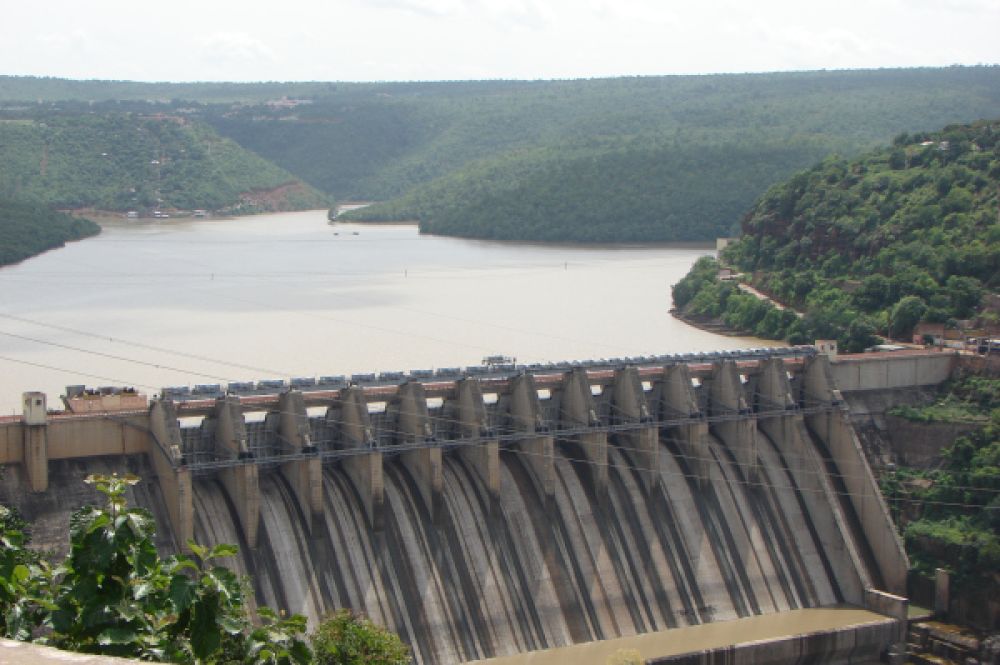
Location: Spanning the Sutlej River, near the border of Punjab and Himachal Pradesh.
-
Height: At 225.55 meters, it ranks as the second-tallest structure of its kind in India, following the Tehri Dam.
-
Reservoir: The water-storage capacity of Gobind Sagar amounts to 9.34 billion cubic meters.
-
Function:
-
Primarily for irrigation, hydroelectric power generation, and flood control.
-
Downstream from Nangal Dam, operators use water to produce hydroelectric power while they also provide water for agricultural purposes throughout the area.
-


Pong Dam:

-
Location: The Beas River runs through Himachal Pradesh where the dam was established under its official name Maharana Pratap Sagar.
-
Completion: The completion occurred in 1975 which established this water reservoir for irrigation purposes and power generation operations.
-
Ecological Importance:
-
The Pong Dam Reservoir received protection status as a Wildlife Sanctuary due to the Himachal Pradesh government in 1983.
-
The Government of India gave Pong Dam status as a Wetland of National Importance during 1994.
-
Ramsar Site recognition surfaced in November 2002 because the site meets international standards for a wetland ecosystem.
-
About Inter-State Water Dispute
What is Inter-State Water Dispute?
-
Two or more states face conflicts and disagreements about water resources control and utilization, as well as the distribution of rivers and their valleys that span state borders.

Reason for the dispute of interstate water dispute
-
Unequal Water availability: Several Indian states hold different levels of rainfall and river resources.
-
Agriculture and industrial needs: Agricultural sectors along with industries, compete against each other to obtain irrigation water and drinking water and industrial needs.
-
Upstream and downstream states: States located above other states possess the ability to construct dams or extract excess water which leads to downstream river flow interruptions.
-
Rising population, together with urbanization, leads to conflicts between states regarding their shared water resources.
-
Delay in decision: Legal delays in settlements together with tribunals result in protracted conflicts between parties.

Constitutional Provision for Inter-State Water Dispute
|
Provision |
Details |
|
Article 262 |
Empowers Parliament to adjudicate inter-state water disputes. |
|
Inter-State River Water Disputes Act, 1956 |
Main law to resolve such disputes by forming tribunals. |
|
Entry 17 of State List |
States can legislate on water, subject to the provisions of Entry 56. |
|
Entry 56 of Union List |
Centre can regulate inter-state rivers and river valleys. |
Inter-State Water Dispute Between States
|
Dispute |
States Involved |
River |
|
Cauvery |
Karnataka vs Tamil Nadu (also Kerala, Puducherry) |
Cauvery |
|
Krishna |
Maharashtra, Karnataka, Telangana, Andhra Pradesh |
Krishna |
|
Godavari |
Maharashtra, Telangana, Andhra Pradesh, Odisha |
Godavari |
|
Yamuna |
Himachal Pradesh, Uttarakhand, Haryana, Uttar Pradesh, Delhi |
Yamuna |
|
Ravi-Beas |
Punjab vs Haryana |
Ravi & Beas |
Mechanisms for Dispute Resolution:
-
The River Board Act, 1956 grants power to the Centre to create river boards but they have not been established thus far.
-
Under the provisions of Inter-State Water Dispute Act, 1956 states may petition tribunal formation when consultation between states fails to resolve conflicts. Since 2002 the Act received amendments which incorporated Sarkaria Commission recommendations for setting up the tribunal within one year while the tribunal must issue its decision within three years
Measures for Resolution:
-
Inter-State Council: The Inter-State Council should assume authority to resolve water disputes by acting as per Article 263 so states can make decisions through consensus.
-
Water Efficiency: Water efficiency programs and water harvesting techniques along with water recharge programs need support to decrease dependency on river water supplies.
-
Unified Water Management Agency: The Unified Water Management Agency should create one organization with authority to research surface water alongside ground water at union and state and district levels.
-
Fast-Track Tribunals: The Fast-Track Tribunals should provide quick verdicts that become legally binding court decisions.
-
Centralized Data Repository: Create a centralized water data repository for informed decision-making and transparency in dispute resolution.
Conclusion
A water-sharing conflict exists between Haryana and Punjab due to issues in managing natural resources across geographical boundaries. This case shows why states require cooperative federalism together with strong legal frameworks which enable climate-resistant water management approaches. Indian Supreme Court's handling of this legal case will challenge the nation's approach toward resolving interstate disputes regarding water resources along with its ability to balance competing political interests and resource distribution fairness.