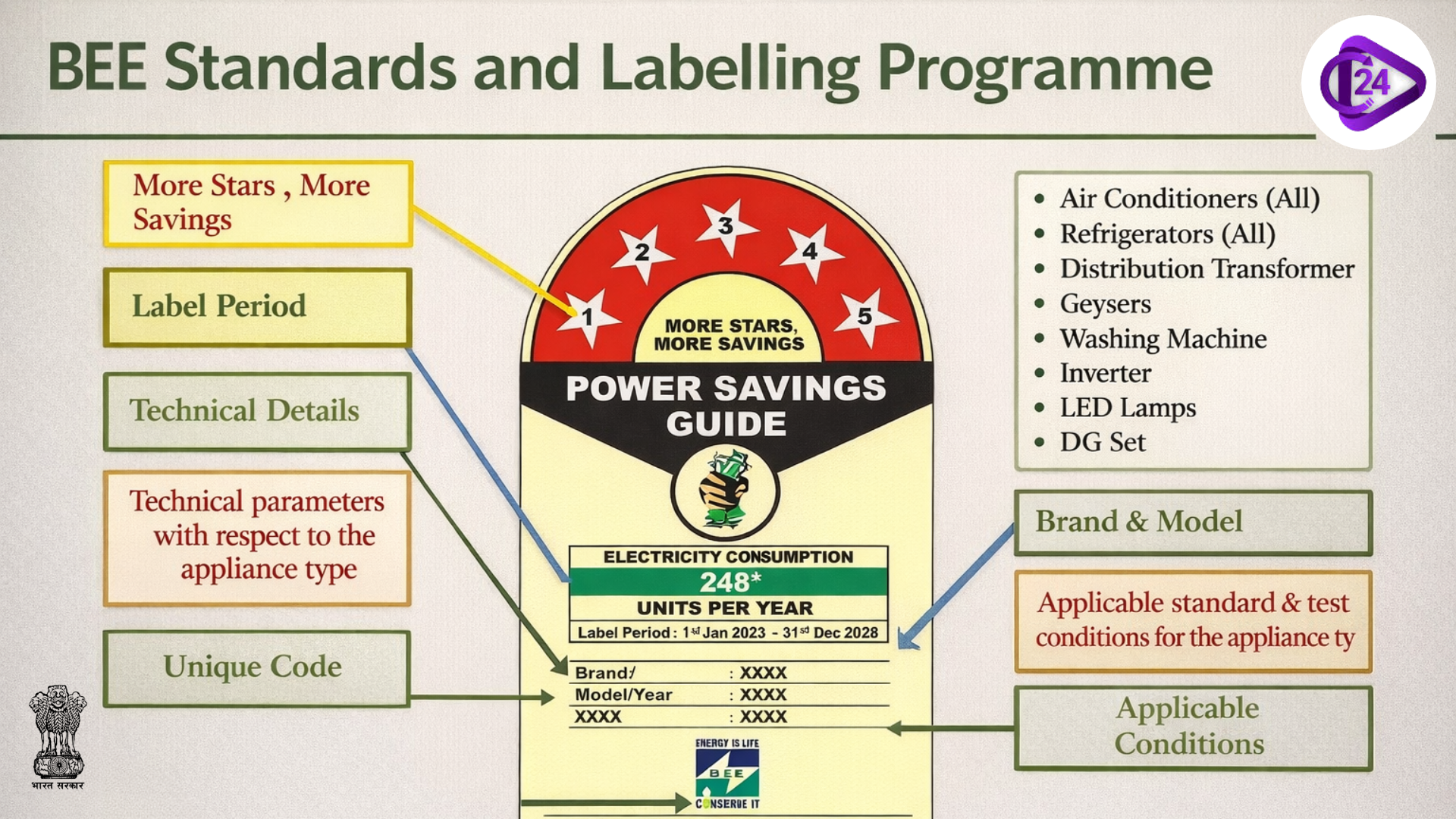
The BEE Standards and Labelling Programme is an energy-saving programme introduced in May 2006 under the Energy Conservation Act, 2001, and administered by the Bureau of Energy Efficiency as part of the Ministry of Power in India. The programme helps consumers make better decisions by displaying the clear star rating (1-5) of appliances and equipment based on their energy performance and consumption. More stars indicate higher energy efficiency, allowing buyers to save on power expenses and reduce the amount of energy used in the country. The scheme covers a wide range of household and industrial products, with some being compulsorily labelled and others labelled voluntarily as well.
About the BEE Standards and Labelling Programme
-
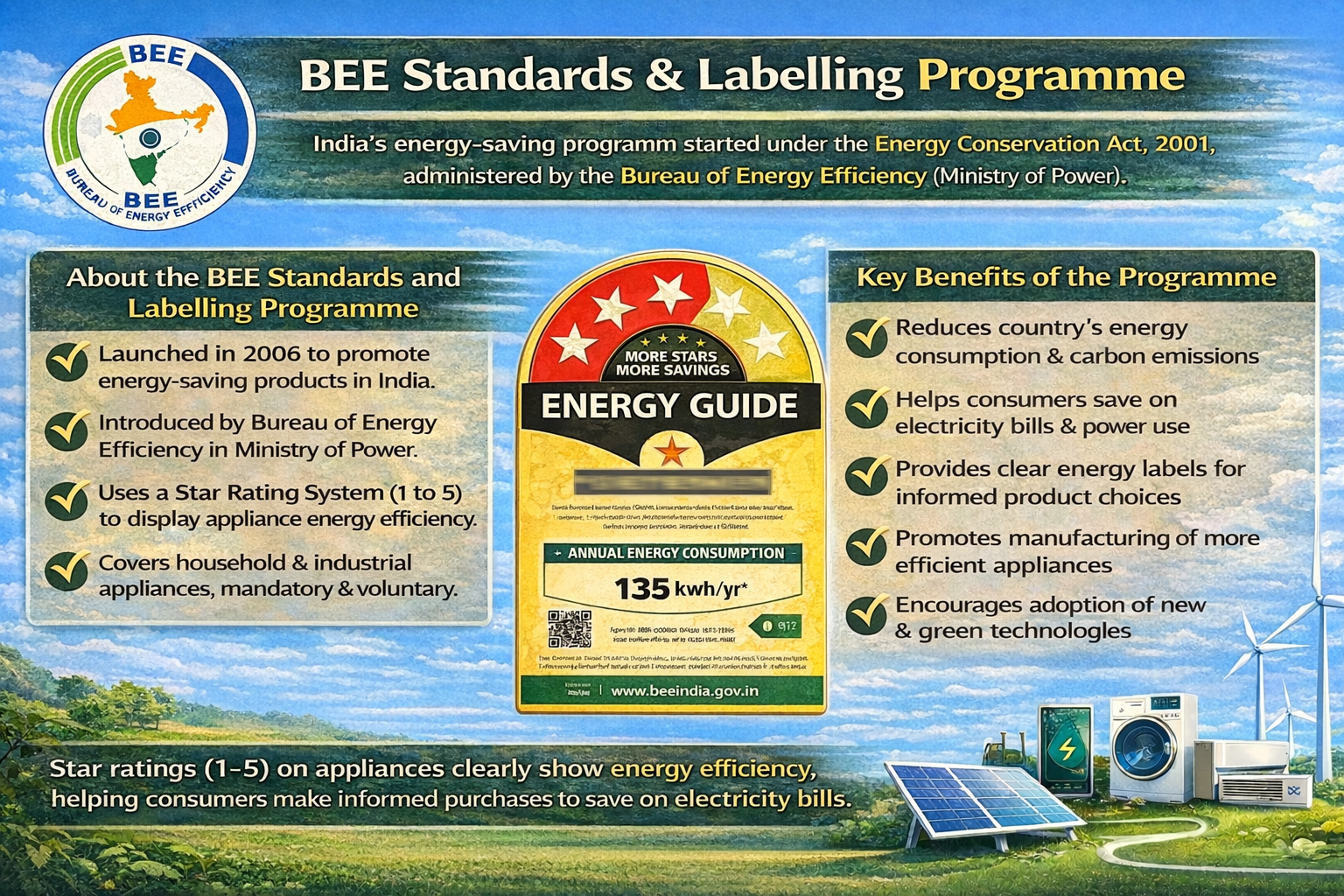
Its launch occurred in 2006 to encourage the consumption of energy-saving products and educate consumers in India.
-
Introduced by the Bureau of Energy Efficiency in the Ministry of Power.
-
Adopts a star rating system (1 to 5) to demonstrate the performance of appliances in terms of energy.
-
The higher ratings of stars imply less consumption of electricity and lower cost of operation.
-
Labels a wide variety of household and industrial appliances, on both a mandatory and voluntary basis.
-
Creates incentives for manufacturers to enhance the efficiency of the product and use new technologies.
-
Helps lower energy consumption in the country, carbon emission and electricity expenditure by consumers.
PYQs for BEE Standards and Labelling Programme
| Exam Name | Year | Question | Answer |
|---|---|---|---|
| UPSC Civil Services Prelims | 2016 | On which of the following can you find the Bureau of Energy Efficiency Star Label? (Ceiling fans, Electric geysers, Tubular fluorescent lamps) | All three (Ceiling fans, Electric geysers, Tubular fluorescent lamps) |
| UPSC Civil Services Prelims | 2021 | With reference to street lighting, how do sodium lamps differ from LED lamps? (Energy efficiency context citing BEE-rated LEDs) | LED lamps are more energy-efficient and long-lasting than sodium lamps |
| UPRVUNL JE EE | 2021 | As per the Standards & Labelling programme, identify the equipment introduced under mandatory labelling | Frost-Free Refrigerator |
Expected MCQs About BEE Standards and Labelling Programme
The BEE Star Labelling Programme primarily aims to:
A) Reduce electricity bills only for industrial users
B) Encourage energy-efficient products and reduce national energy consumption
C) Promote renewable energy generation
D) Monitor carbon emissions of vehicles
Answer: B) Encourage energy-efficient products and reduce national energy consumption
Explanation: The programme informs consumers and pushes manufacturers to produce efficient appliances, saving energy nationwide.
Under the BEE Standards & Labelling Programme, voluntary and mandatory schemes differ mainly in:
A) Star rating range
B) Applicability of appliances and legal enforcement
C) Colour of the label
D) Cost of the appliance
Answer: B) Applicability of appliances and legal enforcement
Explanation: Mandatory labelling applies to high energy-consuming appliances, while voluntary covers others; enforcement differs.
Which of the following statements is correct regarding energy efficiency ratings?
A) 5-star appliances consume more energy than 1-star appliances
B) Star ratings only indicate the cost of the appliance
C) Higher star rating appliances help reduce peak load on the electricity grid
D) Only industrial appliances are rated
Answer: C) Higher star rating appliances help reduce peak load on the electricity grid
Explanation: Efficient appliances lower energy consumption, easing the load on the national grid.
Consider the following appliances: LED tube lights, frost-free refrigerators, and air conditioners. Which of these are covered under the BEE Standards & Labelling Programme?
A) Only refrigerators
B) Refrigerators and ACs
C) All three
D) Only LED tube lights
Answer: C) All three
Explanation: These appliances are included under mandatory or voluntary labelling schemes depending on energy consumption.
The BEE Star Label includes which of the following information?
A) Energy efficiency rating (stars)
B) Annual energy consumption
C) Voltage & frequency
D) All of the above
Answer: D) All of the above
Explanation: The label gives stars, energy consumption, and technical details to help consumers make informed choices.
Conclusion (BEE Standards and Labelling Programme)
The BEE Standards and Labelling Programme is a plan to encourage energy efficiency to ensure that the consumer makes the right decisions and minimises electricity use. It increases the investment in advanced technologies by encouraging manufacturers, thus reducing the costs of operations, unloading grid loads, and promoting sustainable use of energy, which, in addition to achieving climate goals in India, will help create an energy-conscious society