
Day: January 3, 2026

BEE Standards and Labelling Programme: Star Ratings, Benefits & Products Covered

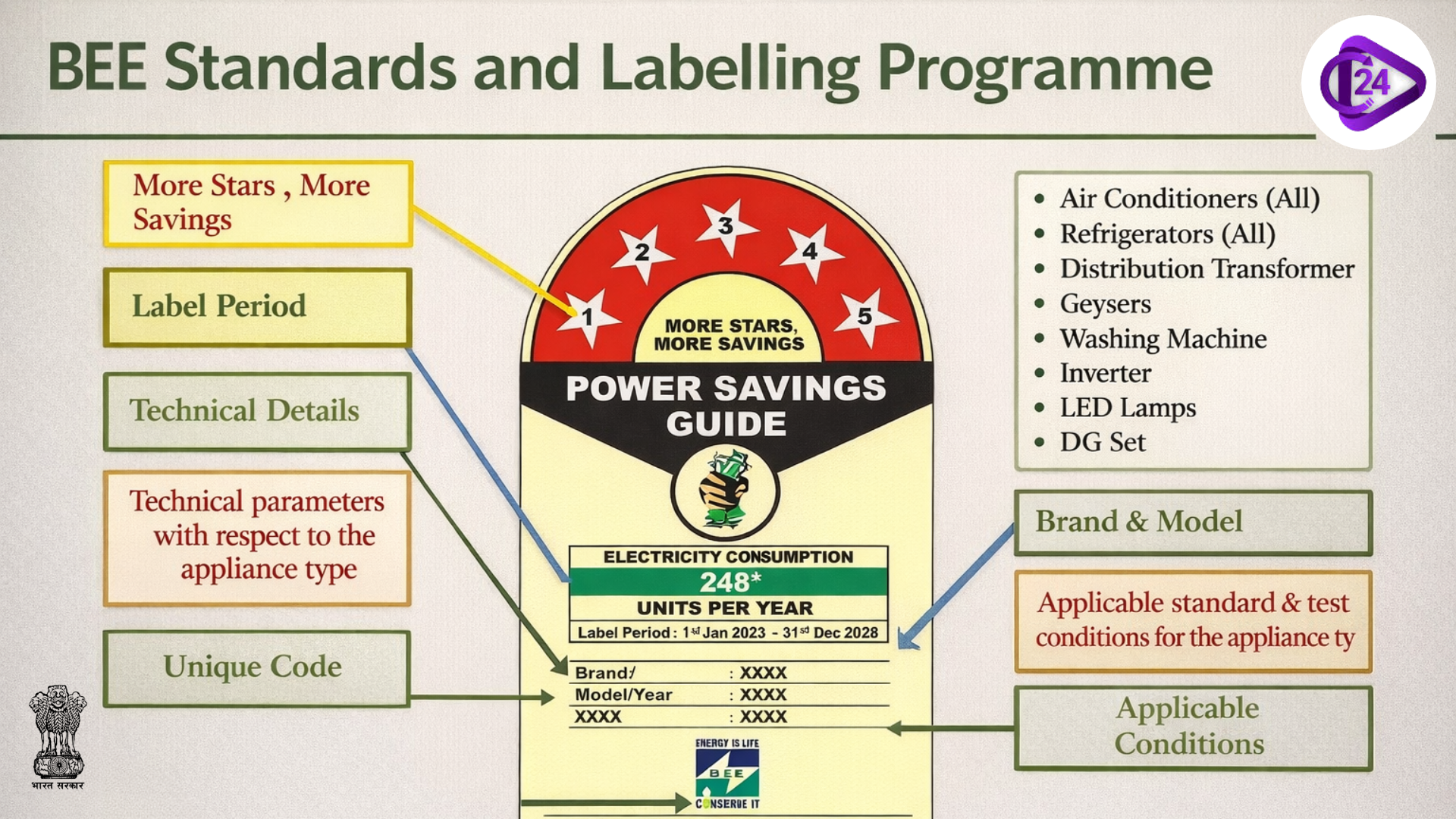
The BEE Standards and Labelling Programme is an energy-saving programme introduced in May 2006 under the Energy Conservation Act, 2001, and administered by the Bureau of Energy Efficiency as part of the Ministry of Power in India. The programme helps consumers make better decisions by displaying the clear star rating (1-5) of appliances and equipment based on their energy performance and consumption. More stars indicate higher energy efficiency, allowing buyers to save on power expenses and reduce the amount of energy used in the country. The scheme covers a wide range of household and industrial products, with some being compulsorily labelled and others labelled voluntarily as well.

About the BEE Standards and Labelling Programme

  • Its launch occurred in 2006 to encourage the consumption of energy-saving products and educate consumers in India.

  • Introduced by the Bureau of Energy Efficiency in the Ministry of Power.

  • Adopts a star rating system (1 to 5) to demonstrate the performance of appliances in terms of energy.

  • The higher ratings of stars imply less consumption of electricity and lower cost of operation.

  • Labels a wide variety of household and industrial appliances, on both a mandatory and voluntary basis.

  • Creates incentives for manufacturers to enhance the efficiency of the product and use new technologies.

  • Helps lower energy consumption in the country, carbon emission and electricity expenditure by consumers.

PYQs for BEE Standards and Labelling Programme

Exam Name Year Question Answer
UPSC Civil Services Prelims 2016 On which of the following can you find the Bureau of Energy Efficiency Star Label? (Ceiling fans, Electric geysers, Tubular fluorescent lamps) All three (Ceiling fans, Electric geysers, Tubular fluorescent lamps)
UPSC Civil Services Prelims 2021 With reference to street lighting, how do sodium lamps differ from LED lamps? (Energy efficiency context citing BEE-rated LEDs) LED lamps are more energy-efficient and long-lasting than sodium lamps
UPRVUNL JE EE 2021 As per the Standards & Labelling programme, identify the equipment introduced under mandatory labelling Frost-Free Refrigerator

Read Also: 

Expected MCQs About BEE Standards and Labelling Programme

The BEE Star Labelling Programme primarily aims to:
A) Reduce electricity bills only for industrial users
B) Encourage energy-efficient products and reduce national energy consumption
C) Promote renewable energy generation
D) Monitor carbon emissions of vehicles
Answer: B) Encourage energy-efficient products and reduce national energy consumption
Explanation: The programme informs consumers and pushes manufacturers to produce efficient appliances, saving energy nationwide.

Under the BEE Standards & Labelling Programme, voluntary and mandatory schemes differ mainly in:
A) Star rating range
B) Applicability of appliances and legal enforcement
C) Colour of the label
D) Cost of the appliance
Answer: B) Applicability of appliances and legal enforcement
Explanation: Mandatory labelling applies to high energy-consuming appliances, while voluntary covers others; enforcement differs.

Which of the following statements is correct regarding energy efficiency ratings?
A) 5-star appliances consume more energy than 1-star appliances
B) Star ratings only indicate the cost of the appliance
C) Higher star rating appliances help reduce peak load on the electricity grid
D) Only industrial appliances are rated
Answer: C) Higher star rating appliances help reduce peak load on the electricity grid
Explanation: Efficient appliances lower energy consumption, easing the load on the national grid.

Consider the following appliances: LED tube lights, frost-free refrigerators, and air conditioners. Which of these are covered under the BEE Standards & Labelling Programme?
A) Only refrigerators
B) Refrigerators and ACs
C) All three
D) Only LED tube lights
Answer: C) All three
Explanation: These appliances are included under mandatory or voluntary labelling schemes depending on energy consumption.

The BEE Star Label includes which of the following information?
A) Energy efficiency rating (stars)
B) Annual energy consumption
C) Voltage & frequency
D) All of the above
Answer: D) All of the above
Explanation: The label gives stars, energy consumption, and technical details to help consumers make informed choices.

Conclusion (BEE Standards and Labelling Programme)

The BEE Standards and Labelling Programme is a plan to encourage energy efficiency to ensure that the consumer makes the right decisions and minimises electricity use. It increases the investment in advanced technologies by encouraging manufacturers, thus reducing the costs of operations, unloading grid loads, and promoting sustainable use of energy, which, in addition to achieving climate goals in India, will help create an energy-conscious society

India’s ‘Diamond Capital’ Set To Become The Country’s First Slum-Free City

Surat, famously referred to as the Diamond Capital in India due to its pre-eminence in cutting and polishing the diamonds of the globe, is set to become the first major city in India that will be the first without slums, according to the government officials. The active urban planning and housing programmes have drastically cut down slum populations by an estimated 38 per cent to about 5 per cent in the last 20 years. The government of Gujarat has a long-term goal of ensuring that slums do not exist in the state; instead, dignified households have been provided, and better living standards have been provided by the government to all occupants of this industrial and economic powerhouse of the state.

How Surat is Becoming India’s First Slum-Free City

  • The slum population in Surat has reduced drastically by approximately 36 per cent in 2006 to 5 per cent today, with a significant improvement being trended towards no slumming.

  • The Government of Gujarat is introducing gradual, performance-based, urban housing initiatives to eradicate slums in the city.

  • Affordable Housing Programs such as Pradhan Mantri Awas Yojana and state housing programmes have delivered basic services to lakhs of permanent homes.

  • Infrastructure, sanitation and water supply in the city have been improved to enhance living conditions in the old slums.

  • Surat is a large economic centre with a high rate of migration, which makes its capacity to strike the right balance between growth and inclusive housing an important step to reaching this goal.

Read Also: 

Expected Question For Upcoming Exams

Surat’s slum-free initiative mainly integrates which of the following strategies?

A) Affordable housing and infrastructure upgrades

B) Diamond industry incentives only

C) Tourism development programs

D) Reduction of population

Answer: A) Affordable housing and infrastructure upgrades

Explanation: Housing schemes combined with sanitation, water, and electricity upgrades are key to slum elimination.

 Which indicator shows Surat is approaching a slum-free status?
A) Diamond exports increase.
B) Slum population percentage declines.
C) Rise in tourism.
D) Expansion of textile units
Answer: B) Slum population percentage decline
Explanation: The drop from 36% to 5% signals major progress toward a slum-free city.

Which of the following urban policies contributed to Surat’s slum-free target?
A) Pradhan Mantri Awas Yojana (PMAY)
B) State housing schemes
C) Infrastructure upgrades
D) All of the above
Answer: D) All of the above
Explanation: Combined housing schemes and infrastructure improvements achieved the target.

What type of climate does Surat experience?

A) Tropical wet and dry (savanna)

B) Desert climate

C) Subtropical humid

D) Alpine

Answer: A) Tropical wet and dry (savanna)

Explanation: Surat has hot summers, heavy monsoon rains, and mild winters typical of tropical wet and dry climates.

Surat lies in which seismic zone of India?

A) Zone II (low risk)

B) Zone III (moderate risk)

C) Zone IV (high risk)

D) Zone V (very high risk)

Answer: B) Zone III (moderate risk)

Explanation: Surat is in a moderately active seismic zone, so urban planning considers earthquake-resistant structures.

Conclusion (Surat is Becoming India’s First Slum-Free City)

Surat has become the first slumless city in India, which is an indication of good urban planning, housing policies and good governance. Lower housing expenses, modernised infrastructure, and sustainable development have enhanced the living standards of the residents and have balanced the accelerated industrialisation. The city is a prototype of the nationwide urban development and social inclusion.

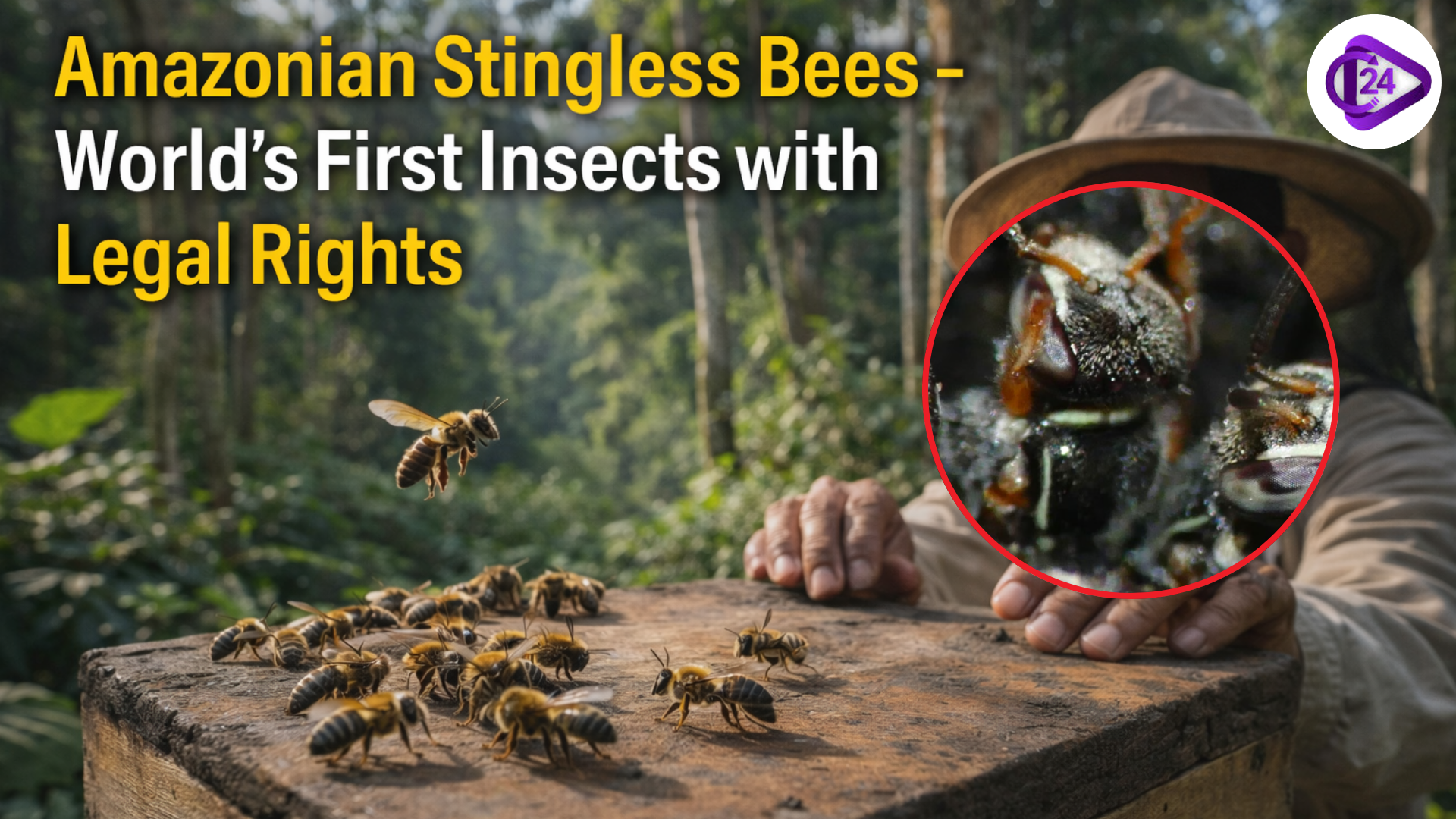
Amazonian Stingless Bees First Insects to Get Legal Rights in the World

The world has recorded history when the stingless bees in the Amazonian region were the first insects to be given legal rights through formal legislation. The municipalities of Satipo and Nauta in the Peruvian Amazon in a historic action declared these indigenous pollinators as rights-bearing entities in a plan that granted them the rights to exist, procreate, have healthy populations and live in unpolluted and otherwise healthy environments. It is an unprecedented level of legal protection of the bees, which are crucial to rainforest biodiversity and the Indigenous cultures, against the forces of deforestation, pesticides, and climate change, establishing a new international precedent in conservation and environmental law.

What are Amazonian Stingless Bees?

  • Stingless bees of the Amazon rainforest are indigenous and pollinate the rainforest; they are in the Meliponini.

  • They do not have stingers or have a non-functional one; hence, they are harmless to people.

  • They are the oldest living species of bees on earth, with a lifespan of millions of years.

  • They are generally common in tropical areas, particularly in the Amazon basin.

  • They play an important role in pollinating rainforest crops and plants.

  • Their honey is regarded as having medicinal value and their cultural value by Indigenous communities.

Amazonian Stingless Bees: Species, Habitat and Role in the Ecosystem

  • Amazonian stingless bees are members of the Meliponini tribe that contains hundreds of species distributed around the world, with an extremely high diversity in the Amazon basin.

  • They inhabit mostly the tropical and subtropical woods and nest in hollow trees, logs and natural depressions.

  • These bees are important pollinators of rainforest plants, fruit trees and crops and aid in the regeneration of the forests.

  • They contribute to the well-being of biodiversity, stable food chains and ecosystem resilience.

  • They contribute significantly to the livelihoods of Indigenous people because of pollination and honey-making.

  • The fact that there are some is a good sign of a healthy forest ecosystem.

Read Also:

Conclusion (Amazonian Stingless Bees)

The stingless bees in the Amazon are essential to the survival of the rainforest, biodiversity, and food security. Pollinating thousands of plant species, they ensure the ecological balance and Indigenous livelihoods. By giving them a status in the law, it becomes clear that there is a need to ensure the protection of even the minute life forms to provide a sustainable and resilient planet.

Frequently Asked Questions (FAQs)

The current affairs cover recent national and international events related to UPSC, SSC, Banking, Railways, and State PCS.

You need to read about the current affairs daily, and revise them every week and every month to keep them longer in your memory.

Yes, Class24 provides free downloadable Daily Current Affairs PDFs for easy revision.

Yes, you can practice MCQs and quizzes to boost your exam preparation.

Absolutely. The content is written in simple, easy-to-understand bilingual language suitable for beginners.

Go to class24.com and click on the current affairs section directly, where you find everything that you need.

ssc-toppers

Start Learning Today with Class24

Related current affairs

Class24 offers free video lectures for smart preparation, covering CGL, CPO, CHSL, MTS, and GD exams. Learn from expert faculty, revise concepts easily, practice with PYQs, and improve speed and accuracy through high-quality, exam-focused video lessons anytime, anywhere.

Get success in your hand. Start study anytime anywhere.

The journey becomes simple and enjoyable when you start taking interest in it. And through our app “Class24”, we will be your trusted partners in developing that interest.

Daily Quizzes
Mock Tests
Ongoing

No ongoing tests right now.