

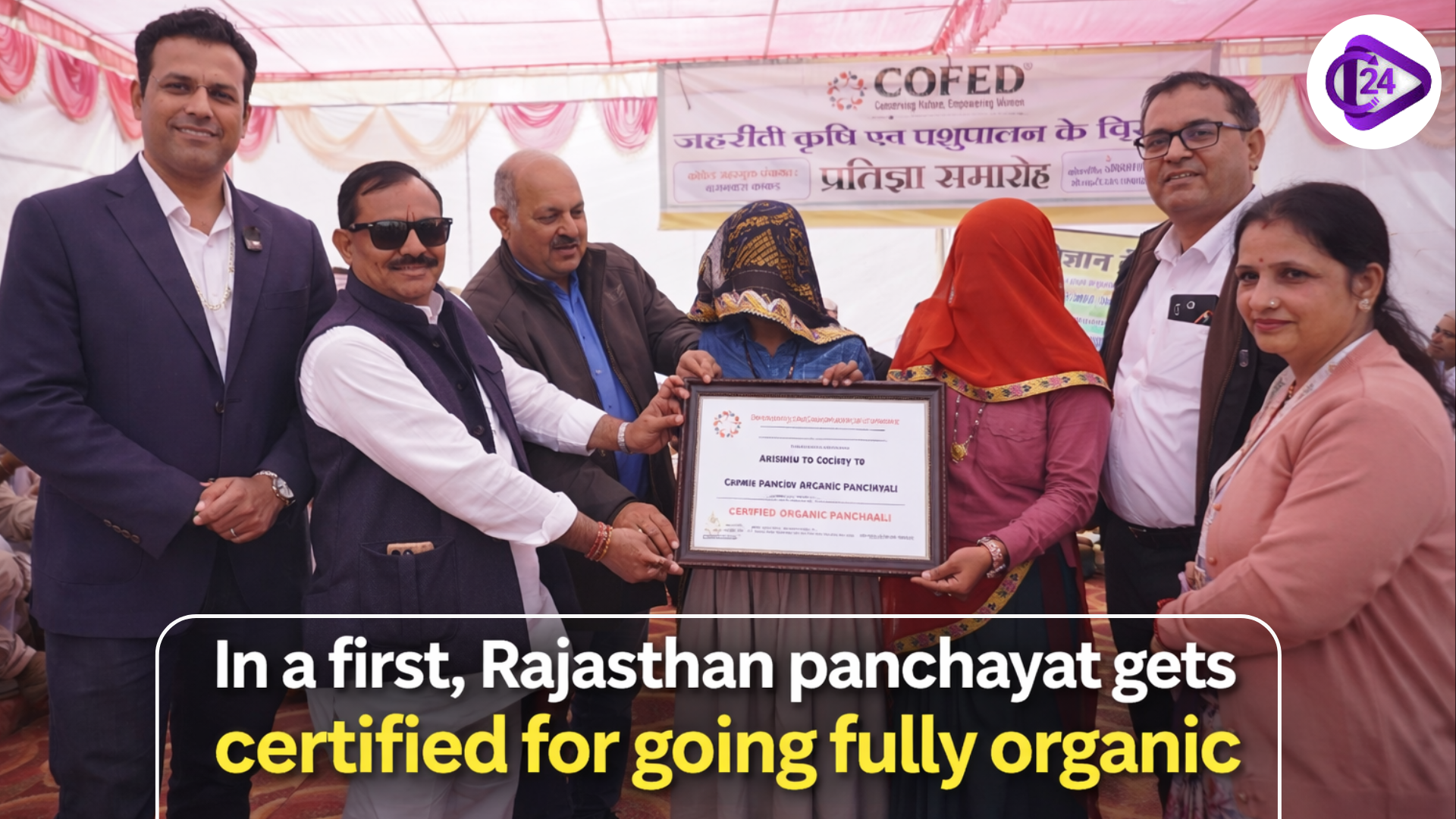
Bamanwas Kankar panchayat, Rajasthan, has become the first panchayat in Northwest India (and indeed, in many ways, the first in India as well) to be fully organic-certified in its farm areas and in its cattle herd. Spanning an area of approximately 1,500 hectares and housing over 6,000 cattle, the community pledged to get rid of chemical pesticides and artificial fertilisers, adopting ecological farming methods and managing livestock with organic methods. Through a well-organised involvement of women, farmers officially committed themselves to maintaining organic principles, and that was a significant example of community-based environmental management and sustainable rural livelihoods in the area.
What Makes Bamanwas Kankar Panchayat Fully Organic?
-
A cultural panchayat covering an area of approximately 1500 hectares became chemical-free and livestock farming.
-
The farmers are committed to not using pesticides or synthetic fertilisers in any field.
-
There are also organic standards for keeping livestock without the use of chemicals.
-
Give emphasis on environment, soil wellbeing, and bio-economics rather than short-term outputs.
-
Women spearhead the community-based transition to organic practices to a great extent.
-
Both land and cattle are enjoyed under certification, which is again first in Northwest India.
-
The panchayat merges farming, animal, and environmental protection together.
-
The focus is on community involvement to preserve organic standards always.
-
Fosters sustainable livelihood and conservation of natural resources and biodiversity.
Recently Asked PYQs on Organic Farming
| Exam | Year | Question | Answer |
|---|---|---|---|
| UPSC Prelims | 2018 | With reference to organic farming in India, which state became the first fully organic state? | Sikkim |
| UPSC Mains (Agriculture Paper-I) | 2024 | Explain the concept and principles of organic farming. | Agriculture without chemical fertilisers or pesticides, using natural inputs and sustainable practices |
| Rajasthan PCS Prelims | 2019 | Which programme promotes organic agriculture in India under the National Programme for Organic Production (NPOP)? | National Programme for Organic Production (launched 2000) |
| SSC CHSL (General Awareness) | 2022 | Organic farming avoids which of the following? | Chemical fertilisers and synthetic pesticides |
| IBPS Bank Clerk | 2021 | Which organisation certifies organic products in India? | APEDA (Agricultural and Processed Food Products Export Development Authority) |
| RRB NTPC | 2023 | Which Indian state has achieved 100% organic certification in panchayat farms? | Sikkim / Bamanwas Kankar example (recent) |
| State PSC (MPPSC/UPPSC) | 2020 | Key benefits of organic farming include? | Soil health improvement, biodiversity conservation, and sustainable livelihoods |
| SSC GD | 2022 | Which is NOT a principle of organic farming? | Use of synthetic chemical fertilisers |
| Railway Group D | 2021 | What is the main goal of organic farming? | Reduce chemical usage, promote ecological balance, and maintain soil fertility |
| Bank PO (General Awareness) | 2023 | What does NPOP stand for in the context of Indian organic agriculture? | National Programme for Organic Production |

Conclusion (Rajasthan Panchayat Becomes First Fully Organic)
The success of Bamanwas Kankar Panchayat as the first fully organic community in Rajasthan demonstrates the potential of the collective effort and sustainable farming. The panchayat has implemented a model of chemical-free farming, certified organic practices, and, even better, environmental protection; thus, the panchayat has bettered the livelihoods of the people and created a model that can be replicated by other rural communities in India to develop their countries in a way that does not harm the environment.