

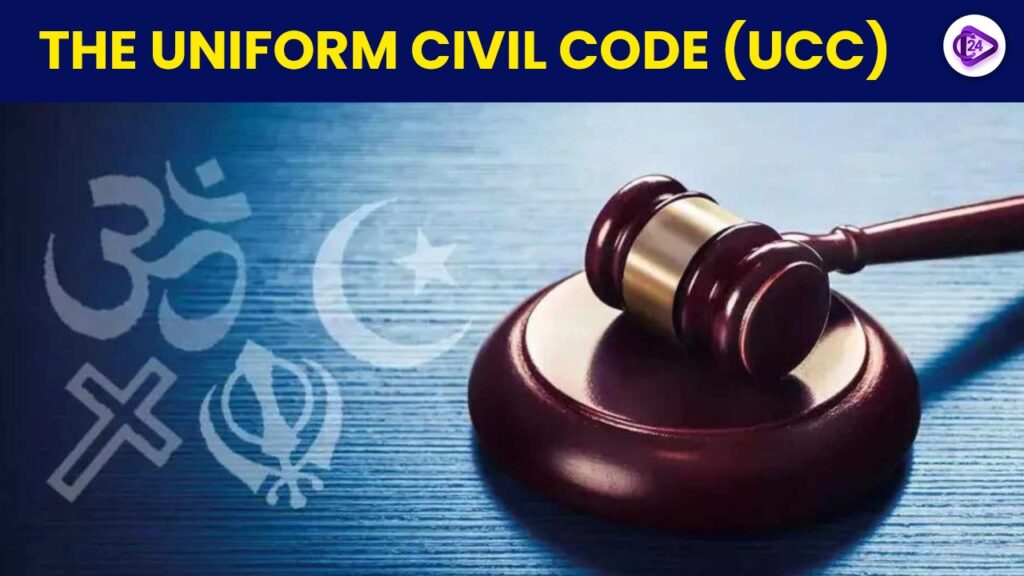
On January 27, 2025, Uttarakhand established a record as the first Indian state to execute the Uniform Civil Code (UCC). Chief Minister Pushkar Singh Dhami launched the UCC portal and distributed a formal notification to confirm Uttarakhand's acceptance of the UCC. CM Dhami stated at the launch that the UCC functions under constitutional authority to eliminate discriminatory practices while protecting basic equal rights for every citizen. The UCC would create women's empowerment while removing social evils which include halala, polygamy, child marriage along with triple talaq. The scheduled tribes under Article 342 of the Constitution will maintain their rights through exemptions according to CM Dhami.
Key Developments and Provisions Under the UCC in Uttarakhand:
-
Launch of UCC Portal and Manual:
-
The UCC manual along with the UCC portal began operations after Chief Minister Dhami initiated them for overseeing procedures such as marriage and divorce recognition followed by wills administration as stated in the UCC.
-
Uttarakhand became the first state to fully execute the UCC when its chief minister completed the initial registration on the portal.
-
-
Mandatory Registration:
-
Uttarakhand residents must now register their marriages and divorces after the UCC's introduction. Under the new legislation, live-in relationships must be registered collectively with other personal record filings.
-
The registration infrastructure exists throughout the state at Gram Panchayat, Nagar Panchayat, Nagar Nigam, and Mahanagar Palika locations.
-
All persons without compliance with registration requirements face possible fines of up to Rs 25000. The failure to register will also result in the loss of government facilities' eligibility and benefits.
-
-
Superseding Personal Laws:
-
Under the new UCC Act, any personal laws in Uttarakhand will become invalid and replaced by this law. The UCC establishes its dominant position by superseding all personal or other laws which contain incompatible provisions.
-
Key Changes and Provisions of UCC:
-
Marriage, Divorce, and Inheritance Laws:
-
The legislation concerning marriage divorce alimony and inheritance law will uniformly govern every religious community and its associated followers.
-
Under this reform, the legal marriage age was set to 21 years for men and 18 years for women.
-
-
Rights and Equality:
-
Women possess the same divorce application rights which match those of men.
-
Under the proposed legal framework all traditional marriage rituals identified as halala and iddat will be prohibited.
-
Inheritances will have equal value regardless of child legitimacy while both males and females will retain equal ownership rights.
-
Unborn children born outside legitimized matrimony receive full inheritance rights that match biological children.
-
Children from adoption and children born through surrogacy alongside those with biological origins using assisted reproductive techniques will hold identical status to genuine biological children.
-
Womb-born children will receive safeguards concerning their property rights.
-
-
Registration and Legal Rights:
-
The government requires all couples sharing a residence to sign up for official records. Users of these relationships generate offspring who receive all the legal rights that biological children possess.
-
The new law requires that if two people share a residence plan to end their relationship they need to officially file for separation.
-
Failure to register as per requirement may lead to a Rs 25000 fine as well as imprisonment for six months or both punitive measures.
-
-
Other Provisions:
-
To acquire housing facilities such as residences, hostels and PG accommodations people in live-in relationships must present their registration documentation.
-
Under this proposal, the law grants unrestricted power for people to share their residential properties with any individuals of their choice while simultaneously streamlining inheritance procedures nationwide.
-
What exactly constitutes the Uniform Civil Code (UCC)?
-
Purpose: The Code seeks to standardize Indian law involving personal matters including marriage together with divorce, adoption and guardianship and succession and inheritance procedures for all citizens regardless of religion.
-
Focus on Equality: All personal law matters now promote equality between men and women thus establishing justice and fairness.
Personal Laws in India
Current Status: In India, every religious community has specific personal laws that follow their specific religious traditions with Hindus Muslims Sikhs Christians Parsis and Jews practicing different religious personal law systems.
Religious Communities & Their Laws:
-
Hindu Personal Laws: Manusmriti and Dharmashastras established the laws of Hindu Personal Laws which control marriage and inheritance systems alongside succession rights.
-
Muslim Personal Laws: Through Sharia laws, Muslim personal legislation incorporates distinct Islamic jurisprudential perspectives (Hanafi Shafi’i and others).
-
Christian Personal Laws: Christianity follows the Indian Christian Marriage Act of 1872 combined with ancillary statutes.
-
Parsi Personal Laws: According to the Parsi Marriage and Divorce Act of 1936 all aspects of Parsi personal law are governed.
-
Sikh Personal Laws: Composition by the Anand Marriage Act of 1909.
Constitutional Framework for UCC
-
Article 44 of the Indian Constitution: The Constitution obliges the state to work toward establishing a single legal system that applies to all citizens throughout the nation. The state must promote a Uniform Civil Code but this goal exists within Directive Principles of State Policy and lacks legal enforceability.
-
Personal Laws and Concurrent List: The Concurrent List contains rules for personal matters of marriage relationship and inheritance so both State governments and Parliament retain legislative authority in these areas.
Debates Around UCC in the Constituent Assembly (CA)
Proponents (e.g., B.R. Ambedkar, K.M. Munshi): Argued that UCC would promote:
-
Equality: A UCC would establish uniform equality for all citizens through religious agnosticism so the Muslim community could overcome divergent marriage registration regimes.
-
National Integration: The framework supports social unity while it minimizes religious dogma loyalty thus creating national solidarity.
-
Gender Justice: The UCC establishes equal legal rights for women who need equal treatment during inheritance along with divorce and marriage processes while eliminating existing discriminatory personal law barriers.
-
Modernization: Through UCC outdated restrictive methods like polygamy and child marriage with triple talaq would be abolished.
-
Global Image: India positions its legal system to meet international human rights requirements thus increasing its standing on the global stage.
-
Simplicity: The legal system becoming more efficient results because conflicting personal laws and their complexity have been replaced.
Opponents are concerned about:
-
Cultural Sensitivities: Some religious groups struggle to adopt their traditional traditions under this law framework.
-
Social Unrest: The proposed integration worries people because they anticipate both social conflicts and pressure to abandon their cultural values.
-
Diverse Practices: The heterogeneous mix of religions combined with cultural diversity creates obstacles to securing unified personal laws across India.
-
Resistance from Communities: The UCC makes religious organizations worry about losing their freedom to manage personal matters independently so they fear it will threaten their cultural identity.
-
Political and Social Consensus: Multiple political factions together with civil society members have not reached a consensus about enforcing a UCC throughout India.
-
Constitutional Hurdles: Article 25 protects religious freedom exactly whereas some doubt the UCC could oppose this liberty.
-
Tribal Rights: Many tribal groups fear that UCC may threaten their traditional laws as well as their established customs.
Historical Background of UCC
-
British Colonial Era: The British suggested creating standardized laws for legal documents in 1835 yet they decided to keep personal religious traditions untouched.
-
Post-Independence Efforts: The B.N. Rau Committee with its work (1941) alongside the Hindu Succession Act (1956) established rules for Hindu law.
-
Personal laws active in separate forms simultaneously govern Muslims alongside Christians and Parsis.
Case Law on UCC
-
Shah Bano Case (1985): The Supreme Court approved Muslim women's right to receive Section 125 of the Criminal Procedure Code maintenance benefits.
-
Sarla Mudgal Case (1995): The Supreme Court determined that Hindu husbands who marry another woman after converting to Islam without divorcing their first spouse establish no valid marriage.
-
Shayara Bano Case (2017): Muslim personal law reform took a major step when the Supreme Court declared triple talaq practices unconstitutional.
Law Commission’s Views on UCC
-
21st Law Commission (2018): At the current moment the 21st Law Commission concluded that both a general UCC and judicial reform of personal laws are unnecessary. The committee endorsed law modification for personal jurisprudence to resolve unclear provisions along with discriminatory practices while maintaining cultural tolerance.
-
22nd Law Commission (2023): The commission released an advisory document to engage public opinion about UCC because they recognized the challenges of establishing such a legal framework.
Conclusion
Uttarakhand marks a groundbreaking achievement in India's legal and social framework through its implementation of the Uniform Civil Code. The state intends to establish personal law uniformity because this process will eliminate discrimination and create equal rights for all citizens while advancing gender equality beyond religious membership boundaries. If successful with UCC implementation Uttarakhand will establish itself as a benchmark for future UCC adoption by other states.